
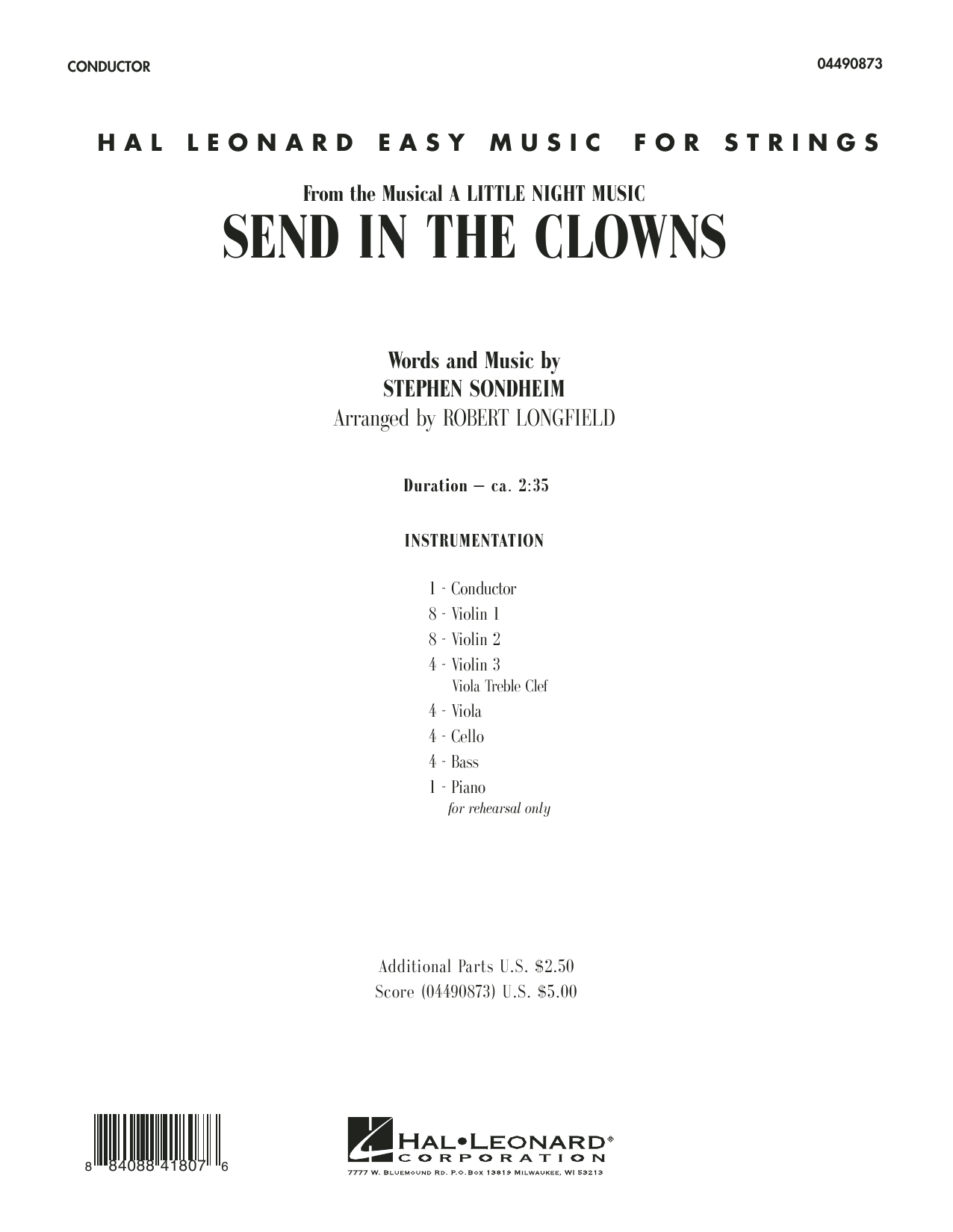

Send in the Clowns (from A Little Night Music) (arr. Robert Longfield): String Orchestra Conductor Score & Parts
By Stephen Sondheim / Arranged by Robert Longfield
Grade: 2
Item: 35-PK01212658
$40.00
Pickup currently not available
Buy Extra Parts (Digital PDF Download)
Parts Added to Cart!
Description
One of Sondheim's most enduring songs is now available in this playable version for developing strings. Robert has skillfully arranged this memorable melody in 3/4 meter, making it easily approachable with student players and creating a version they can perform with ease and confidence. Dur: 2:35


Send in the Clowns (from A Little Night Music) (arr. Robert Longfield): String Orchestra Conductor Score & Parts isn't in MakeMusic Cloud just yet...but it could be. Let us know you'd like to see it, and you'll help shape what comes next. In the meantime, start a free trial and dive into thousands of interactive titles your students can play along with today.
Request This Title
Tell us you want it.
Start Your Free Trial
Explore everything that's ready to play right now.
Sample Audio
No sample audio found.
Sample Video
No sample videos found.
Additional Details
Publisher:
Hal Leonard
SKU:
35-PK01212658
More about this title
About the Composer: Stephen Sondheim
Stephen Sondheim fundamentally changed how music works in theater by treating lyrics and melody as equally sophisticated dramatic tools. His songs demand that performers understand subtext, character motivation, and emotional nuance in ways most musical theater repertoire does not. For music educators, Sondheim's work offers students a bridge between classical training and contemporary storytelling through song.
Why we love this
Robert Longfield's arrangement strips away the piano accompaniment and character complexity of the original without losing what makes this song resonate. Your students get to inhabit a genuinely sophisticated moment of musical theater without the technical demands that typically come with Sondheim, and they'll recognize the melody instantly because it genuinely matters in the culture they inhabit.
What to expect
The piece carries the bittersweet resignation of a performer stepping into the spotlight despite doubt and weariness. There's vulnerability in the 3/4 waltz rhythm that never quite feels celebratory, even as the melody rises. Your ensemble becomes the voice of someone asking essential questions about failure, presence, and the cost of visibility.
Who it's for
String orchestras at the high school or advanced middle school level looking for repertoire that earns respect from both musicians and audiences. Directors programming concert seasons want pieces that matter culturally and musically, not just fill time. This arrangement delivers both.
How to get the most out of it
- Shape the melody with long bow strokes that mirror the phrasing of a vocalist. Sondheim wrote this as a song, so resist the urge to make it sound orchestral in the traditional sense.
- Balance the first and second violin parts so the countermelody supports rather than competes with the main line. The arrangement's strength lies in how the inner voices create harmonic depth without clutter.
- Let the tempo breathe slightly at phrase endings, particularly around the lyrical peaks. This is not a waltz that marches forward; it's a character reflecting.
- Check intonation carefully in the chromatic passages. Sondheim's harmonic language moves more frequently than typical grade 2 repertoire, and accuracy here transforms the emotional impact.
How to use it
Schedule this as the emotional anchor of a concert exploring themes of performance, identity, or growth. It pairs naturally with classical or contemporary art song arrangements, or stands alone as a statement about musical theater's literary sophistication. The 2:35 duration makes it ideal for shorter programs or as a transition between more demanding works.
Skills your students will build
- Phrasing and rubato in waltz meter without rushing or dragging
- Balancing countermelody and accompaniment textures within the same instrumental section
- Playing with dramatic intent rather than technical correctness alone
- Intonation precision in chromatic voice leading
- Reading 3/4 time as a lyrical meter rather than a metric pattern