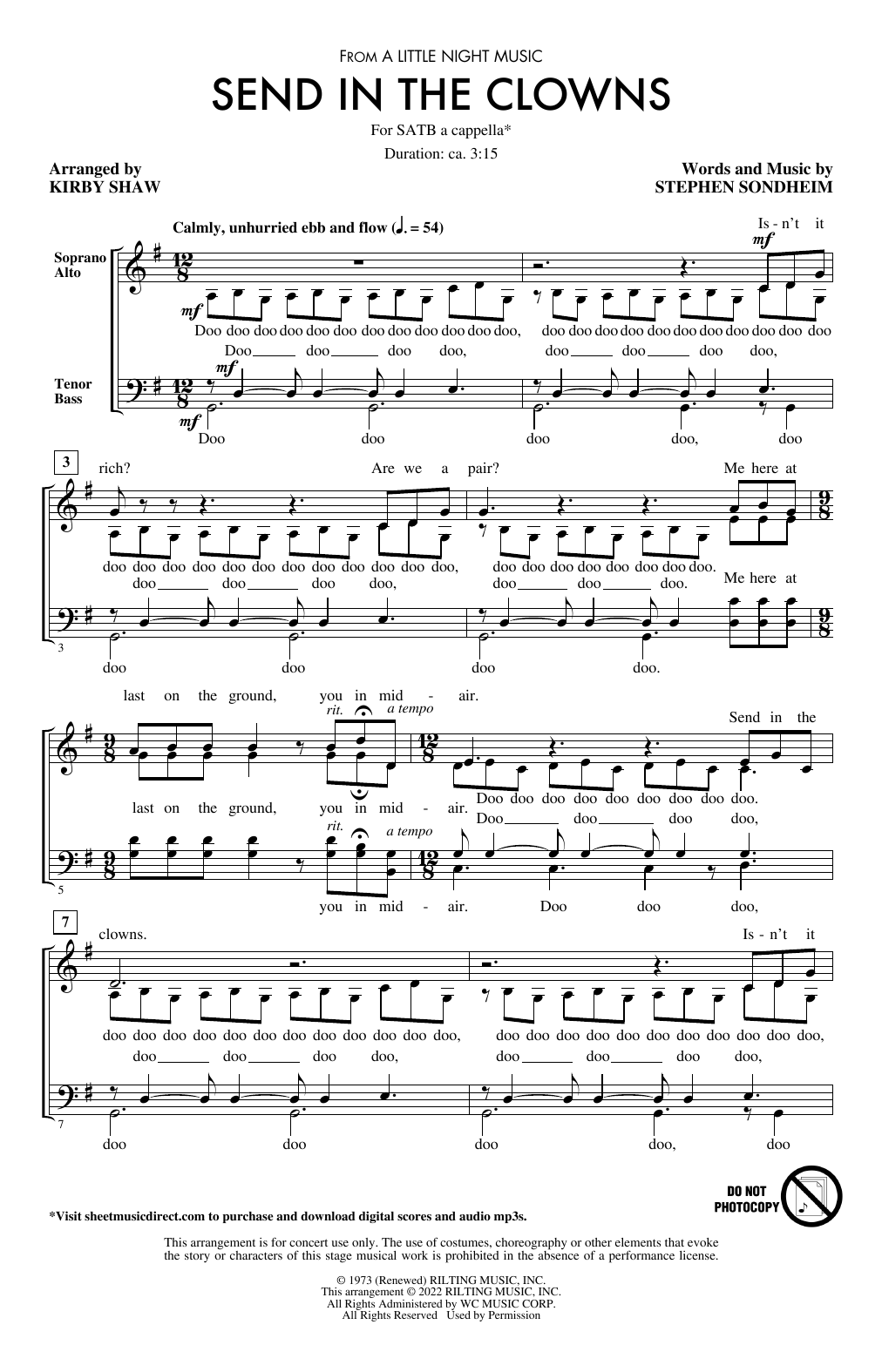
Send In The Clowns (from A Little Night Music) (arr. Kirby Shaw) Sheet Music Preview

Send In The Clowns (from A Little Night Music) (arr. Kirby Shaw): SATB Choral Octavo

By Stephen Sondheim / Arranged by Kirby Shaw

Item: 35-DS01098683

Digital Download
$2.99
Description

Send In The Clowns (from A Little Night Music) (arr. Kirby Shaw): SATB Choral Octavo isn't in MakeMusic Cloud just yet...but it could be. Let us know you'd like to see it, and you'll help shape what comes next. In the meantime, start a free trial and dive into thousands of interactive titles your students can play along with today.

Sample Audio
No sample audio found.
Sample Video
Additional Details
Publisher: Hal Leonard
Page Count: 6
SKU: 35-DS01098683

More about this title

About the Composer: Stephen Sondheim

Stephen Sondheim revolutionized musical theater by treating the song as a vehicle for character development and emotional complexity rather than mere entertainment. His lyrics combine sophisticated rhyme schemes with conversational naturalness, and his melodies often resist easy singability in favor of psychological authenticity, making his work endlessly rewarding for singers willing to dig into the emotional subtext.

Why we love this

Kirby Shaw's arrangement captures the song's essential vulnerability while making it accessible for SATB voices without oversimplifying Sondheim's harmonic language. The piece works equally well as a concert feature or as part of a larger Broadway programming initiative, and its modest accompaniment requirements mean even smaller programs can perform it with impact.

What to expect

Bittersweet and introspective, this song sits in the quiet spaces between laughter and sorrow. The harmonic language feels sophisticated without being austere, and the text's dark humor carries an undertone of genuine loneliness that even a full SATB voicing cannot entirely mask.

Who it's for

This arrangement serves choirs that want to tackle Broadway repertoire with musical substance beyond entertainment value. It works for programs seeking a solo-feature piece with rich harmonic support and for directors looking to introduce singers to Sondheim's approach to melody and meaning.

How to get the most out of it

  • Treat the lyric as storytelling first. The melody serves Sondheim's text, so clarity of diction and phrase meaning matters more than perfect legit tone throughout.
  • Balance the ensemble parts so they support rather than compete with whoever carries the primary melody. The harmonic progression is sophisticated enough that any voice getting lost will blur the chord colors.
  • Allow space for the melody to breathe in moments of reflection. Sondheim's pauses and rests are compositional choices that deepen the emotional impact.
  • Shape the dynamic arc across the entire piece rather than treating phrases in isolation. The song's emotional trajectory builds subtly, and a static dynamic approach flattens the journey.

How to use it

This works beautifully as a bridge between traditional musical theater and more contemporary choral programming. Use it as a concert centerpiece that showcases your ensemble's ability to handle complex harmonies and dramatic nuance, or pair it with other Sondheim selections for a thematic evening that explores how musical theater can operate as serious art.

Skills your students will build

  • Singing through sophisticated harmonic movement and seventh/ninth chords
  • Balancing ensemble parts that don't fall into predictable soprano-melody patterns
  • Text interpretation that serves character and emotional subtext
  • Maintaining phrase shape and musical direction across rests and silences
  • Ensemble intonation in chromatic and non-diatonic passages

You May Also Like