
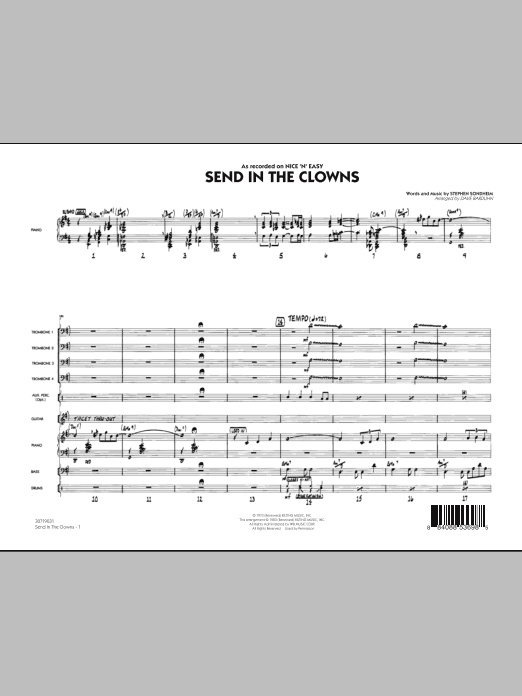

Send In The Clowns: Jazz Ensemble Conductor Score & Parts
By Stephen Sondheim / Arranged by Dave Barduhn
Grade: 3
Item: 35-PK00157726
$45.00
Pickup currently not available
Buy Extra Parts (Digital PDF Download)
| Product | Price | Quantity |
|---|---|---|
| Send In The Clowns - Full Score | $8.00 | |
| Send In The Clowns - Alto Sax 1 | $6.00 | |
| Send In The Clowns - Alto Sax 2 | $6.00 | |
| Send In The Clowns - Tenor Sax 1 | $6.00 | |
| Send In The Clowns - Tenor Sax 2 | $6.00 | |
| Send In The Clowns - Baritone Sax | $6.00 | |
| Send In The Clowns - Trumpet 1 | $6.00 | |
| Send In The Clowns - Trumpet 2 | $6.00 | |
| Send In The Clowns - Trumpet 3 | $6.00 | |
| Send In The Clowns - Trumpet 4 | $6.00 | |
| Send In The Clowns - Trombone 1 | $6.00 | |
| Send In The Clowns - Trombone 2 | $6.00 | |
| Send In The Clowns - Trombone 3 | $6.00 | |
| Send In The Clowns - Trombone 4 | $6.00 | |
| Send In The Clowns - Piano | $6.00 | |
| Send In The Clowns - Bass | $6.00 | |
| Send In The Clowns - Drums | $6.00 | |
| Send In The Clowns - Aux Percussion | $6.00 |
Parts Added to Cart!
Description
Beautifully adapted for younger groups, here is the classic arrangement by Dave Barduhn of "Send in the Clowns" first published in 1983. Featuring a piano soloist throughout, plus lush scoring for the ensemble, this chart stands the test of time and is a wonderful addition for contest or festival.


Send In The Clowns: Jazz Ensemble Conductor Score & Parts isn't in MakeMusic Cloud just yet...but it could be. Let us know you'd like to see it, and you'll help shape what comes next. In the meantime, start a free trial and dive into thousands of interactive titles your students can play along with today.
Request This Title
Tell us you want it.
Start Your Free Trial
Explore everything that's ready to play right now.
Sample Audio
No sample audio found.
Sample Video
No sample videos found.
Additional Details
Publisher:
Hal Leonard
SKU:
35-PK00157726
More about this title
About the Composer: Stephen Sondheim
Stephen Sondheim revolutionized musical theatre by proving that complex, sophisticated songwriting belonged on the Broadway stage. His work prioritizes lyrical precision and harmonic depth, creating melodies that challenge both performers and audiences to listen more closely. For music educators, Sondheim's catalog offers students a masterclass in how popular song can coexist with genuine artistic ambition.
Born in New York in 1930, Sondheim studied composition formally and worked as a lyricist before establishing himself as both composer and lyricist for landmark shows including "West Side Story," "Follies," and "Sunday in the Park with George." His influence extends far beyond theatre; his songs have become standards in jazz repertoire, prized for their harmonic interest and emotional range. Directors and teachers recognize his work as essential material for helping young musicians understand that melody, harmony, and storytelling can operate at the highest level simultaneously.
Why we love this
Dave Barduhn's 1983 arrangement captures the wistful beauty of Sondheim's composition while keeping the demands reasonable for Grade 3 ensembles. The piano soloist sits front and center throughout, giving your group a natural focal point and a chance to accompany a featured performer; this setup creates authentic jazz energy without requiring virtuosic playing from every section. It's the kind of chart that sounds sophisticated in performance but doesn't demand weeks of intensive preparation.
What to expect
Melancholy and theatrical, with moments of understated elegance. The chart creates a cabaret atmosphere; there's intimacy in the writing even when the full ensemble is playing. Sondheim's melody lingers in the ear, and Barduhn's orchestration ensures it stays front and center while allowing younger musicians to contribute meaningfully to the soundscape.
Who it's for
Jazz ensembles at the Grade 3 level, including middle school and less experienced high school groups. Directors seeking material that teaches jazz style and harmonic literacy without overwhelming young musicians. Teachers who want to introduce students to theatre repertoire through a jazz lens and connect them to Sondheim's compositional legacy.
How to get the most out of it
- Let the piano soloist breathe independently rather than locking rigidly to the ensemble. Sondheim's melody has natural rubato, and Barduhn's arrangement preserves space for that flexibility.
- Balance the ensemble parts beneath the soloist; your job is to frame the piano, not compete with it. Soft dynamics and careful voice leading keep the focus where it belongs.
- Pay attention to the harmonic movement in the inner voices. The arrangement's sophistication lives in the supporting chords, and students who follow those lines will understand why this song endures.
- Take time in rehearsal with the piano soloist to establish how you'll handle the bridge section and any tempo variations. Communication between soloist and rhythm section matters more than mechanical precision.
How to use it
This works beautifully as a late-set closer at a jazz concert, especially one focused on standards and American songbook material. It pairs naturally with other theatrical or lyrical jazz selections, offering contrast to uptempo charts and showcasing your ensemble's ability to play with restraint and sophistication. Festival and contest organizers appreciate how it demonstrates musicality and ensemble balance in a piece with genuine dramatic weight.
Skills your students will build
- Accompanying a soloist while maintaining ensemble cohesion
- Playing jazz comping rhythms with discretion and sensitivity
- Reading and performing harmonically complex chord changes
- Balancing volume and texture across multiple sections
- Understanding swing feel and jazz time in a ballad context
- Responding to a soloist's interpretive choices in real time