Send In The Clowns Sheet Music Preview

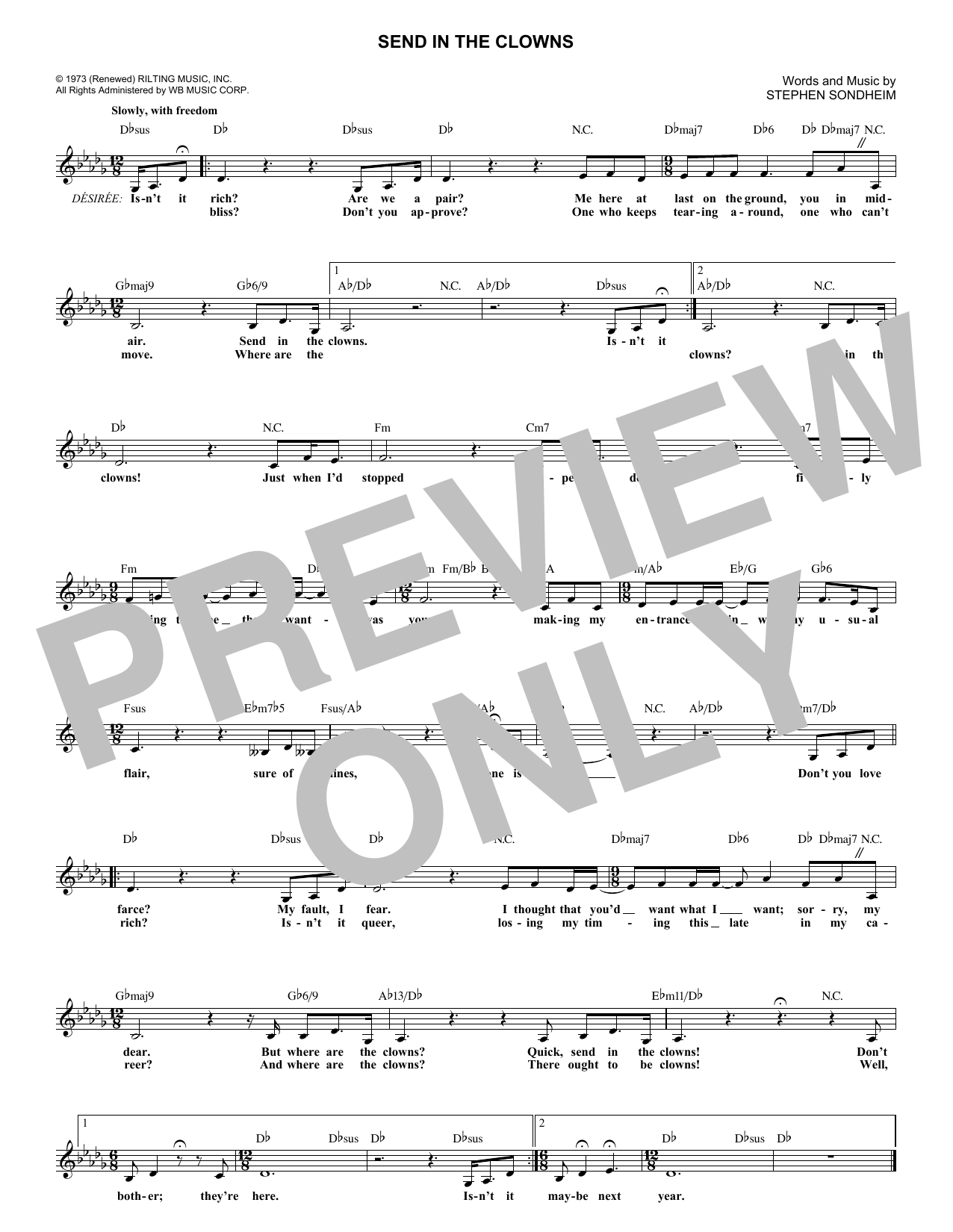
Send In The Clowns: Lead Sheet / Fake Book

Item: 35-DS00411397

Digital Download
$3.99
Description

Send In The Clowns: Lead Sheet / Fake Book isn't in MakeMusic Cloud just yet...but it could be. Let us know you'd like to see it, and you'll help shape what comes next. In the meantime, start a free trial and dive into thousands of interactive titles your students can play along with today.

Sample Audio
No sample audio found.
Sample Video
Additional Details
Publisher: Hal Leonard
Page Count: 1
SKU: 35-DS00411397

More about this title

About the Creator: Stephen Sondheim

Stephen Sondheim (1930–2021) shaped modern musical theater through his intricate lyrics and sophisticated harmonic language. His collaborations with composer Richard Rodgers, lyricist James Lapine, and director Harold Prince produced some of Broadway's most intellectually demanding and emotionally resonant scores. Sondheim's influence extends far beyond the stage; his work has become essential study material for anyone learning songwriting, harmonic analysis, or dramatic music.

As both composer and lyricist, Sondheim approached each song as a character study. His melodies often mirror the emotional complexity of his lyrics, creating pieces that reveal new dimensions with each encounter. "Send In The Clowns" exemplifies this approach: a deceptively simple-sounding waltz that contains sophisticated harmonic movement and deeply theatrical storytelling.

Why we love this

This lead sheet captures one of Broadway's most eloquent character moments without requiring an orchestral reduction. The sparse format lets performers zero in on Sondheim's harmonic choices and the way the melody breathes within the waltz time signature, making it ideal for jazz ensembles, cabaret programming, and voice students exploring standards with real compositional depth.

What to expect

Quiet and introspective, with an underlying current of irony. The waltz meter carries an old-fashioned quality, yet the harmonic twists keep the ear engaged and slightly off balance. There's a melancholic tenderness here, the kind of song that asks you to sit with uncomfortable truths before it lets you leave.

Who it's for

Pianists and keyboardists working with singers who want to explore Sondheim repertoire, jazz musicians building their standards vocabulary, and voice teachers seeking material that develops both musical maturity and interpretive skill. This single page serves vocalists preparing auditions and students studying contemporary musical theater composition.

How to get the most out of it

  • Treat the tempo as flexible within the 3/4 framework. The waltz pulse should feel unhurried and reflective rather than metronomic.
  • Listen closely to how the melody sits against the implied changes. Sondheim's harmonic movement is purposeful, so let the chords guide your phrasing rather than fighting them.
  • Shape the dynamics around the lyrical arc, even if performing instrumentally. This song exists in the space between resignation and dark humor.
  • Experiment with chord voicings in accompaniment. The lead sheet format invites creative harmonic reinterpretation while honoring Sondheim's original intent.

How to use it

Pair this with other Sondheim material in a cabaret or concert featuring musical theater standards. It also works beautifully in a program exploring the waltz form across genres, or as an opening number for a recital focused on character-driven songs. Voice students can use it to explore how lyrics and harmony reinforce each other.

Skills your students will build

  • Reading and interpreting lead sheet notation with jazz chord symbols
  • Understanding harmonic rhythm in Sondheim's sophisticated chord progressions
  • Performing in 3/4 time with theatrical musical phrasing
  • Accompanying a vocalist while managing improvised voicing choices
  • Analyzing how melodic contour interacts with harmonic movement

You May Also Like