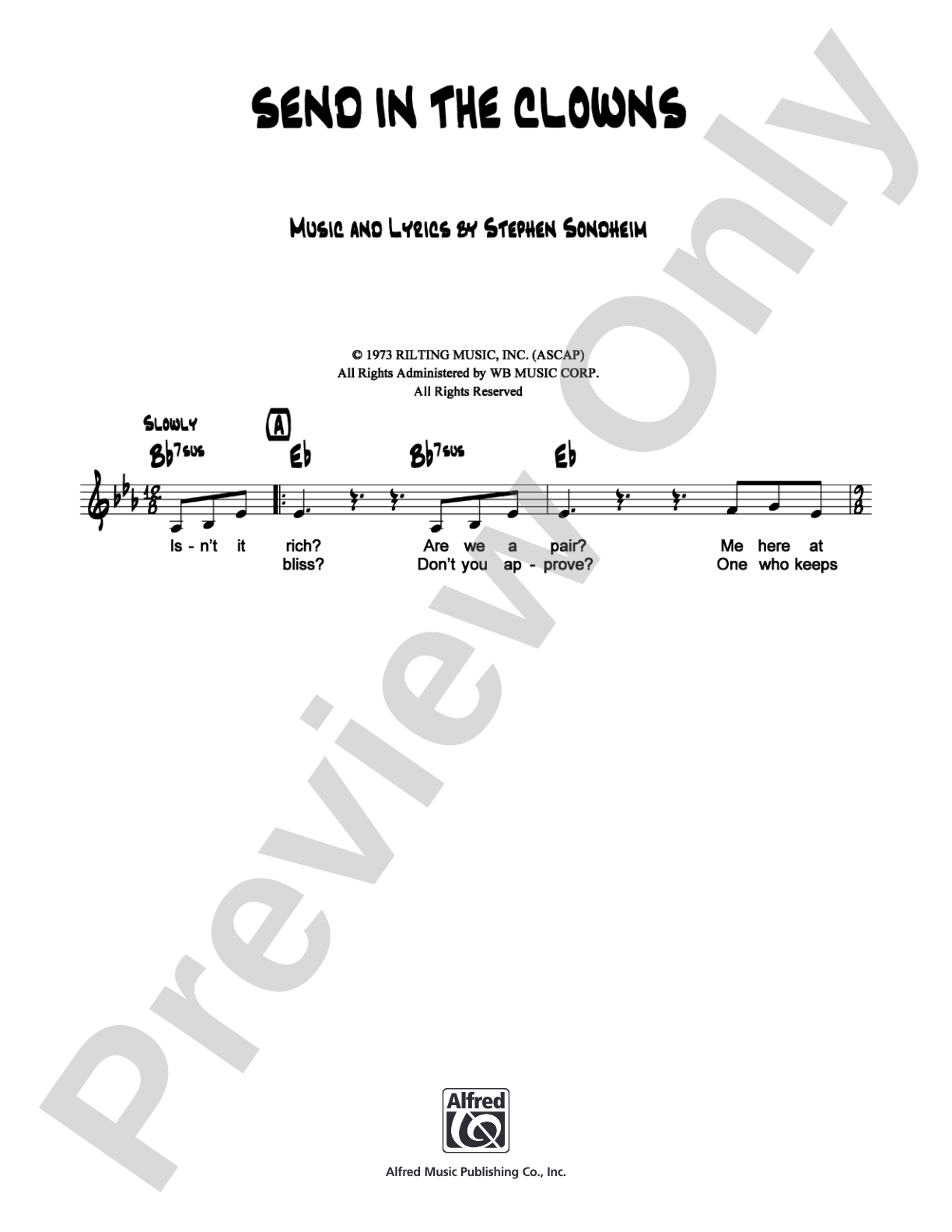
Send in the Clowns: Lead Sheet Digital Sheet Music

Send in the Clowns: Lead Sheet Digital Sheet Music

Barbra Streisand, Stephen Sondheim, Judy Collins

Item: 00-PS-0009420

Digital Download
$1.99
Description

Send in the Clowns: Lead Sheet Digital Sheet Music isn't in MakeMusic Cloud just yet...but it could be. Let us know you'd like to see it, and you'll help shape what comes next. In the meantime, start a free trial and dive into thousands of interactive titles your students can play along with today.

Sample Audio
No sample audio found.
Sample Video
Additional Details
SKU: 00-PS-0009420

More about this title

About the Artist: Barbra Streisand

Barbra Streisand's interpretive gifts shaped how generations of singers approach the American songbook. Her instinct for emotional clarity and her willingness to find new angles in familiar material make her recordings essential listening for anyone serious about understanding song interpretation.

Streisand's technical command, her intonation, phrasing control, and ability to sit behind or push ahead of the beat, offers a masterclass in how to inhabit a lyric. For educators, her recordings demonstrate that mastery isn't about vocal display; it's about serving the story.

Why we love this

Sondheim's melody sits in a conversational range that welcomes singers at every level, and this lead sheet gives you the harmonic architecture to explore it from jazz interpretations to lyrical cabaret approaches. The song's deceptive structure, simple on the surface, emotionally complex underneath, makes it a powerful teaching tool for understanding how great songwriting works.

What to expect

A conversation conducted in minor key and wry humor, where melancholy doesn't feel heavy. There's wisdom here, the kind that comes from disappointment that doesn't harden into bitterness. The song sits in reflective territory, allowing space for both vulnerability and dry comedic timing.

Who it's for

This lead sheet serves singers preparing for auditions or recitals, jazz musicians arranging or improvising over a standard, and music students studying Sondheim's harmonic language and theatrical song craft. It works equally well for voice teachers coaching interpretive choices and for ensemble musicians (piano, guitar, bass) supporting a vocalist.

How to get the most out of it

  • Treat the rubato as structural rather than ornamental. Sondheim's phrase lengths often sit slightly outside regular bar divisions, and honoring those asymmetries creates the song's reflective quality.
  • Pay attention to how the lyric's punctuation and thought-completion guide your phrasing and breath placement. The narrative arc matters as much as the melodic contour.
  • Explore the harmonic movement beneath the melody. The chord changes contain tension and resolution that deserve audible attention, particularly in passages where the melody sits simple over complex harmony.
  • Adjust tempo and dynamic subtly between verses. The emotional terrain shifts, and your performance should reflect those shifts without requiring dramatic tempo changes.

How to use it

This works beautifully as a solo recital piece for a vocalist, whether in a cabaret, concert, or audition setting. It also pairs well in a program exploring Sondheim's song writing or as a bridge between musical theater and jazz repertoire. Consider pairing it with other contemporary standards to show range in style and emotional territory.

Skills your students will build

  • Phrasing across irregular phrase lengths and lyric punctuation
  • Interpretation of harmony in relation to emotional content
  • Rubato and tempo flexibility within a fixed metric framework
  • Narrative delivery in sung text
  • Understanding of contemporary musical theater song structure

You May Also Like