
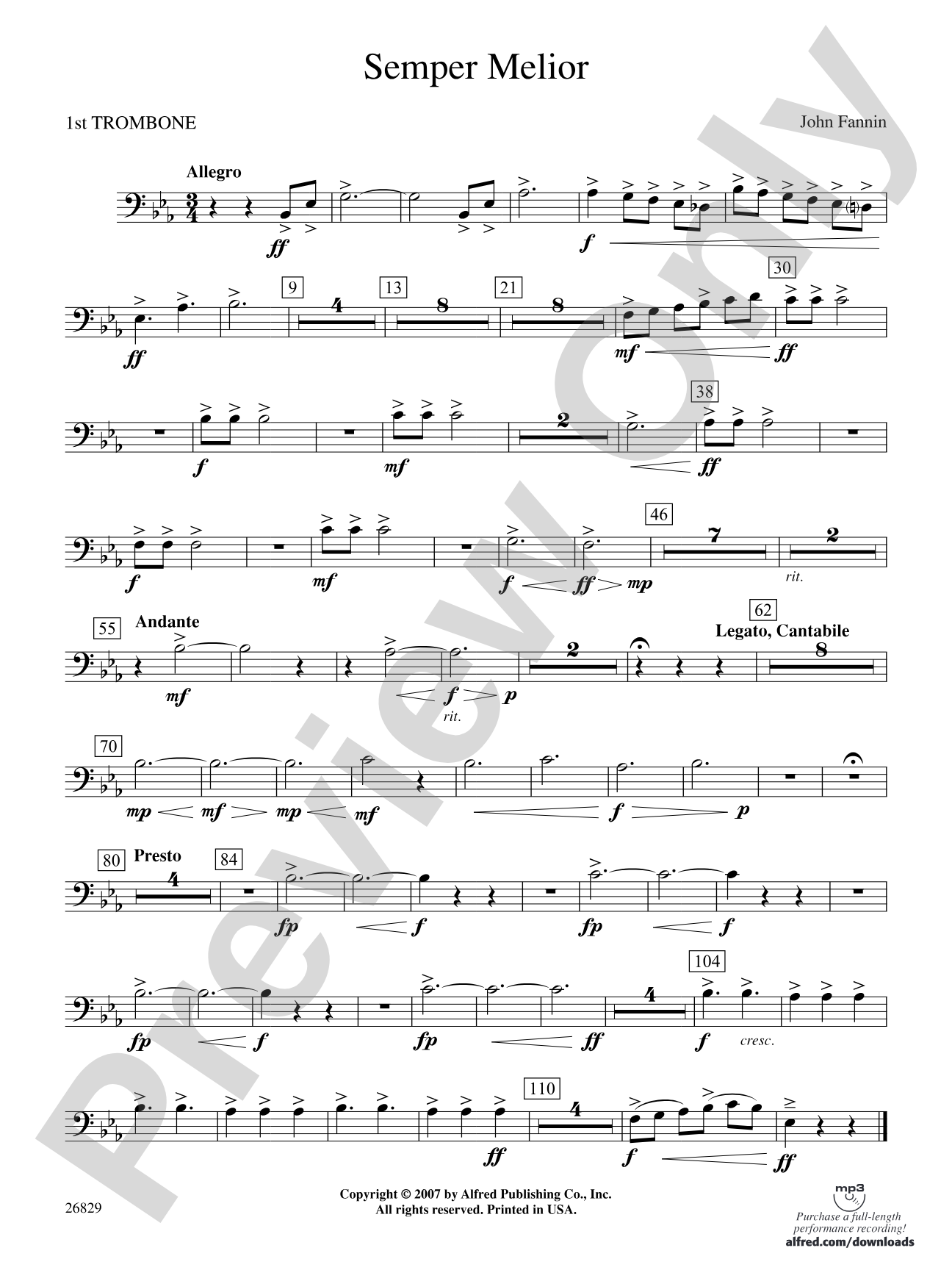

Semper Melior: 1st Trombone
By John Fannin
Grade: 2.5 (Medium Easy)
Item: 00-PC-0001267_TN1
$3.00
Pickup currently not available
Description
Semper Melior (Always Better) is the motto of the Murray Middle School and Murray High School Bands, who commissioned this marvelous composition. This exciting piece gives student the opportunity to explore shifting 6/8 -- 3/4 rhythmic patterns. Woodwind runs are based on the E-flat major scale and lay well for developing techniques. This title is available in MakeMusic Cloud.


Don't just read it, hear it, play along with it, and watch your students grow with it. In MakeMusic Cloud, Semper Melior: 1st Trombone comes alive with professional accompaniment, adjustable tempo, and built-in practice tools that turn solo practice into real progress.
Open in the Player
Jump straight in and assign it today.
Start Your Free Trial
Open this title and explore the full library in minutes.
Sample Audio
1
Audio File
--:--
0:00
0:00
Sample Video
No sample videos found.
Additional Details
Series:
Young Symphonic
Publisher:
Alfred Music
Page Count:
130
SKU:
00-PC-0001267_TN1
More about this title
About the Composer: John Fannin

John Fannin built his reputation over decades as both a high school band director and university educator. He directed bands in New Mexico and Arizona before joining Murray State University in 1995, where he served as Assistant Director of Bands until his retirement in 2020. During his tenure, he transformed the Racer Marching Band from 85 members to 300, earning recognition that included performances at the Bands of America Grand National Championships in 2006 and 2012.
Fannin's contributions to music education extend far beyond his home institution. He has guest conducted and clinicked across the United States and internationally, including work in Brazil, Bangladesh, and England. His awards span the full spectrum of the profession: the 2017 Max Carman Outstanding Teacher Award, the 2009 KMEA University Teacher of the Year designation, and recognition from Phi Beta Mu for his contributions to Kentucky bands. As owner of Fannin Musical Productions LLC and a published composer with major publishers including Alfred Music, he continues to serve as a creative resource for high school and college programs.
Why we love this
Fannin writes with a genuine understanding of what student musicians need to grow. The rhythmic interplay between 6/8 and 3/4 keeps young players engaged and thinking rather than coasting, while the woodwind passages sit comfortably enough that technique develops naturally without becoming a slog. This is the kind of piece that works equally well on a concert program or festival schedule because it balances musical substance with accessibility.
What to expect
Semper Melior radiates the optimism its title promises. The piece builds energy through its rhythmic vitality and bright orchestration, with woodwind runs that dance above steady harmonic motion. There's momentum throughout without meanness; this is music that makes student musicians feel capable and proud.
Who it's for
This piece sits perfectly for developing concert bands in grades 6-8 or lower high school ensembles ready to explore metric variety without sacrificing musicality. Students need secure fundamentals but not advanced technique; the Grade 2.5 level reflects writing that challenges young musicians where it matters while staying within reach.
How to get the most out of it
- Establish the metric relationship between 6/8 and 3/4 early in rehearsal. Have the ensemble tap both meters simultaneously to internalize how they interact before adding harmonic or melodic content.
- Balance the woodwind runs so they emerge as musical lines rather than technical exercises. Assign principal players to each section to model phrasing and sustain clarity across the quick passages.
- Let the E-flat major scale feel natural to your woodwind players by spending time on it as preparation. Once they own the scale, the runs will sit in the fingers rather than requiring constant counting.
- Shape phrases with the metric shifts. Don't treat each meter change as a restart; instead, hear it as a continuation that simply breathes differently.
How to use it
Program this early in the season to introduce metric flexibility in a musical context rather than a theoretical one. It works well as a concert opener or as part of a festival set because it commands attention without requiring the full weight of your ensemble's advanced repertoire. The commissioned origin also makes it a natural fit if you want to celebrate your program's identity or highlight student growth.
Skills your students will build
- Reading and performing in shifting 6/8 and 3/4 time signatures
- Executing scale-based woodwind passages with clean articulation and phrasing
- Maintaining ensemble unity through metric transitions
- Developing independence in independent harmonic lines while supporting larger musical shape