
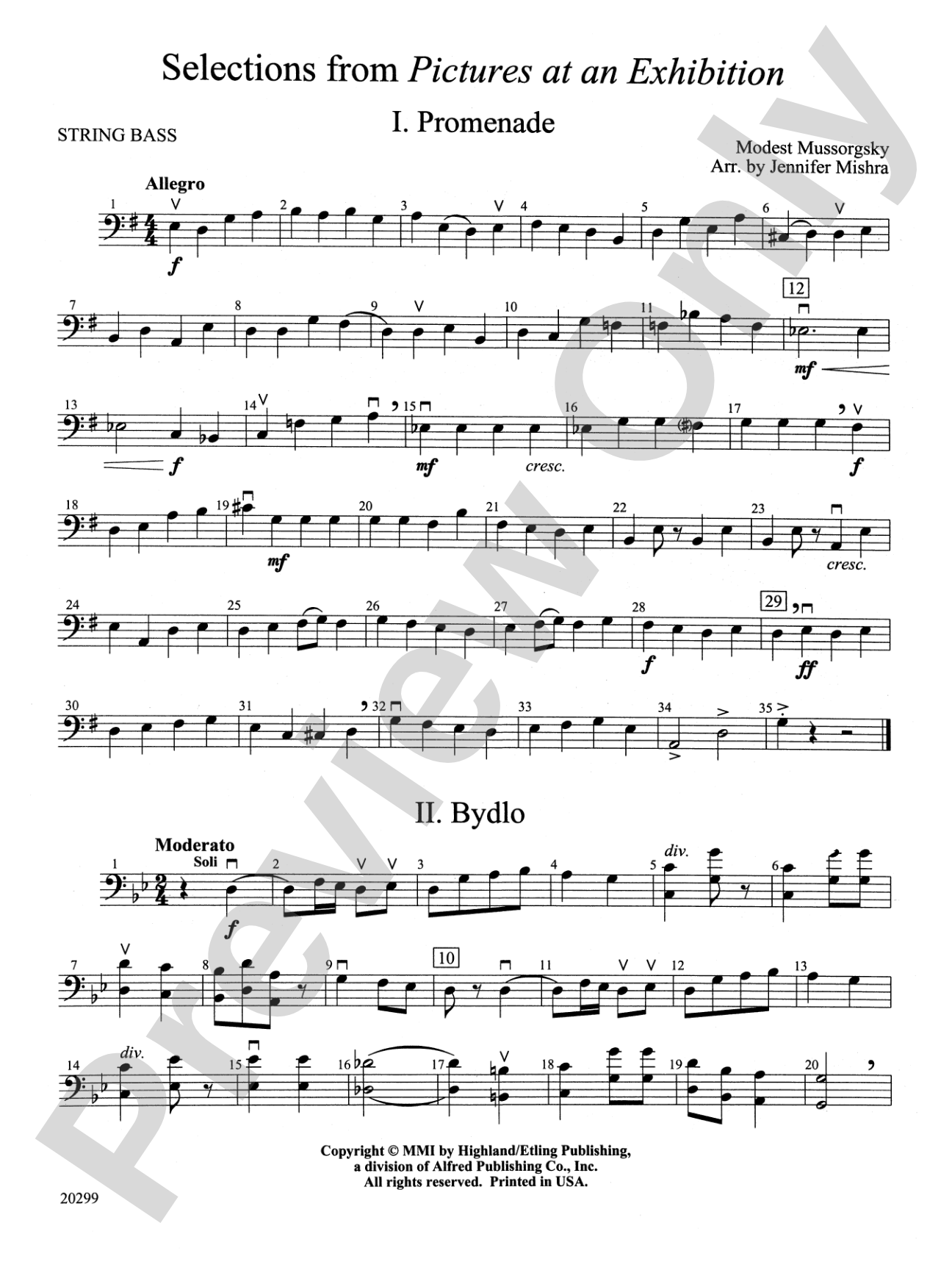

Selections from Pictures at an Exhibition: String Bass
I. Promenade, II. Bydlo, III. The Ballet of the Unhatched Chicks, IV. The Great Gate of Kiev
Music by Modest Mussorgsky / arr. Jennifer Mishra
Grade: 3
Item: 00-PC-0000383_SB
$5.99
Pickup currently not available
Description
Pictures at an Exhibition (originally written for piano) is a collection of musical miniatures inspired by drawings of the artist Victor Hartmann. Here, the power and brilliance of Mussorgsky's work are beautifully arranged and transcribed for string orchestra. Movements include "Promenade," "Bydlo," "The Ballet of the Unhatched Chicks" and "The Great Gate of Kiev." This title is available in MakeMusic Cloud.


Don't just read it, hear it, play along with it, and watch your students grow with it. In MakeMusic Cloud, Selections from Pictures at an Exhibition: String Bass comes alive with professional accompaniment, adjustable tempo, and built-in practice tools that turn solo practice into real progress.
Open in the Player
Jump straight in and assign it today.
Start Your Free Trial
Open this title and explore the full library in minutes.
Sample Audio
1
Audio File
--:--
0:00
0:00
Sample Video
No sample videos found.
Additional Details
Series:
Highland/Etling String Orchestra
Publisher:
Alfred Music
Page Count:
124
SKU:
00-PC-0000383_SB
More about this title
About the Composer: Modest Mussorgsky
Modest Mussorgsky (1839-1881) was a Russian composer who rejected the Western European conservatory tradition in favor of a distinctly Russian musical voice. Though trained as a pianist and briefly as a composer, he spent much of his life working in the Russian Imperial bureaucracy, composing in his spare time. His refusal to sand down the rough edges of his music and his embrace of folk idioms, modal harmony, and unconventional structures made him a visionary ahead of his contemporaries.
Pictures at an Exhibition stands as his masterpiece of the imagination. Composed in 1874 as a solo piano work, it was inspired by an exhibition of drawings by his friend Viktor Hartmann and conceived as a series of musical snapshots that move from one image to another. The work's harmonic daring, vivid orchestration (especially in later arrangements), and narrative sweep have made it one of the most frequently performed and transcribed works in the classical repertoire.
Why we love this
Mussorgsky's original work is orchestrally conceived even in its piano form, and Mishra's arrangement unlocks those colors for young string players without oversimplifying the architecture. Grade 3 orchestras gain immediate access to a genuine masterwork rather than a note-reduced approximation, and the selection of four iconic movements creates a program that feels substantial and musically cohesive.
What to expect
Moving from architectural grandeur to intimate humor, these four selections paint vivid emotional landscapes. "Promenade" strides forward with dignified purpose, "Bydlo" creaks and groans with ancient, earthbound weight, "The Ballet" sparkles with mischievous delicacy, and "The Great Gate of Kiev" swells into towering, almost liturgical splendor. The arrangement captures the cinematic quality of the original, where each movement feels like stepping into a different painted world.
Who it's for
String orchestra conductors working with advancing Grade 3 ensembles who want to program substantial repertoire without selecting a brand-new composition. Orchestras preparing for contests or festivals will find four movements that sit comfortably in the standard string orchestra range while demanding musical maturity and ensemble discipline. Players at this level are ready to wrestle with Romantic harmony and the textures Mussorgsky created.
How to get the most out of it
- Shape the "Promenade" theme as a unified statement across the entire violin section; encourage players to listen across parts rather than locking into individual lines so the melody breathes as one voice.
- Balance the pizzicato figures in "Bydlo" so they anchor the harmonic foundation without overwhelming the lyrical upper voices; this movement rewards attention to dynamic layering.
- Press for rhythmic precision in "The Ballet of the Unhatched Chicks" without sacrificing the whimsical, almost bouncy character; light bowstrokes and clear articulation matter more than volume.
- Let "The Great Gate of Kiev" build gradually through the full arc; resist the urge to play the final climax at maximum volume too early, saving dynamic intensity for the final cadential phrases.
How to use it
Open a concert with the full cycle of four movements to create a dramatic arc that showcases the orchestra's range and maturity without requiring multiple separate pieces. Alternatively, feature "The Great Gate of Kiev" as the finale of a spring concert, pairing it with lighter opening works to let this masterwork statement land with maximum impact. The movements also work individually if your program calls for showcasing orchestral color and Romantic-era sophistication.
Skills your students will build
- Reading and executing Romantic-era harmonic progressions with modal inflections
- Balancing independent string parts while maintaining phrase coherence across the ensemble
- Sustaining lyrical tone through extended passages while managing bow distribution efficiently
- Articulating pizzicato passages with precision and rhythmic clarity
- Shaping dynamic arcs over longer musical phrases rather than note-by-note fluctuation
- Playing with stylistic awareness of Russian nationalistic idioms and folk-influenced melody