
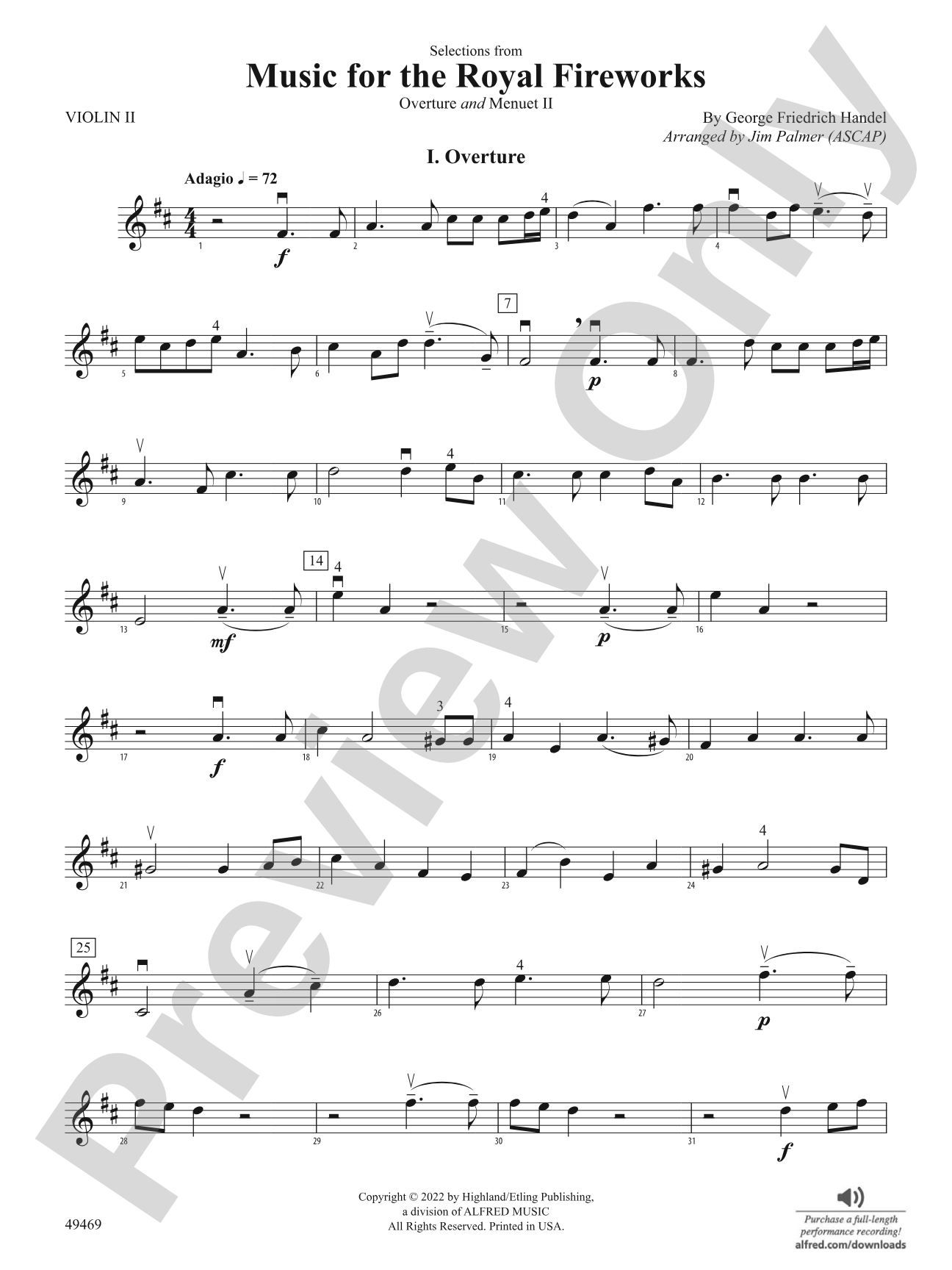

Selections from Music for the Royal Fireworks: 2nd Violin
Overture and Menuet II
By George Friedrich Handel / arr. Jim Palmer
Grade: 2
Item: 00-PC-0018787_VN2
$3.00
Pickup currently not available
Description
Jim Palmer's arrangement of Music for the Royal Fireworks is an exciting two-movement work that is perfect for your young string orchestra. The movements work together or are effective played on their own. Terraced dynamics and authentic articulations will help your students gain an understanding of music from the Baroque era. A perfect opener or closer to any concert. (3:15) This title is available in MakeMusic Cloud.


Don't just read it, hear it, play along with it, and watch your students grow with it. In MakeMusic Cloud, Selections from Music for the Royal Fireworks: 2nd Violin comes alive with professional accompaniment, adjustable tempo, and built-in practice tools that turn solo practice into real progress.
Open in the Player
Jump straight in and assign it today.
Start Your Free Trial
Open this title and explore the full library in minutes.
Sample Audio
1
1 Music for the Royal Fireworks Music - Overture
--:--
2
2 Music for the Royal Fireworks Music - Menuet II
--:--
1 Music for the Royal Fireworks Music - Overture
0:00
0:00
Sample Video
Additional Details
Series:
Highland String Orchestra (HSO)
Publisher:
Alfred Music
SKU:
00-PC-0018787_VN2
More about this title
About the Composer: George Friedrich Handel
George Friedrich Handel (1685-1759) dominated the musical landscape of 18th-century London, where he established himself as a master of opera, oratorio, and instrumental music. His compositions combined Italian melody with German counterpoint and English sensibility, creating works of enduring appeal and structural brilliance.
Handel's Music for the Royal Fireworks stands as one of his most celebrated instrumental works, originally commissioned to accompany a fireworks display in London in 1749. The piece demonstrates his genius for crafting clear, memorable themes and building momentum through orchestration and rhythm, qualities that make his music especially valuable in music education.
Why we love this
Jim Palmer's arrangement strips away the complexity of Handel's orchestration while preserving the compositional genius that makes this music memorable. The terraced dynamics and articulation markings are not merely decorative; they teach young string players what Baroque phrasing actually sounds like, preparing them for deeper work with Bach and Vivaldi down the road. It's the kind of piece that opens or closes a concert with genuine impact, and students feel genuinely accomplished when they can execute it well.
What to expect
Brilliant and ceremonial without being heavy-handed. The music moves with Baroque forward momentum, built on clear harmonic progressions and rhythmic drive. There's genuine grandeur here, but it arrives through transparent orchestration and articulation rather than sheer density.
Who it's for
Grade 2 string orchestras looking for substantial repertoire with real musical weight. Directors seeking festival or contest programming that builds student understanding of period style while remaining technically accessible.
How to get the most out of it
- Shape each phrase with clear articulation by observing the marked bowings; in Baroque style, the articulation pattern itself carries melodic expression.
- Balance the two movements by letting the second one breathe after the first concludes; silence is part of the architecture here.
- Emphasize rhythmic clarity in the faster passages without rushing; precision in the ensemble's rhythmic foundation lets the melodic lines sing.
- Use terraced dynamics as architectural tools, not just volume changes; each dynamic shift should feel like a structural arrival.
How to use it
Program this as an opener to set a festive tone, or close a concert with genuine ceremonial impact. The two-movement structure gives you flexibility: use both movements for a substantial climax, or perform just one movement if you need tighter programming without sacrificing the Handel experience.
Skills your students will build
- Baroque articulation and phrasing conventions
- Terraced dynamics and echo effects
- Rhythmic precision in fast-moving passages
- Understanding of period-appropriate string technique and bowing
- Listening to harmonic direction within diatonic frameworks