
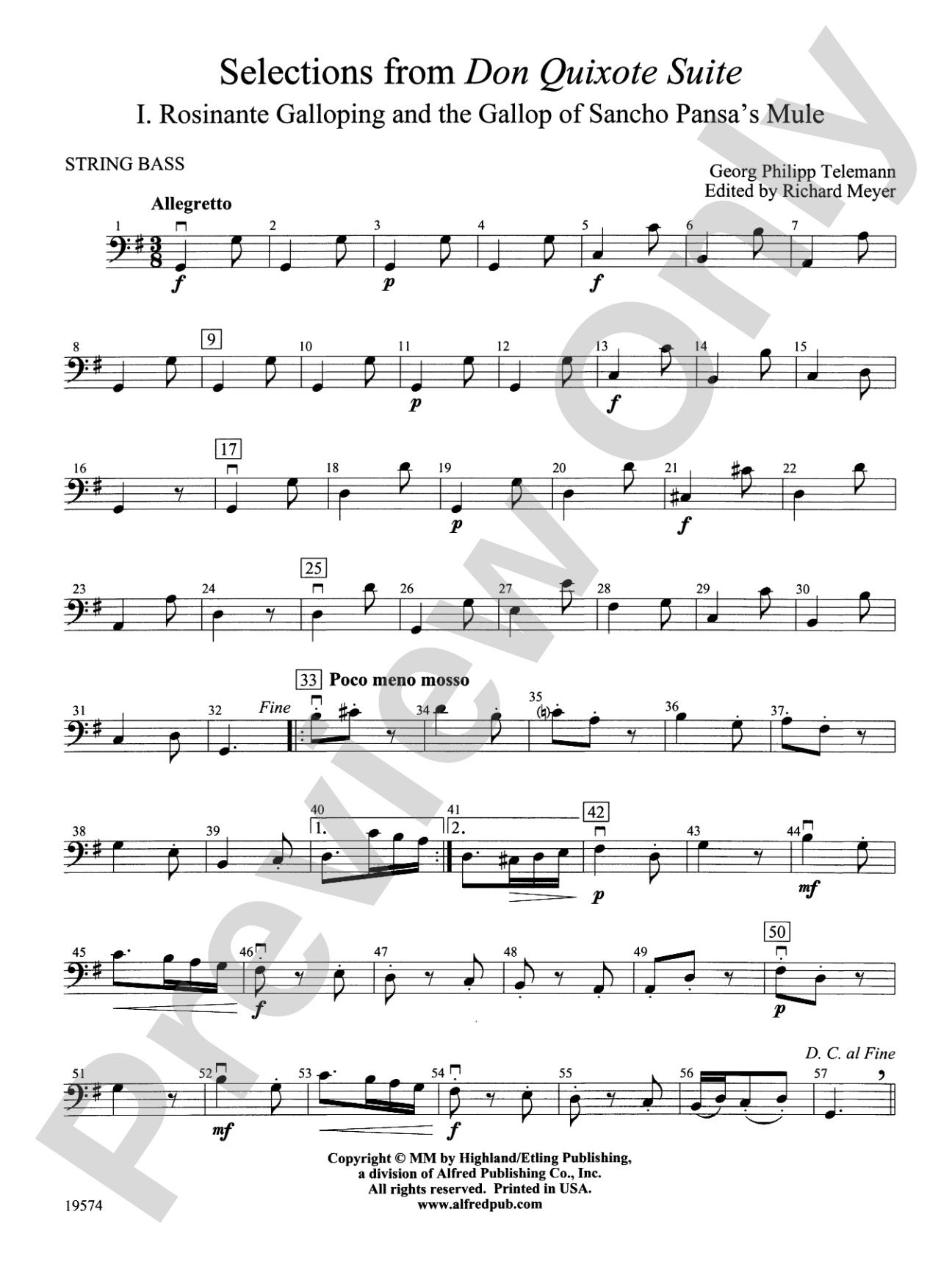

Selections from Don Quixote Suite: String Bass
Music by Georg Philipp Telemann / ed. Richard Meyer
Grade: 3
Item: 00-PC-0014262_SB
$5.99
Pickup currently not available
Description
A wonderful example of an early effort at program music (much in the spirit of Vivaldi's Four Seasons), these selections are to capture your students' imaginations. Included are "Rosinante Galloping," "Sighs of Love for Princess Dulcinea" and "His Attack on the Windmills." All three movements are Telemann's original composition. Only the bowing has been altered by the editor, to be more playable by the student orchestra.


Don't just read it, hear it, play along with it, and watch your students grow with it. In MakeMusic Cloud, Selections from Don Quixote Suite: String Bass comes alive with professional accompaniment, adjustable tempo, and built-in practice tools that turn solo practice into real progress.
Open in the Player
Jump straight in and assign it today.
Start Your Free Trial
Open this title and explore the full library in minutes.
Sample Audio
1
Audio File
--:--
0:00
0:00
Sample Video
No sample videos found.
Additional Details
Series:
Highland/Etling String Orchestra
Publisher:
Alfred Music
Page Count:
124
SKU:
00-PC-0014262_SB
More about this title
About the Composer: Georg Philipp Telemann
Georg Philipp Telemann (1681-1767) was one of the most prolific composers of the Baroque era, writing over 3,000 works across nearly every genre. A German composer and virtuoso instrumentalist, Telemann served as Kapellmeister in Frankfurt and Hamburg, positions that shaped his gift for writing music that balances sophistication with accessibility. His instrumental works demonstrate a keen ear for orchestration and melodic invention that makes them enduringly popular in educational settings.
Telemann's approach to program music predated many of his more celebrated contemporaries. The Don Quixote Suite exemplifies his talent for narrative composition, translating the adventures of Cervantes' famous character into vivid musical scenes. His writing for strings remains remarkably playable while maintaining genuine artistic interest, a quality that has made his works staples of student orchestra repertoire.
Why we love this
Telemann crafts three distinct musical tableaux that tell a story without requiring advanced orchestral technique, giving your students genuine program music to perform rather than generic etude material. The bowing adjustments preserve the Baroque voice-leading while making passage work accessible at Grade 3, so your ensemble stays connected to the original composition instead of struggling through unidiomatic original bowings. Each movement has its own character and pacing, giving you natural building blocks for a concert that feels curated rather than routine.
What to expect
Telemann's Don Quixote music captures the spirit of tilting windmills, romantic longing, and the tireless hoofbeats of an aging horse without ever feeling overstated. The Baroque elegance remains throughout, even in the most adventurous moments; these are charming vignettes brought to life with orchestral color rather than bombastic storytelling. Your ensemble will hear themselves painting scenes with their bows and voices.
Who it's for
Grade 3 string orchestras looking for Baroque program music that honors the original while remaining genuinely playable. Directors seeking a narrative arc for a concert program will find these three movements work beautifully as a complete suite or as individual selections placed strategically throughout a concert.
How to get the most out of it
- Balance the rhythmic vitality of 'Rosinante Galloping' by keeping the pulse steady in the rhythm section while allowing the melody line flexibility; student horses tend to trot when they should gallop.
- Shape the lyrical phrases in 'Sighs of Love for Princess Dulcinea' with slight rubato, treating it as a song without words rather than a technical exercise.
- Define articulation crisply in 'His Attack on the Windmills' to capture the comedic urgency of the scene; avoid letting rapid passages blur into one another.
- Use the conductor parts to map out textural shifts between the three movements so your ensemble hears them as movements of a suite rather than three unrelated pieces.
How to use it
Program these selections as a three-movement suite to open or close a concert, letting the narrative journey anchor a program of contrasting works. Alternatively, scatter the movements throughout the concert, using 'Rosinante Galloping' as an energetic interlude and 'Sighs of Love for Princess Dulcinea' as a lyrical counterpoint to heavier repertoire. The familiar source material makes them excellent bridge pieces between classical repertoire and contemporary works.
Skills your students will build
- Reading and executing edited bowings that preserve Baroque phrasing while adapting to student ensemble capabilities
- Maintaining rhythmic precision in galloping figures and energetic passage work
- Shaping phrases with direction and character in lyrical sections
- Balancing melody and accompaniment across multiple string parts
- Recognizing how composers use orchestration to convey narrative and character