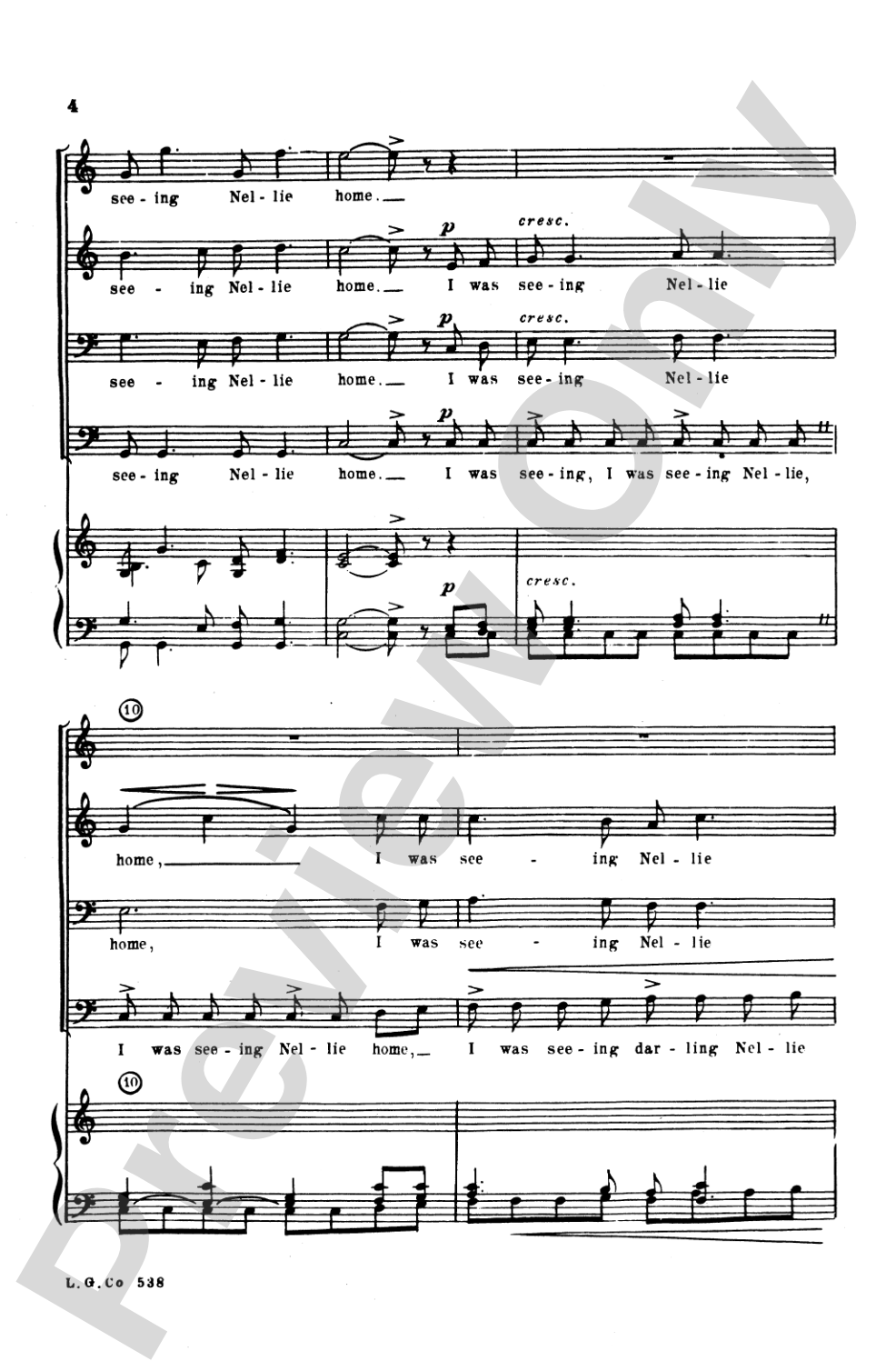
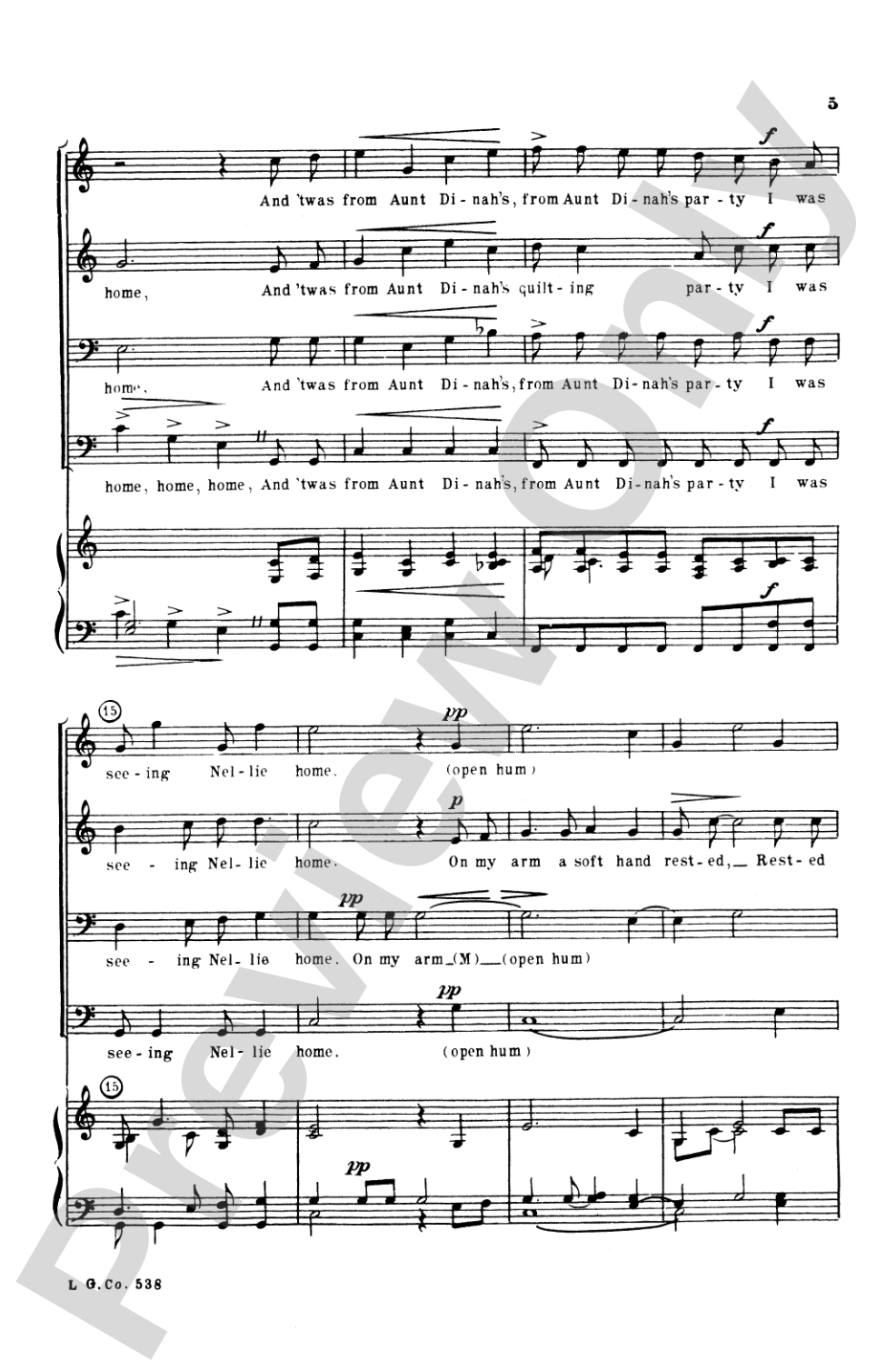
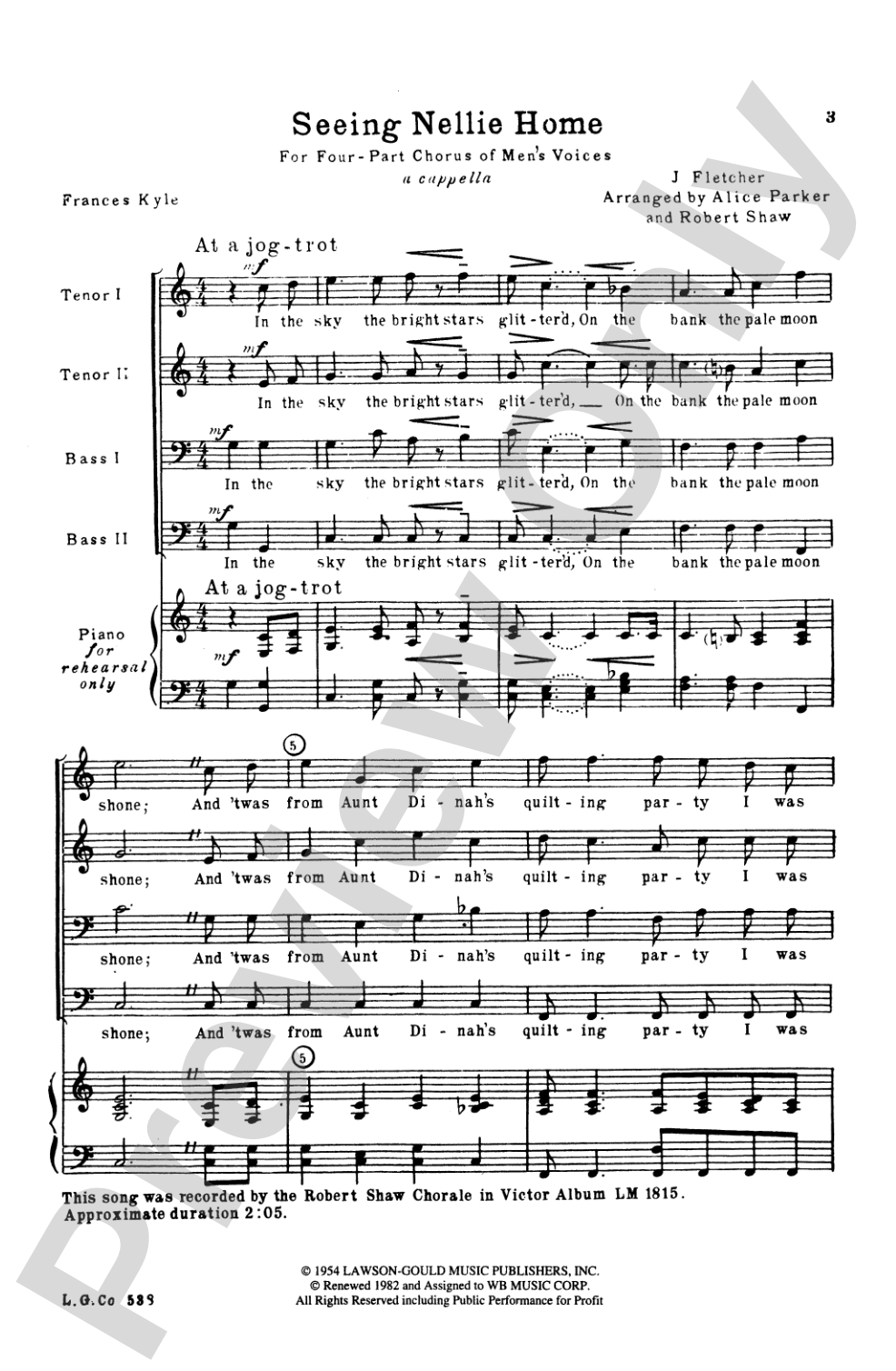
Seeing Nellie Home Sheet Music Preview

Seeing Nellie Home: TTBB Choral Octavo

By J. Fletcher / arr. Alice Parker and Robert Shaw

Item: 00-PO-0004925

Digital Download
$2.95

Minimum order quantity: 20 copies

Description

Seeing Nellie Home: TTBB Choral Octavo isn't in MakeMusic Cloud just yet...but it could be. Let us know you'd like to see it, and you'll help shape what comes next. In the meantime, start a free trial and dive into thousands of interactive titles your students can play along with today.

Sample Audio
No sample audio found.
Sample Video
Additional Details
Series: Alfred Archive Edition: Lawson-Gould Music Publishers
Publisher: Alfred Music
Page Count: 16
SKU: 00-PO-0004925

More about this title

Why we love this

Alice Parker and Robert Shaw's arrangement transforms this classic into a gem for men's voices, capturing the tenderness of the original while giving the harmonies room to breathe across all four parts. The voicing sits naturally for TTBB choirs and offers enough textural variety to keep singers engaged without demanding an advanced technical skill set.

What to expect

Warm, nostalgic, and deeply American. The tune carries you along like a gentle river, supported by harmonies that feel both classic and approachable. There's genuine affection in the arrangement, a sense of singers coming together around something worth remembering.

Who it's for

TTBB choirs ranging from high school men's groups to college and community ensembles. This octavo works equally well for choirs building confidence in the barbershop idiom and those seeking accessible Americana repertoire that doesn't demand solo soloists.

How to get the most out of it

  • Balance the melody between tenors and basses so the tune stays audible even when all four parts move independently; younger singers often need a reminder to listen across the ensemble rather than only their own line.
  • Shape each phrase with slight rubato to honor the song's narrative quality; these Americana melodies benefit from breath-like phrasing rather than metronomic precision.
  • Experiment with dynamics to highlight harmonic shifts; the arrangement rewards subtle terracing that doesn't require a complete restart from pianissimo.

How to use it

Pair this with other traditional Americana selections for a concert built around American vocal heritage, or tuck it into a lighter second half to showcase your men's voices in a narrative-driven piece. It also makes a natural encore when audiences crave something singable and heartfelt.

Skills your students will build

  • Reading four-part TTBB voicing and maintaining independent lines
  • Balancing melody and harmony across distributed voice parts
  • Phrasing and shaping in the barbershop and Americana traditions
  • Blending tenors across two parts and achieving unified bass sonority

You May Also Like