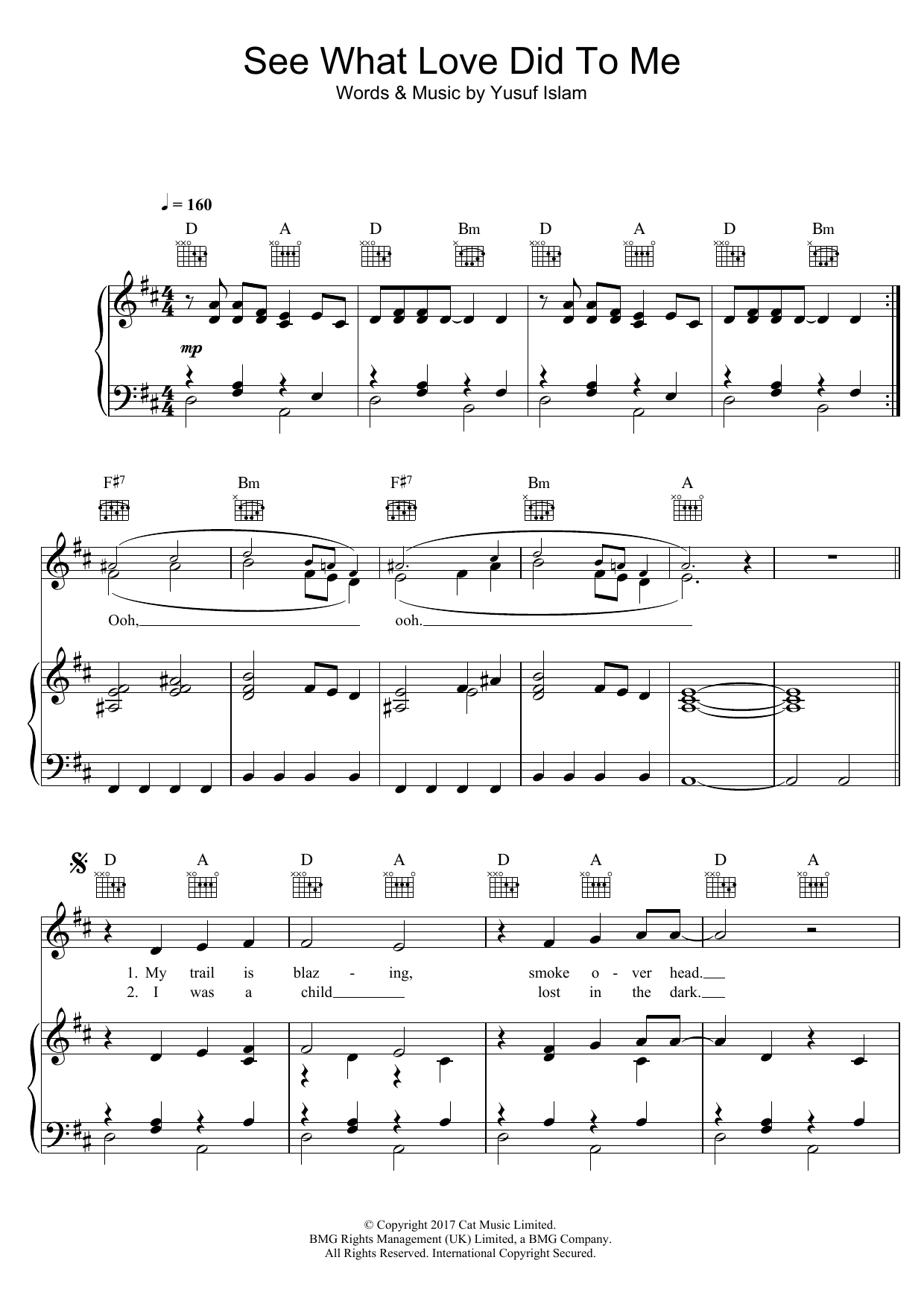
See What Love Did To Me Sheet Music Preview

See What Love Did To Me: Piano/Vocal/Guitar (Piano Accompaniment)

As performed by Yusuf Islam

Item: 35-DS00396027

Digital Download
$5.99

One moment…

One moment…

Description

See What Love Did To Me: Piano/Vocal/Guitar (Piano Accompaniment) isn't in MakeMusic Cloud just yet...but it could be. Let us know you'd like to see it, and you'll help shape what comes next. In the meantime, start a free trial and dive into thousands of interactive titles your students can play along with today.

Sample Audio
No sample audio found.
Sample Video
Additional Details
Publisher: Hal Leonard
Page Count: 7
SKU: 35-DS00396027

More about this title

About the Artist: Yusuf Islam

Yusuf Islam, formerly known as Cat Stevens, is a singer-songwriter whose catalog spans folk, pop, and standards from the 1960s and 1970s. His melodic gift and introspective lyricism established him as a significant voice in popular music before he stepped away from recording in the late 1970s. His compositions remain part of the standard repertoire, valued by musicians for their emotional directness and accessible yet sophisticated harmonic language.

In educational settings, his work provides students with examples of strong melodic writing and lyrical storytelling. The accessible vocal lines and guitar-friendly harmonies make his songs ideal for developing singers and instrumentalists working in contemporary folk and popular idioms.

Why we love this

This arrangement captures a deeply personal lyric with musical restraint. The piano accompaniment respects the vocal line without overwhelming it, creating space for singers to connect with the emotional content of the text. For programs looking to program meaningful ballads or contemporary folk standards, this offers substance without requiring virtuosic vocal chops.

What to expect

Quiet and confessional. The music creates an intimate conversational space where the singer's voice becomes the primary instrument, with piano and guitar providing gentle harmonic context rather than dramatic gesture. There's a wistfulness here that rewards stillness.

Who it's for

Singers developing interpretive skills with ballads and introspective material will benefit from this piece's emotional demands. It works well for students exploring folk and contemporary standards, particularly those building jazz or cabaret repertoire.

How to get the most out of it

  • Allow the text to shape your phrasing. The melody should follow the natural speech patterns of the lyrics rather than mechanical rhythmic divisions.
  • In the piano part, keep left hand accompaniment transparent so the right hand melody can support the vocal line without doubling it unnecessarily.
  • Balance the guitar voicings with the piano to determine which instrument leads the accompaniment in each section. Consider whether one instrument drops out during vulnerable moments in the lyric.

How to use it

Position this in a concert alongside other contemporary folk standards or in a set focusing on singer-songwriter material. It pairs naturally with acoustic guitar-based programming and offers an effective contrast to more energetic or theatrical selections.

Skills your students will build

  • Phrasing based on lyrical content rather than metrical regularity
  • Balance and blend with multiple accompaniment instruments
  • Intimate vocal communication and dynamic restraint
  • Interpreting piano voicings to understand harmonic support

You May Also Like