

See the Baby: SATB a cappella Choral Octavo
Words and music by Jay Althouse
Item: 00-PO-0003265
$1.90
Minimum order quantity: 20 copies
Pickup currently not available
Related Items
See the Baby: SATB a cappella Choral Octavo |
$1.90
|
View |
Description
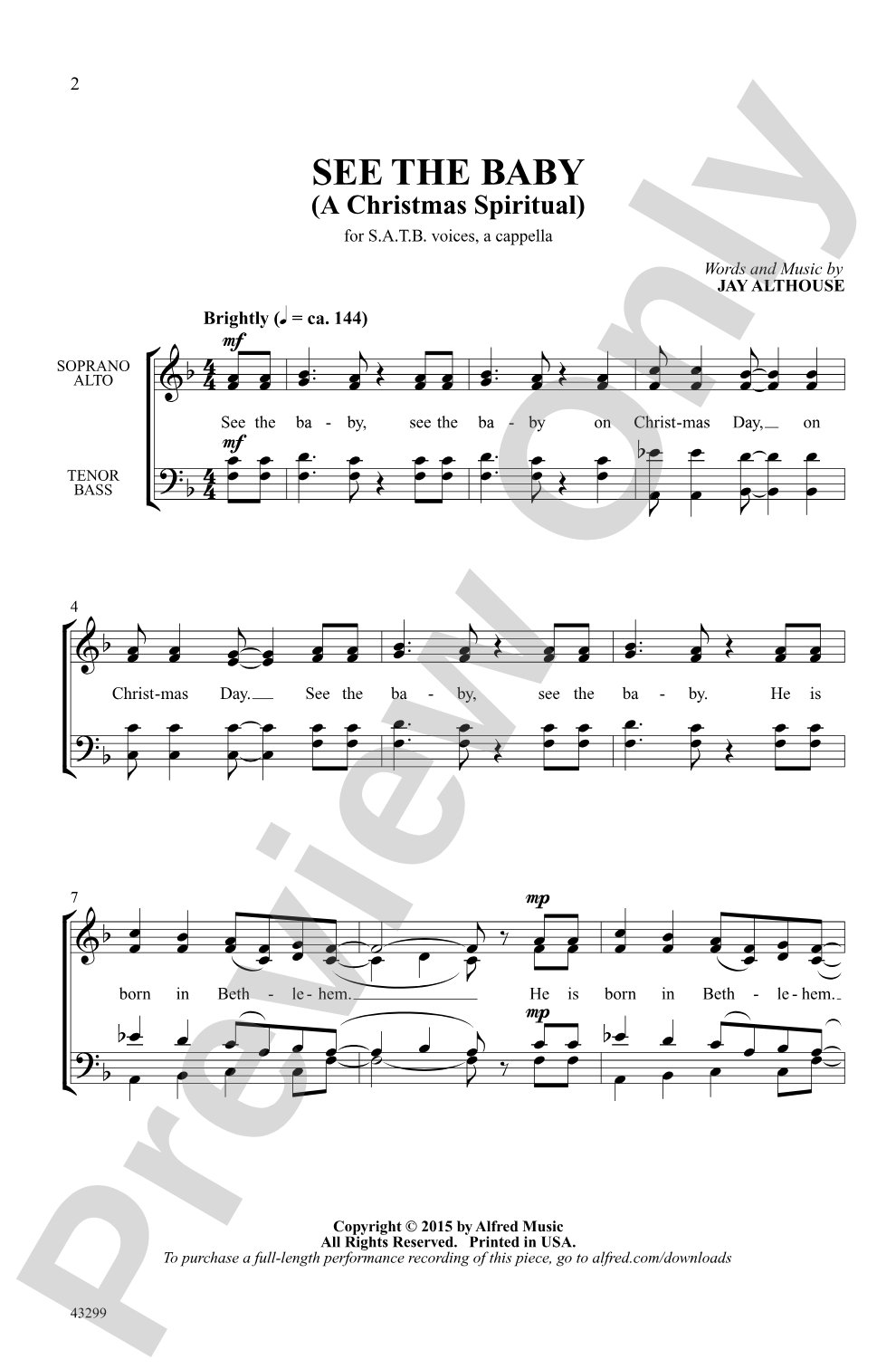
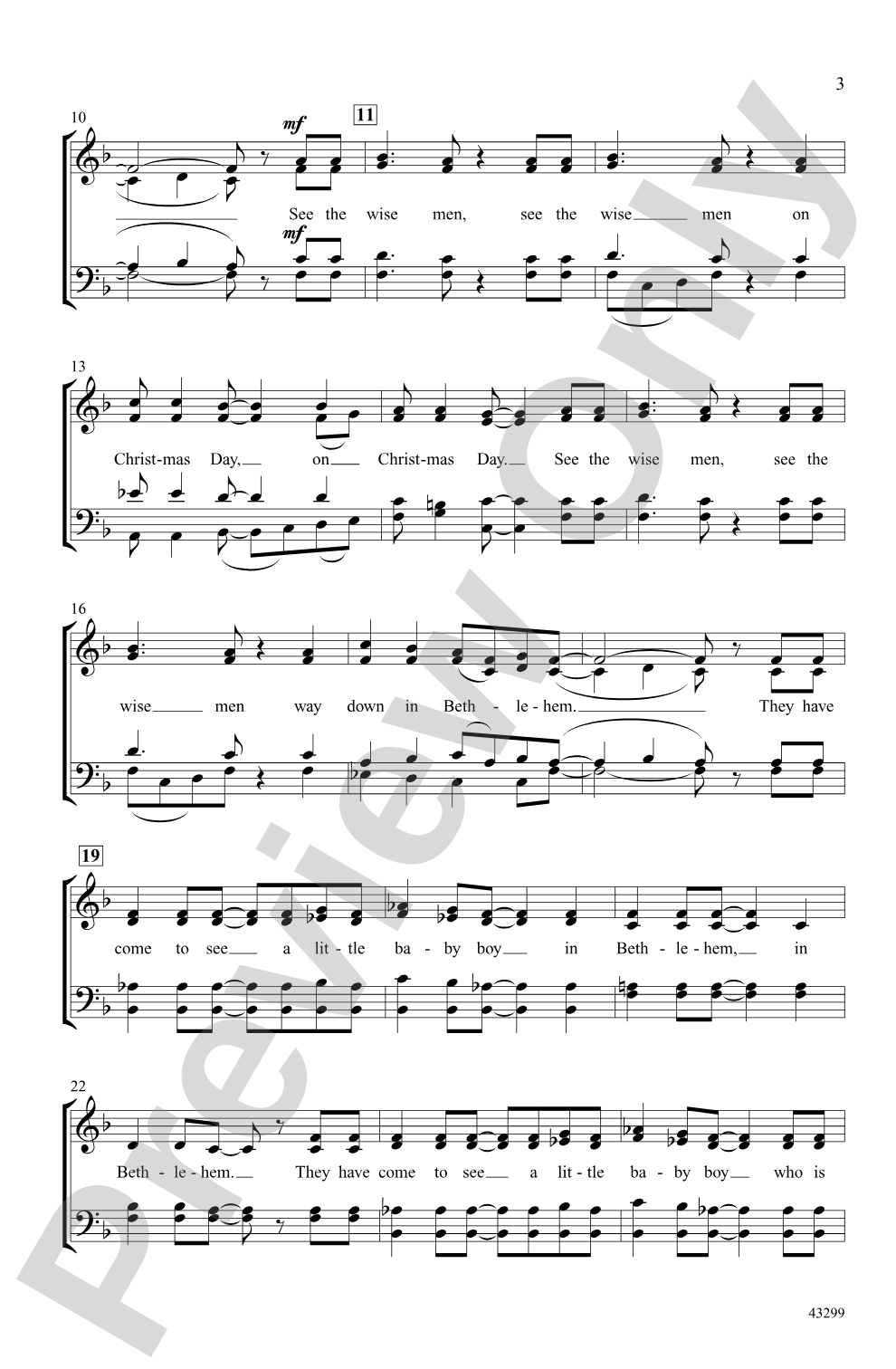
Here's an exuberant a cappella feature, equally appropriate for school and church. Traditional choral writing, a familiar form, a characteristic bass line, and a soprano descant give this original composition its authentic spiritual sound. A contrasting middle section features reflective phrases from well-known "Mary Had a Baby."


See the Baby: SATB a cappella Choral Octavo isn't in MakeMusic Cloud just yet...but it could be. Let us know you'd like to see it, and you'll help shape what comes next. In the meantime, start a free trial and dive into thousands of interactive titles your students can play along with today.
Request This Title
Tell us you want it.
Start Your Free Trial
Explore everything that's ready to play right now.
Sample Audio
1
Audio File
--:--
0:00
0:00
Sample Video
No sample videos found.
Additional Details
Series:
Alfred Choral Designs
Publisher:
Alfred Music
Page Count:
8
SKU:
00-PO-0003265
More about this title
About the Composer: Jay Althouse

Jay Althouse studied music education and music at Indiana University of Pennsylvania, where he later received the Distinguished Alumni award. His career spans both publishing and composition; he spent eight years managing rights and licenses for a major educational music publisher and served on the Executive Board of the Music Publishers Association of America.
As a composer, Althouse has over 800 choral works in print and a significant following among school and church choirs worldwide. He holds membership in ASCAP and is a frequent recipient of the ASCAP Special Award. Beyond composition, he has co-written children's musicals with Sally K. Albrecht, compiled respected vocal solo collections, and authored several educational resources including The Complete Choral Warm-up Book, Accent on Composers, and reproducible classroom materials. His choral work I Hear America Singing, co-written with Albrecht, was performed by the San Francisco Girls and Boys Choirs at President Barack Obama's inauguration in 2009.
Why we love this
Althouse balances authenticity with accessibility here. The a cappella writing sits comfortably for mixed voices while the soprano descant and characteristic bass line signal genuine spiritual roots rather than generic contemporary choral writing. The addition of "Mary Had a Baby" phrases in the contrasting section gives directors a recognizable anchor that audiences connect with immediately.
What to expect
Spirited and grounded. The exuberant character feels celebratory without losing the contemplative weight that comes from genuine spiritual tradition. When the familiar phrases from "Mary Had a Baby" emerge in the middle section, the piece shifts into something more intimate before building back to that initial joyful energy.
Who it's for
School and church choirs with solid blend and intonation skills. The a cappella texture demands singers who can sustain pitch without instrumental support and hear their own voice within the chord; this works well for high school choirs, college ensembles, and experienced church choir sections.
How to get the most out of it
- Shape the bass line with clear rhythmic intent; its characteristic motion anchors the spiritual idiom and prevents the a cappella texture from feeling static.
- Balance the soprano descant so it sits above the choir without dominating; this requires disciplined restraint from your sopranos and solid support from the three lower voices.
- Use the shift to the reflective middle section as a genuine breath moment. Let the tempo settle slightly and allow the familiar "Mary Had a Baby" phrases to land with recognition.
- Lock the unison passages with precise vowel shaping. In a cappella writing, tonal blend matters as much as intonation.
How to use it
This fills a Christmas programming slot that feels substantial without requiring instrumental support. Pair it with longer seasonal works to create a mixed-mood holiday set, or use it as a closing piece that sends the audience out with energy. The compact eight-page format makes it manageable within a concert that includes other major repertoire.
Skills your students will build
- Sustaining pitch in a cappella texture without instrumental reinforcement
- Balancing soprano descant lines against SATB harmonic foundation
- Reading and executing characteristic bass line patterns in spiritual idiom
- Blending vowels across four-part homophonic sections
- Performing with stylistic authenticity in sacred choral traditions