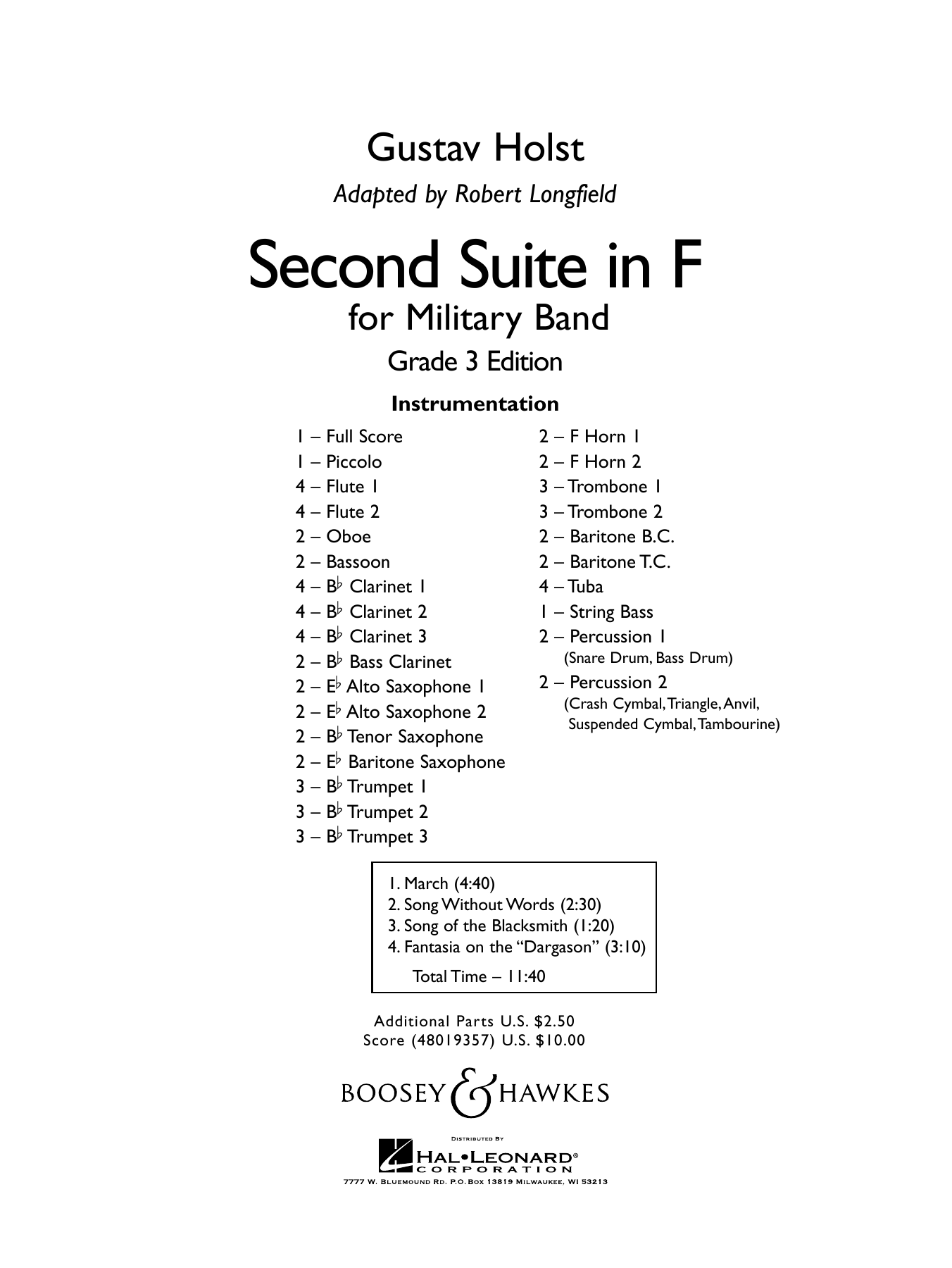
Second Suite in F (arr. Robert Longfield): Concert Band Conductor Score & Parts
By Gustav Holst / Arranged by Robert Longfield
Grade: 3.5
Item: 35-PK01204937
Digital Download
$95.00
One moment…
Description
Along with his "First Suite in E-flat", Holst's "Second Suite" is among the most treasured landmark works for band. In this adaptation, Robert Longfield has adjusted the extreme ranges, used the instrumentation of the contemporary young concert band, and added liberal cues (particularly for oboe, bassoon, and horn). However, the integrity of the original (form, keys, harmony, etc.) is completely intact. An absolute must for young bands.
Discover MakeMusic Cloud: thousands of interactive titles your students can play along with today.
Gustav Holst (1874–1934) was an English composer whose prolific output shaped the modern band repertoire. Though celebrated for his orchestral works (particularly The Planets), Holst devoted serious compositional attention to the concert band, understanding its potential as an ensemble of genuine artistic merit. His two suites for band remain cornerstones of the form, combining accessible structures with harmonic sophistication that rewards close study.
Why we love this
Longfield's arrangement respects Holst's voice completely while making the work genuinely playable for developing musicians. The added cues for weak sections (especially the double reeds and horns) reduce the pressure on principal players without padding the score, and the adjusted ranges keep young players engaged rather than frustrated. This is mature literature that doesn't condescend.
What to expect
The suite evokes a stately, English pastoral quality without becoming maudlin. Sections shift between chorale-like solemnity and forward-moving dance rhythms, with enough harmonic color to keep ears engaged. The orchestration feels transparent; you hear individual lines rather than clumps of sound.
Who it's for
Grade 3.5 bands with solid fundamentals and the focus to handle multi-movement form. This works best for ensembles where at least half the band reads fluently; struggling readers will find themselves chasing parts rather than making music. Directors programming toward festival or concert settings will find this an intelligent step up from overture-level repertoire.
How to get the most out of it
Balance the harmonic motion against articulation clarity; Holst's progressions need space to breathe, so avoid rushing into attacks
Mark all the cue entrances in your parts during sectional rehearsals so players see the safety net and then gradually wean off it
Shape the melodic lines as if they were orchestral soloists; the band writing benefits enormously from legit phrasing rather than uniform block voicing
Give the brass section a dedicated rehearsal on the sustained passages, which will likely reveal tuning issues that aren't obvious in full band sound
How to use it
Place this on a concert that includes lighter fare so the emotional weight lands properly. It also pairs well with a modern work of similar duration, letting audiences hear how twentieth-century composers built on Holst's harmonic language. This is the kind of piece that justifies a full half of a concert without feeling heavy.
Skills your students will build
Sustaining long harmonic progressions without wavering intonation
Reading idiomatic writing for band rather than orchestral transcriptions
Identifying and executing phrase structure across multiple movements
Balancing ensemble blend when interior lines carry melodic weight
Responding to cues and conductor shape in through-composed sections
You May Also Like
Scan to Complete Your Purchase
Use your phone's camera to scan the code below
You'll log in on your phone and the order will be added to your account