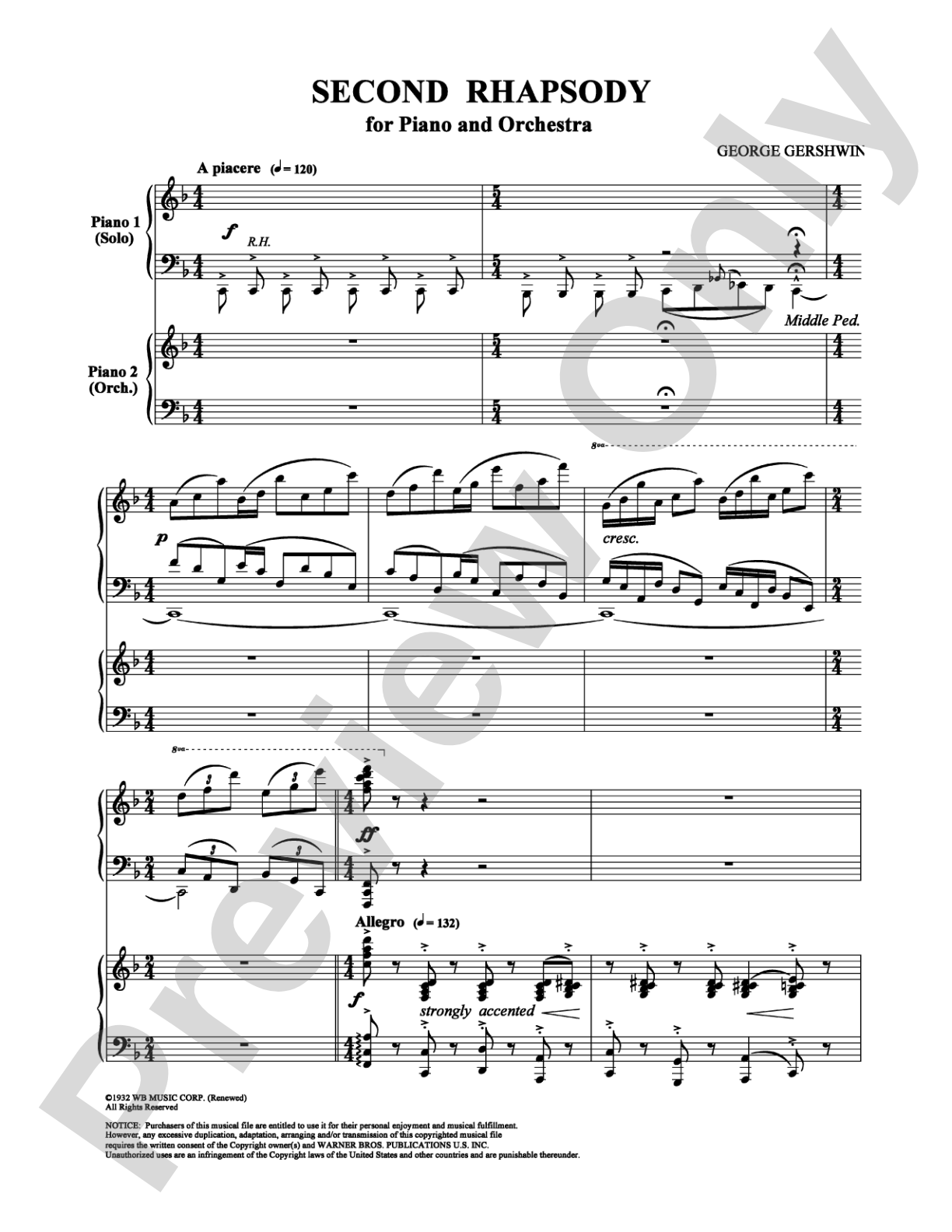
Second Rhapsody: Piano Duets & Four Hands Digital Sheet Music

Second Rhapsody: Piano Duets & Four Hands Digital Sheet Music

George Gershwin

Item: 00-PS-0002147

Digital Download
$3.99
Description

Second Rhapsody: Piano Duets & Four Hands Digital Sheet Music isn't in MakeMusic Cloud just yet...but it could be. Let us know you'd like to see it, and you'll help shape what comes next. In the meantime, start a free trial and dive into thousands of interactive titles your students can play along with today.

Sample Audio
No sample audio found.
Sample Video
Additional Details
SKU: 00-PS-0002147

More about this title

Why we love this

Piano duets create rare opportunities for collaborative performance and ensemble listening skills that solo repertoire cannot provide. Second Rhapsody offers musically substantial material for four hands at one keyboard, giving both players equally engaging parts rather than relegating one to accompaniment.

What to expect

Second Rhapsody captures the lyrical, improvisatory spirit of rhapsodic writing, building from intimate dialogue between the two hands toward moments of shared virtuosity and expressive interplay.

Who it's for

Piano teachers and their intermediate to advanced students who want to explore ensemble playing without requiring a second instrument in the room, as well as adult pianists seeking meaningful collaborative music at the same keyboard.

How to get the most out of it

  • Establish a consistent tempo before you begin; the performer on the primo part (typically the higher voice) should feel authorized to shape phrases, but both players must move through the form together.
  • Balance the acoustic blend by having the secondo (lower) player focus on rhythmic clarity and grounding while the primo part carries melody; avoid pedal competition by negotiating when each player will use the sustain pedal.
  • Rehearse transitions and hand-crossing passages slowly until both players know exactly where the other's hands will be, preventing collisions and building confidence.
  • Record yourselves early and listen back as a pair; duet players often cannot hear their own blend or balance from the bench the way an audience will.

How to use it

Feature this as a duet performance in a studio recital or student showcase, where two pianists can share a single instrument and the piece becomes a conversation the audience witnesses. It also works effectively as a rehearsal and listening experience within a piano class or group lesson setting, even if public performance isn't the goal.

Skills your students will build

  • Ensemble listening and rhythmic coordination at the keyboard
  • Balance and voice independence between primo and secondo parts
  • Collaborative interpretation and musical conversation
  • Managing hand placement and avoiding physical collisions in close proximity
  • Reading and executing rhapsodic phrasing across two interdependent performers

You May Also Like