Second Line (Joe Avery Blues): 3rd B-flat Trumpet Sheet Music Preview

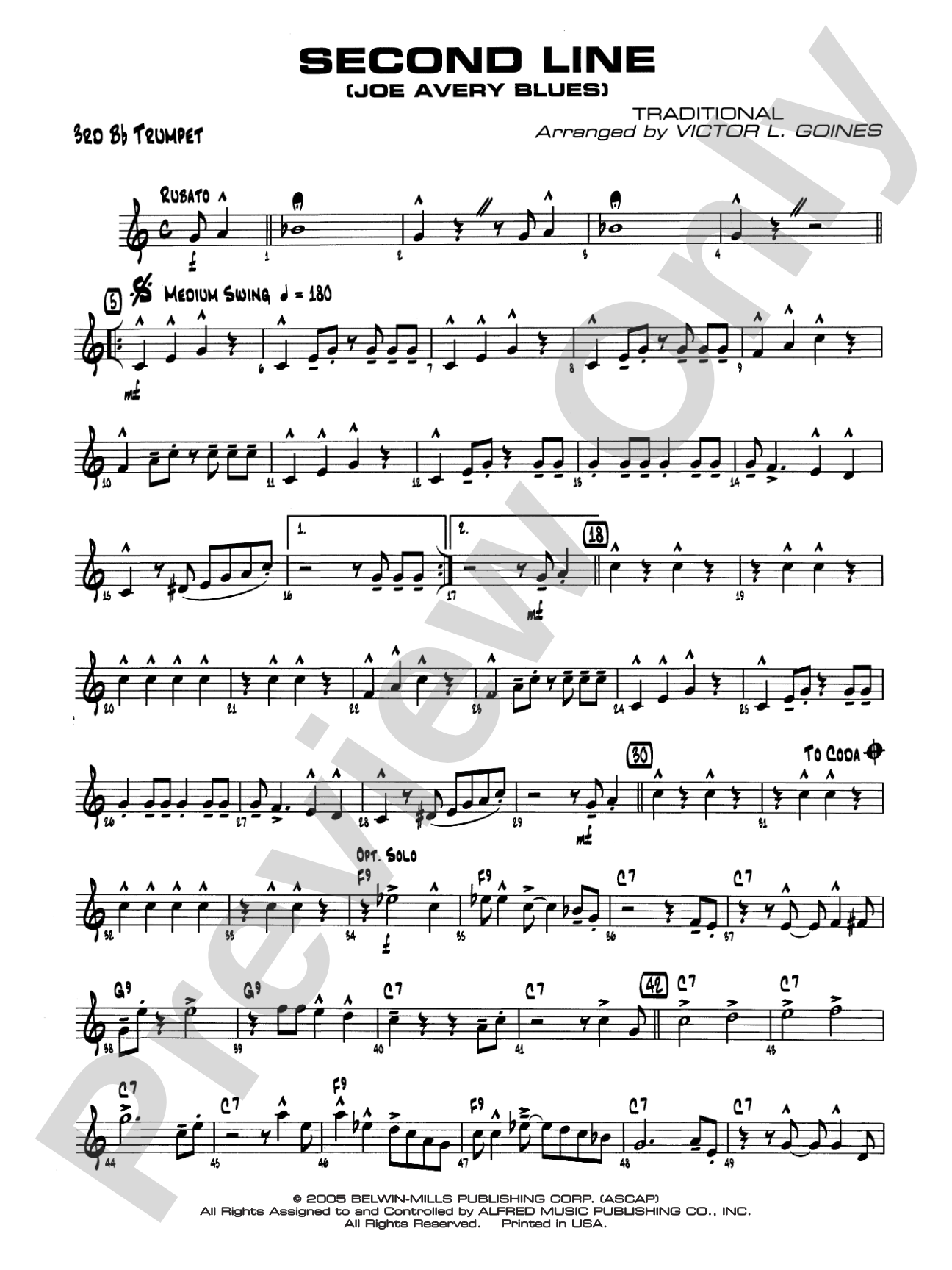
Second Line (Joe Avery Blues): 3rd B-flat Trumpet

Arr. Victor Goines

Grade: 3 (Medium)

Item: 00-PC-0014738_T3

Digital Download
$3.00
Description
For the new Jazz For Young People Series, well-known educator and jazz artist Victor Goines arranged "Second Line" as a medium bright swing. Sometimes called "The Joe Avery Blues," this tune dates back to the early New Orleans style and was recorded by the Preservation Hall Jazz Band. For flexibility, solos are provided for the entire trumpet, saxophone, and trombone sections and can be performed as a section or individually. Includes all the usual optional parts. Correlated to the Jazz at Lincoln Center Jazz for Young People Curriculum. (4:02) This title is available in MakeMusic Cloud.

Don't just read it, hear it, play along with it, and watch your students grow with it. In MakeMusic Cloud, Second Line (Joe Avery Blues): 3rd B-flat Trumpet comes alive with professional accompaniment, adjustable tempo, and built-in practice tools that turn solo practice into real progress.

Sample Audio
0:00
0:00
Sample Video
Additional Details
Series: Jazz for Young People Series
Publisher: Alfred Music
Page Count: 94
SKU: 00-PC-0014738_T3

More about this title

About the Arranger: Victor Goines

Victor Goines is a clarinetist, saxophonist, and composer whose career spans performance, education, and artistic leadership. As Director of Jazz at Lincoln Center, he has shaped the curriculum and vision that guides jazz education across the country, bringing decades of professional performance experience and a deep commitment to teaching the next generation of jazz musicians.

Why we love this

Goines respects the source material while making it genuinely playable for young ensembles. The section solo flexibility means you can tailor the piece to your trumpet, saxophone, and trombone sections' abilities in real time, whether your soloists need the security of playing together or are ready to step out individually. The arrangement swings hard without losing clarity, giving students something authentic to sink their teeth into.

What to expect

Second Line captures the joy and motion of New Orleans parade tradition: bright, swinging, and full of personality. The writing bounces with life while staying accessible, letting young players feel the groove and character of authentic jazz without overcomplicating the harmony or rhythm.

Who it's for

This arrangement serves Grade 3 ensembles (around middle school level and up) who are ready to tackle jazz idiom and want material grounded in real New Orleans tradition. It works equally well for school jazz bands and youth jazz programs seeking repertoire with both educational rigor and genuine stylistic roots.

How to get the most out of it

  • Balance the written section soli carefully; the trombone line often carries harmonic weight, so ensure it isn't buried under the saxophones' rhythmic drive.
  • Lock the rhythm section on the basic swing feel before layering in the horn sections. The groove has to feel relaxed and propulsive, not mechanical.
  • If soloists are new to trading, rehearse the exact handoff points with the rhythm section so the momentum doesn't drop between statements.
  • Use the optional parts strategically. Adding or removing voices lets you control density and highlight different sections as the tune builds.

How to use it

Program this on a jazz concert to anchor a set of New Orleans-rooted pieces, or pair it with spirituals and blues standards to build a thematic program around American jazz history. It's substantial enough to anchor a middle school jazz festival entry and short enough (4:02) to fit easily into a varied concert program. The correlated Jazz at Lincoln Center curriculum makes it a natural fit if you're already using that framework in your band class.

Skills your students will build

  • Reading and performing medium-swing jazz feel and comping rhythms
  • Soloing within a 12-bar blues form with chord changes
  • Section ensemble balance when multiple horn voices move together
  • Trading solos and managing phrase handoffs with the rhythm section
  • Understanding New Orleans jazz history and stylistic conventions through performance

You May Also Like