
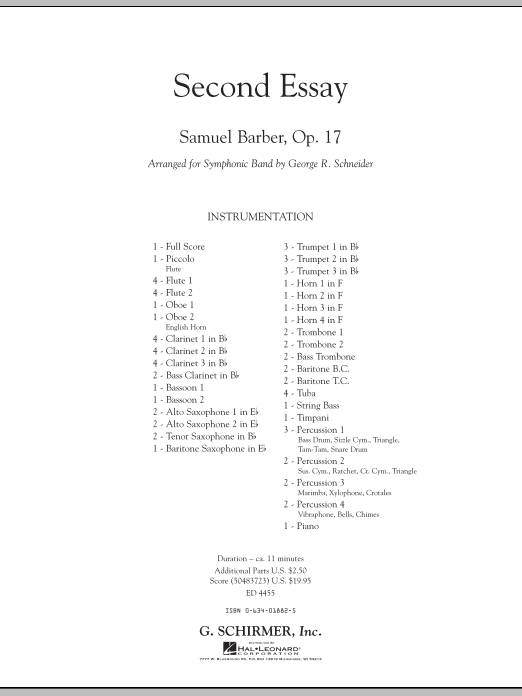

Second Essay: Concert Band Conductor Score & Parts
By Samuel Barber
Grade: 5
Item: 35-PK00157364
$95.00
Pickup currently not available
Buy Extra Parts (Digital PDF Download)
Parts Added to Cart!
Description
Composed in 1942, Barber's "Second Essay" is a masterwork of concentrated musical drama, with a richness of texture comprised of highly charged and succinctly organized musical modules. The opening theme has a definite American flavor, which is followed by a fugal section that evolves from simple tonal patterns to polytonality. After an intensely rhythmic third section, all elements are combined in a huge climax and coda that round off the work. Expertly transcribed for symphonic band by Dr. George Schneider, this is certain to find its place in the standard repertoire for mature ensembles. Dur: 11:00 (Grade 5)


Second Essay: Concert Band Conductor Score & Parts isn't in MakeMusic Cloud just yet...but it could be. Let us know you'd like to see it, and you'll help shape what comes next. In the meantime, start a free trial and dive into thousands of interactive titles your students can play along with today.
Request This Title
Tell us you want it.
Start Your Free Trial
Explore everything that's ready to play right now.
Sample Audio
No sample audio found.
Sample Video
No sample videos found.
Additional Details
Publisher:
Hal Leonard
SKU:
35-PK00157364
More about this title
About the Composer: Samuel Barber
Samuel Barber (1910-1981) stands as one of America's most lyrical composers, known for his gift for soaring melody and emotional directness. His orchestral works, particularly the Adagio for Strings, have become touchstones of American concert music, and his essays for band represent some of the finest contributions to the wind band repertoire in the twentieth century.
Why we love this
Barber's structural mastery shines here: the transcription captures the sweep of his original orchestral essay while the band arrangement reveals fresh colors in each section. This is repertoire that respects your ensemble's maturity without asking for virtuosity at the expense of musicality, making it deeply satisfying to conduct and perform.
What to expect
Urgent and purposeful, with an opening melody that carries hints of folk Americana before the music shifts into denser, more complex harmonic terrain. The piece pulses with forward momentum while never sacrificing the lyric quality that defines Barber's voice.
Who it's for
Advanced high school and college bands ready to engage with twentieth century American concert music. This work demands secure intonation, stylistic maturity, and the ability to balance transparency with dramatic power across a substantial ensemble.
How to get the most out of it
- Shape the opening theme with intentional rubato; Barber's American melody requires breathing room and sensitivity to phrase contours, not mechanical precision.
- Balance the fugal section carefully so that each voice remains audible as it enters, especially when polytonality intensifies. Clarity here rewards careful rehearsal.
- Drive the third section's rhythmic energy without letting it become percussive; the intensity should feel inevitable rather than imposed.
- Build the climax by graduating dynamics across the final statements, allowing each restatement to rise above the last without suddenly jumping to fortissimo.
How to use it
Perfect as the centerpiece of a concert exploring American mid-century orchestral writing, or as a bold concluding work on a program that values substance over length. At eleven minutes, it carries enough weight to anchor a second half on its own.
Skills your students will build
- Sustaining long phrases across multiple phrases without losing shape
- Reading and balancing polyphonic texture in fugal writing
- Navigating harmonic shift from tonality to polytonality
- Executing sudden textural and rhythmic changes with ensemble precision
- Building and controlling dynamics across an extended climactic section