
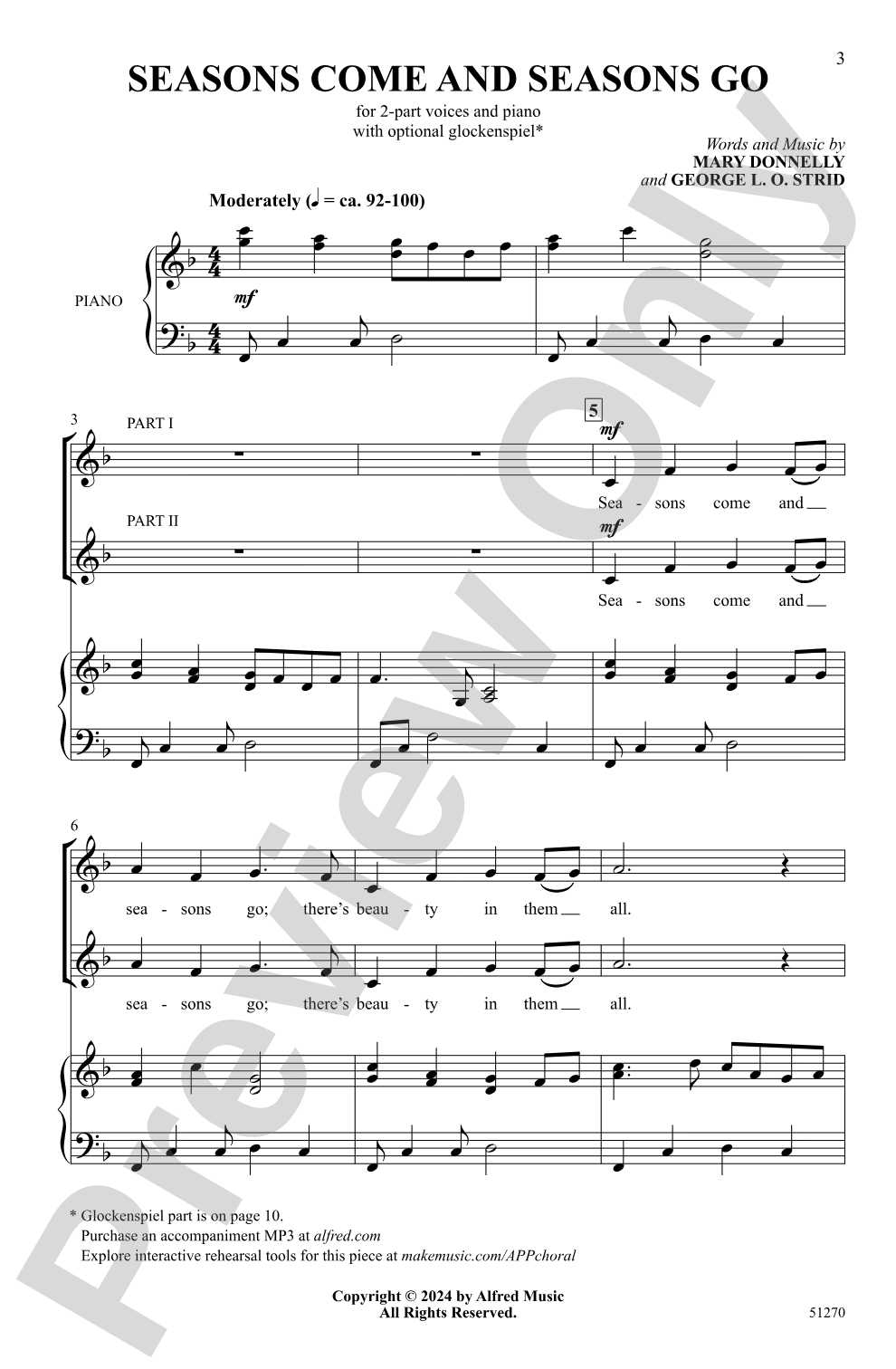
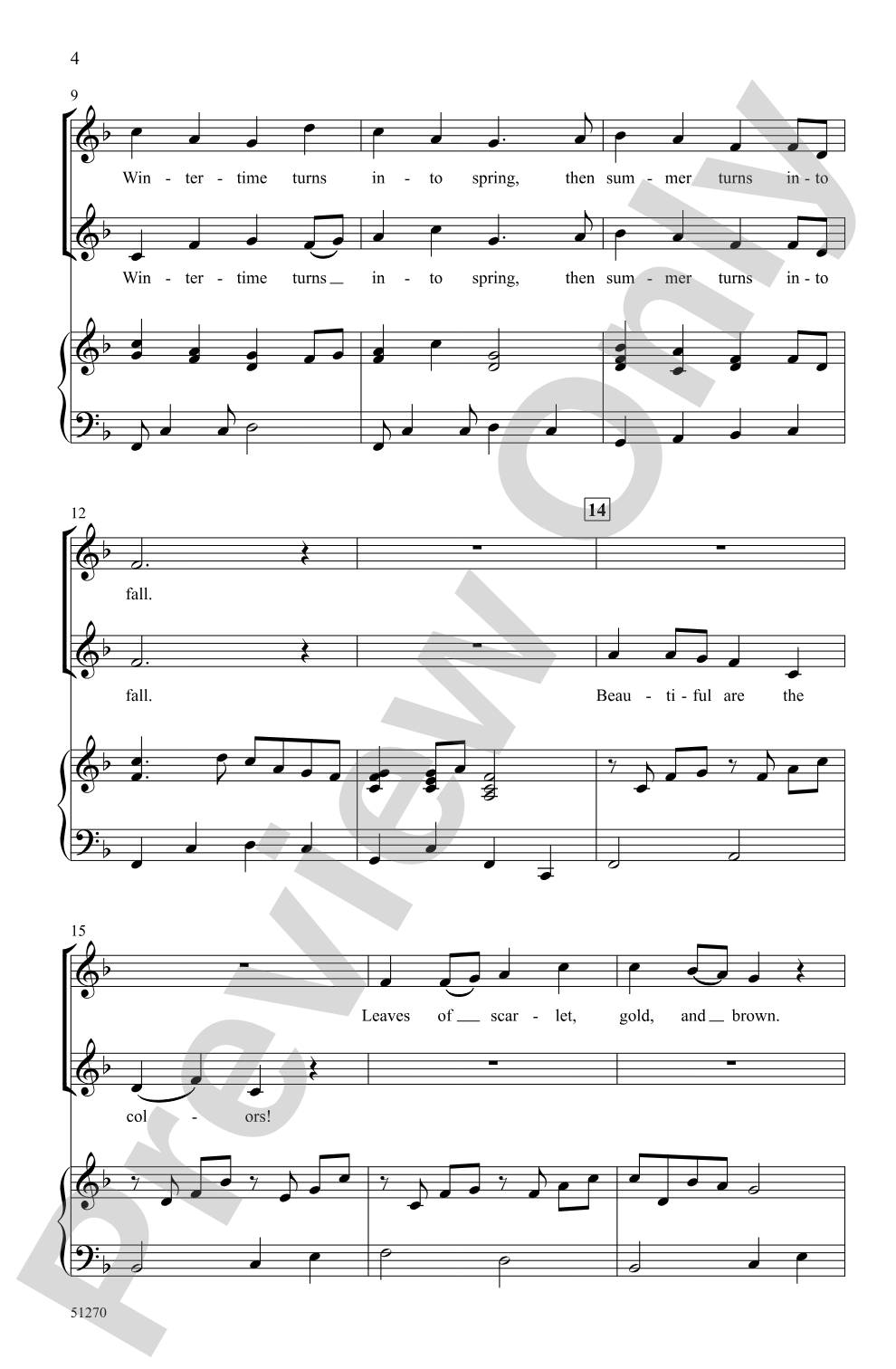

Seasons Come and Seasons Go: 2-Part Choral Octavo
Words and music by Mary Donnelly and George L. O. Strid
Item: 00-PO-0007303
$2.30
Minimum order quantity: 20 copies
Pickup currently not available
Related Items
Seasons Come and Seasons Go: PartTrax Digital Audio Download |
$49.99
|
View |
Description
This mostly pentatonic song finds beauty in the onset of autumn. Approachable 2-part writing from a reliable composing team. The optional glockenspiel adds more color to falling leaves.
The PerformancePlus+ series is an innovative addition to the ever-expanding MakeMusic Cloud interactive library. These engaging selections are presented with educational resources designed to enrich the rehearsal process and create outstanding performances. Including:


The PerformancePlus+ series is an innovative addition to the ever-expanding MakeMusic Cloud interactive library. These engaging selections are presented with educational resources designed to enrich the rehearsal process and create outstanding performances. Including:
- Assignment, recording, and assessment tools within MakeMusic Cloud
- Part-predominant and accompaniment tracks
- Printable sheet music (with a standard MakeMusic Cloud subscription)
- Correlated rehearsal guides and performance notes
- Rights to perform in a live or virtual setting
Seasons Come and Seasons Go: 2-Part Choral Octavo isn't in MakeMusic Cloud just yet...but it could be. Let us know you'd like to see it, and you'll help shape what comes next. In the meantime, start a free trial and dive into thousands of interactive titles your students can play along with today.
Request This Title
Tell us you want it.
Start Your Free Trial
Explore everything that's ready to play right now.
Sample Audio
1
Audio File
--:--
0:00
0:00
Sample Video
Additional Details
Series:
Alfred Choral - PerformancePlus+
Page Count:
12
SKU:
00-PO-0007303
More about this title
About the Composer: Mary Donnelly

Mary Donnelly's thirty-year career in the Reno area schools gave her a front-row seat to what actually works in elementary and middle school choirs. She holds degrees from the University of Nevada, Reno (English and French) and Lesley College (Education), and she brought arts integration into everything she taught. Her retirement hasn't slowed her down; she remains active in ACDA, NEA, and ASCAP.
In 1985, Donnelly partnered with George Strid during a sixth-grade general music class when their principal asked them to write a musical for Reading Week. That first project, The Million Dollar Mystery, launched a prolific collaboration that has produced over two hundred songs and twenty-five musicals. The two have built their catalog on understanding what students can actually sing and what teachers need to make rehearsals work.
Why we love this
Donnelly and Strid know how to write for young voices without talking down to them. The pentatonic writing here feels contemporary and accessible while the optional glockenspiel part gives you a genuine reason to include an unpitched instrumentalist in the performance, which middle school directors always appreciate. This is the kind of straightforward, singable piece that builds confidence while sounding genuinely musical.
What to expect
Autumnal and contemplative. The pentatonic writing creates a folk-song quality that feels both simple and somehow inevitable, like watching leaves settle. There's no bombast here, just clear-eyed observation of seasonal change.
Who it's for
Middle school choirs working with limited rehearsal time and two-part writing. This sits comfortably for groups that are building toward unison and simple harmony without being bored by the process.
How to get the most out of it
- Let the pentatonic framework guide your interpretation; the limited harmonic palette means every voice part needs clarity and commitment to land the melodic shape.
- If you're using the glockenspiel, have that student practice independently so they aren't dependent on finding their cues in a dense two-part texture.
- The recorded accompaniment is strong; use it sparingly in early rehearsals so students anchor their parts by ear first, then bring it back for performance confidence.
How to use it
Consider this for an early-fall concert program or as a transition piece in a longer seasonal set. Its brevity and warmth make it ideal for opening a performance or as a palate-cleanser between contrasting selections. You could also program it alongside instrumental pieces exploring the same season for a thematic concert experience.
Skills your students will build
- Singing in pentatonic harmony without relying on familiar major/minor tonality
- Maintaining independent melodic lines in two-part texture
- Blending with optional non-pitched percussion to support the ensemble sound
- Shaping a legit melodic phrase across multiple bars