
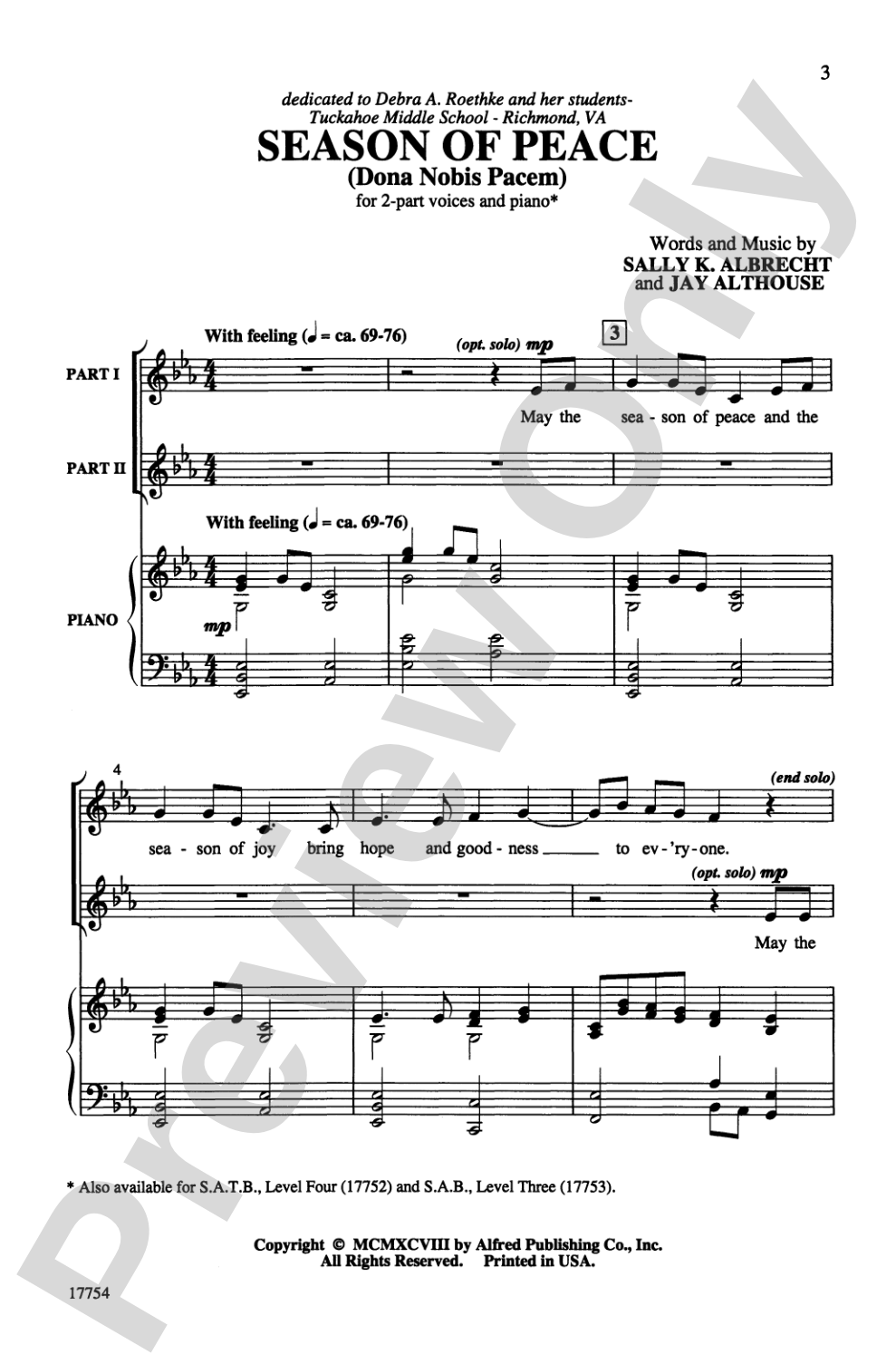

Season of Peace (Dona Nobis Pacem): 2-Part Choral Octavo
Music by Sally K. Albrecht and Jay Althouse
Item: 00-PO-0004014
$2.25
Minimum order quantity: 20 copies
Pickup currently not available
Related Items
Season of Peace (Dona Nobis Pacem): 2-Part Choral Octavo |
$2.25
|
View |
Description
This subtle and lovely choral work is designed to close your December concerts. Simple blessing for the holiday season incorporates the famous "Dona Nobis Pacem" canon.


Season of Peace (Dona Nobis Pacem): 2-Part Choral Octavo isn't in MakeMusic Cloud just yet...but it could be. Let us know you'd like to see it, and you'll help shape what comes next. In the meantime, start a free trial and dive into thousands of interactive titles your students can play along with today.
Request This Title
Tell us you want it.
Start Your Free Trial
Explore everything that's ready to play right now.
Sample Audio
1
Audio File
--:--
0:00
0:00
Sample Video
No sample videos found.
Additional Details
Series:
Alfred Archive Edition: Alfred Choral Designs
Publisher:
Alfred Music
Page Count:
8
SKU:
00-PO-0004014
More about this title
About the Composer: Sally K. Albrecht

Sally K. Albrecht has shaped American choral music for over four decades as a composer, conductor, and voice for accessible, singable literature. A perennial ASCAP award recipient since 1987, she has published more than 600 choral works and numerous musicals, while conducting honor choirs at prestigious venues including Lincoln Center, Carnegie Hall, and The Kennedy Center. Her three decades directing choral and vocal publications at major educational music houses positioned her as a trusted voice in repertoire selection for schools nationwide.
Albrecht earned degrees from Rollins College (B.A. in Music and Theater, 1976) and the University of Miami (M.A. in Drama, 1977; M.M. in Accompanying, 1979). She has taught at Oakland University in Michigan, Jersey City State College in New Jersey, and Meredith College in North Carolina. A native of Cleveland, she currently resides in Wake Forest, North Carolina, with her husband and frequent collaborator, composer and arranger Jay Althouse. In 2021, both Rollins College and the University of Miami Frost School of Music recognized her distinguished contributions with alumni awards.
Why we love this
Albrecht and Althouse craft a genuinely contemplative closer that respects singers' musicality while remaining accessible to developing choirs. The integration of the Dona Nobis Pacem canon feels earned, not forced, and the two-part voicing allows you to program this without worrying about range limitations across your choir. This is the kind of piece that sends audiences home quieter, which in December feels exactly right.
What to expect
Quiet and grounded, this piece settles over the audience like an intentional moment rather than filler. The familiar Dona Nobis Pacem melody surfaces gently within original harmonic writing, creating recognition without predictability. It feels like a blessing given rather than sung.
Who it's for
Any choir closing a December concert, from middle school through community ensembles. The two-part voicing makes it accessible to younger or smaller groups without sacrificing musical substance, while the text and harmonic sophistication appeal to directors seeking something that feels genuine rather than saccharine.
How to get the most out of it
- Let the harmony breathe naturally rather than rushing through phrases. The text asks for restraint, and singers respond well when they feel permission to linger.
- Blend the canon entrance carefully when both parts sing different text simultaneously. Mark a clear prep beat so singers commit to their line without listening sideways.
- Balance tone warmth with clarity of text. The blessing loses power if listeners can't hear the words, particularly during the canon section.
How to use it
Close your December concert with this after stronger, more energetic selections have moved the emotional arc forward. The contemplative quality makes it an ideal final offering, leaving audiences in a reflective rather than celebratory mood. Consider programming it after a brief spoken introduction about the season's meaning to your ensemble.
Skills your students will build
- Blending harmonic parts while maintaining individual line integrity
- Sustaining legit tone across longer phrases without tension
- Balancing text intelligibility with musical expression
- Entering canon parts independently and maintaining alignment