Seascape: Piano Digital Sheet Music

Seascape: Piano Digital Sheet Music

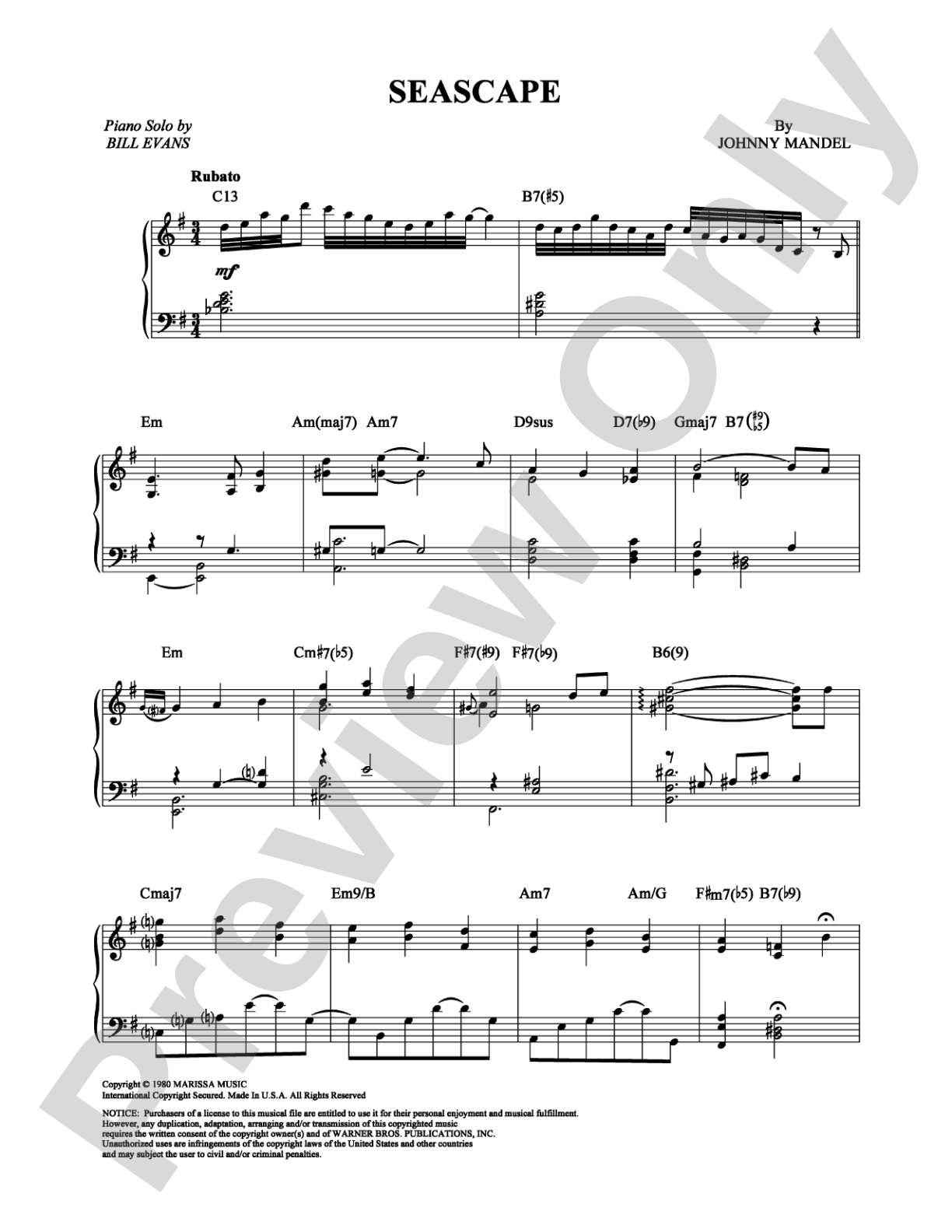
Johnny Mandel, Bill Evans

Item: 00-PS-0001552

Digital Download
$3.99
Description

Seascape: Piano Digital Sheet Music isn't in MakeMusic Cloud just yet...but it could be. Let us know you'd like to see it, and you'll help shape what comes next. In the meantime, start a free trial and dive into thousands of interactive titles your students can play along with today.

Sample Audio
No sample audio found.
Sample Video
Additional Details
SKU: 00-PS-0001552

More about this title

About the Artist: Bill Evans

Bill Evans revolutionized jazz piano through his harmonic sophistication and lyrical touch. His approach to comping, voicing, and solo development influenced generations of jazz pianists and remains central to jazz education. Evans's recordings and compositions reflect a deep engagement with both classical music and bebop, making his work invaluable for students exploring the intellectual and emotional dimensions of jazz.

Why we love this

Evans's compositions sit at the intersection of accessibility and depth, making them ideal for pianists building their jazz language. Seascape rewards careful listening to harmonic movement while remaining playable for advancing students who have solid jazz fundamentals. His writing demonstrates how restraint and clarity can convey mood without relying on excessive technique or speed.

What to expect

A quiet, contemplative journey with gentle motion and shifting colors. The piece evokes a peaceful but thoughtful mood, with harmonic movement that feels both inevitable and surprising. Evans's writing creates intimacy through understatement rather than emotional display.

Who it's for

Intermediate to advanced jazz pianists exploring the standards repertoire and seeking models of economical, harmonically intelligent writing. Students preparing for jazz combos or recitals benefit from Evans's example of how to play with restraint and storytelling. Teachers can use this piece to develop students' understanding of jazz harmony and the relationship between composition and improvisation.

How to get the most out of it

  • Honor the quiet, introspective character by resisting the urge to rush. Let silence and space shape the phrasing as much as the notes themselves.
  • Voice the left-hand comping to support the melodic contour rather than establish a steady groove. Evans favored colors and harmonic conversation over timekeeping.
  • Listen closely to the harmonic rhythm. Evans often sustains tensions across bar lines, so feel where chords resolve rather than playing by metric square.
  • Study recordings of Evans's own interpretation to internalize his touch and pedaling approach. His use of the sustain pedal is compositional, not decorative.

How to use it

Feature this as a solo recital piece that demonstrates musical maturity and jazz sophistication without relying on flashy technique. It pairs well with other introspective jazz standards or as a bridge between classical and jazz repertoire on a mixed program. The piece works beautifully in a jazz history or standards survey context where focus is on composition rather than virtuosity.

Skills your students will build

  • Interpreting jazz harmony and voice leading from a lead sheet or score
  • Developing touch sensitivity and dynamic control in a quiet, sustained context
  • Understanding the relationship between composition and improvisation in jazz standards
  • Building independence between hands when comping and melodic line interact
  • Reading and responding to harmonic rhythm rather than strict metric pulse

You May Also Like