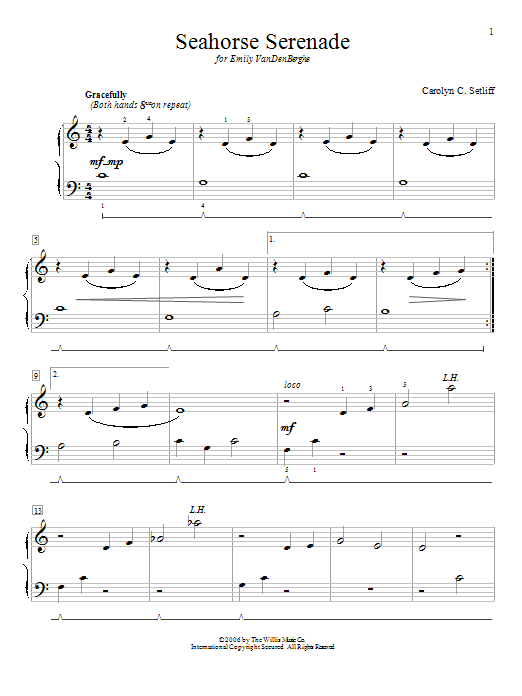
Setliff writes with real understanding of early keyboard technique, balancing accessibility with genuine musicality. The marine imagery gives students an imaginative hook while the writing stays focused on building foundational skills without resorting to gimmicks.
What to expect
Peaceful and slightly wistful, like watching something graceful move through water. The harmonic language unfolds gently, inviting the student to discover how simple shapes and intervals can evoke a complete scene.
Who it's for
Students in their first or second year of piano study who are ready to move beyond purely technical exercises. The piece works for students roughly ages 7 and up who have established basic hand position and can read treble clef with some security.
How to get the most out of it
Shape the melodic line with subtle dynamic shaping rather than rigid adherence to marked dynamics; younger players often benefit from thinking about 'telling a story' rather than following every notation mark.
Keep the tempo steady and unhurried; the serenade character emerges from relaxed, connected phrasing, not speed.
Let any accompanying figures breathe and remain transparent; they should support the melody without overwhelming it.
How to use it
Feature this in a student recital as a confidence builder for intermediate young players, or include it in a spring or end-of-year concert that celebrates the year's progress. It pairs well alongside other descriptive early repertoire and gives students a chance to perform something with genuine character.
Skills your students will build
Legato touch and sustained tone production
Phrasing in a single melodic line
Coordination between melody and accompanying figures
Reading and interpreting dynamic markings expressively
Building musical interpretation beyond note accuracy
You May Also Like
Scan to Complete Your Purchase
Use your phone's camera to scan the code below
You'll log in on your phone and the order will be added to your account