
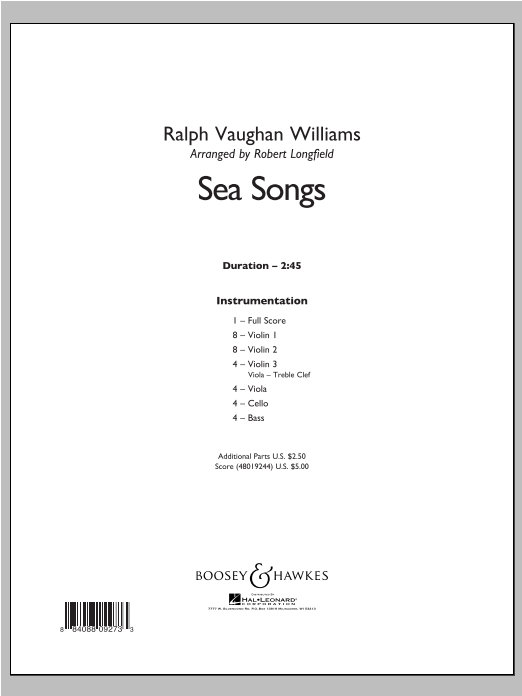

Sea Songs: String Orchestra Conductor Score & Parts
By Vaughan Williams / Arranged by Robert Longfield
Grade: 3-4
Item: 35-PK00251497
$50.00
Pickup currently not available
Buy Extra Parts (Digital PDF Download)
| Product | Price | Quantity |
|---|---|---|
| Sea Songs - Conductor Score (Full Score) | $7.50 | |
| Sea Songs - Violin 1 | $7.00 | |
| Sea Songs - Violin 2 | $7.00 | |
| Sea Songs - Violin 3 (Viola Treble Clef) | $7.00 | |
| Sea Songs - Viola | $7.00 | |
| Sea Songs - Cello | $7.00 | |
| Sea Songs - Bass | $7.00 |
Parts Added to Cart!
Description
Originally, this setting of folk songs was the fourth movement of Vaughan Williams' famous "English Folk Song Suite" for band. Including "Princess Royal," "Admiral Benbow" and "Portsmouth," all the charm and character of the original has been skillfully scored for strings in this outstanding arrangement by Robert Longfield. Dur: 2:45


Sea Songs: String Orchestra Conductor Score & Parts isn't in MakeMusic Cloud just yet...but it could be. Let us know you'd like to see it, and you'll help shape what comes next. In the meantime, start a free trial and dive into thousands of interactive titles your students can play along with today.
Request This Title
Tell us you want it.
Start Your Free Trial
Explore everything that's ready to play right now.
Sample Audio
No sample audio found.
Sample Video
No sample videos found.
Additional Details
Publisher:
Hal Leonard
SKU:
35-PK00251497
More about this title
About the Composer: Vaughan Williams
Ralph Vaughan Williams shaped twentieth-century British music by drawing deeply from folk traditions. His arrangements of English folk songs became cornerstones of music education, balancing accessibility with artistic substance. Beyond his folk-song settings, Vaughan Williams composed symphonies, operas, and film scores that demonstrated how nationalist impulses could serve genuine artistic vision rather than mere nostalgia.
Why we love this
Robert Longfield's string arrangement captures the maritime character of these folk melodies without losing the robustness of the original band scoring. The piece sits at a sweet spot for developing orchestras: accessible enough that Grade 3-4 ensembles can achieve musical results quickly, yet substantial enough that directors can build real interpretive choices around contrasting tunes. Programming three distinct sea songs in a single, coherent package gives you a focused concert moment that audiences recognize as distinctly English without requiring extended rehearsal time.
What to expect
These sea songs evoke the salt and rhythm of maritime life without theatrical excess. Longfield's orchestration finds warmth in divided strings and clarity in the interplay between sections, creating an atmosphere that feels both nostalgic and alive.
Who it's for
String orchestras at the high school or advancing middle school level will find these arrangements within comfortable reach. Directors seeking repertoire that students recognize, that rehearses efficiently, and that delivers genuine musical satisfaction will value this collection.
How to get the most out of it
- Balance the melody between first and second violin lines, especially where Longfield distributes thematic material across both sections. This interplay mirrors the call-and-response character of folk tradition.
- Allow the cello and bass line room to anchor each song's harmonic foundation without rushing the pulse. The folk material benefits from a grounded, almost dance-like rhythmic confidence.
- Shape phrases around the natural breathing points of the melody rather than treating bar lines as rigid. Folk songs ask for language-like phrasing, not metrical correctness.
- Consider the recorded accompaniment not as a blueprint but as one interpretive option. Your ensemble's tempo and flexibility matter more than matching a click track.
How to use it
Open a concert with this suite to establish a British character while building audience goodwill through familiar melodies. Pair it with contrasting modern or American repertoire to highlight Vaughan Williams' unique voice, or program it mid-concert as a palate-cleansing shift in mood and texture.
Skills your students will build
- Balancing divided sections while maintaining phrase coherence
- Responding to folk song phrasing across barlines
- Sustaining tone quality through harmonic changes
- Ensemble rhythmic flexibility within a stable pulse
- Negotiating contrasting articulations between staccato and legato passages