
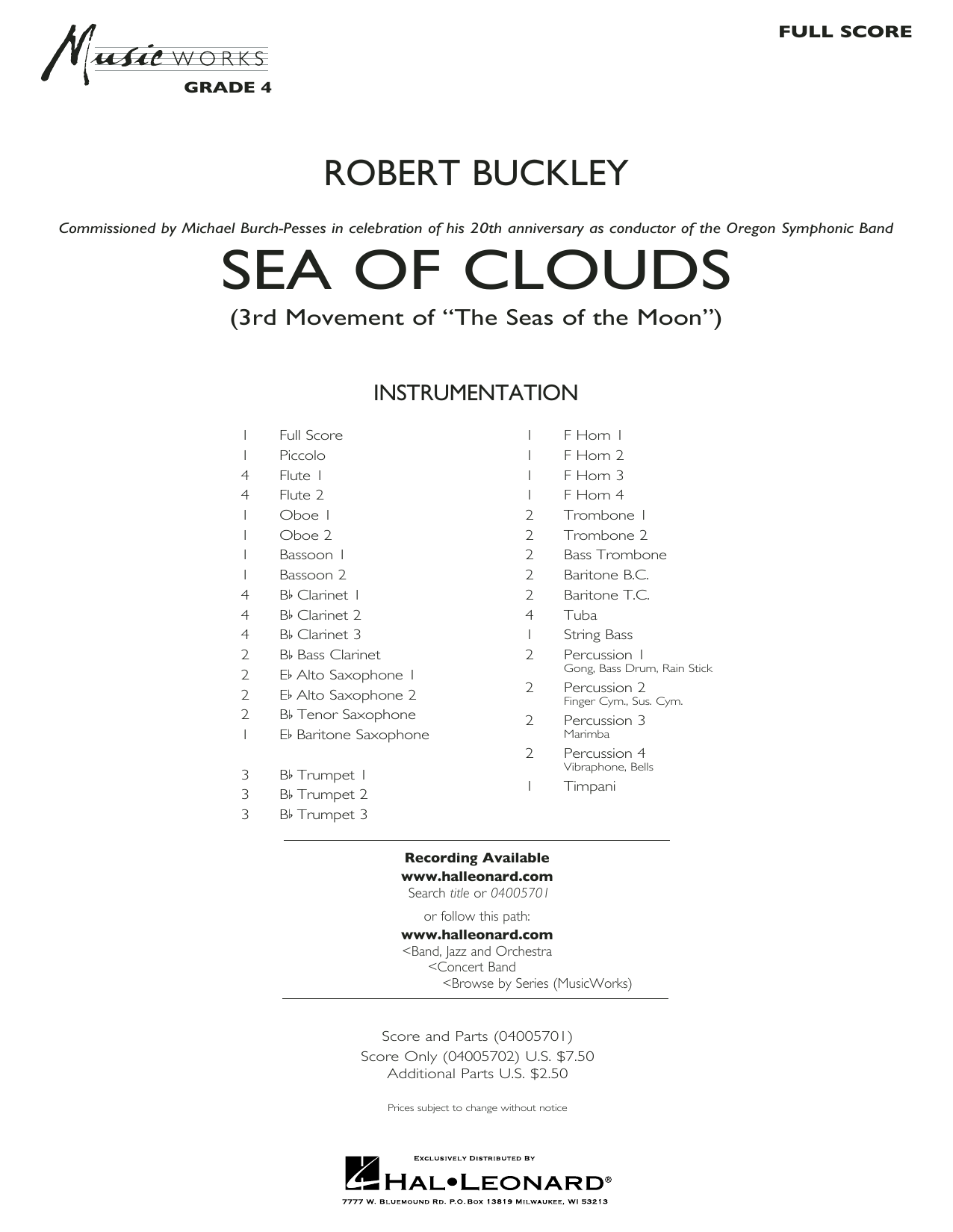

Sea of Clouds: Concert Band Conductor Score & Parts
Grade: 4
Item: 35-PK00434950
$75.00
Pickup currently not available
Buy Extra Parts (Digital PDF Download)
Parts Added to Cart!
Description
The third movement of Robert Buckley's grandly cinematic suite describing impressions of the "seas" of the moon, "Sea of Clouds" was inspired by a series of paintings done by Claude Monet in the London fog. Monet captured the gradations of light as it was affected by fog with ghostly images sifting through. This movement is mostly subdued and dreamlike, the music ebbing and flowing and eventually building to a vast wall of sound and then dissolving into silence. Dur: 5:05


Sea of Clouds: Concert Band Conductor Score & Parts isn't in MakeMusic Cloud just yet...but it could be. Let us know you'd like to see it, and you'll help shape what comes next. In the meantime, start a free trial and dive into thousands of interactive titles your students can play along with today.
Request This Title
Tell us you want it.
Start Your Free Trial
Explore everything that's ready to play right now.
Sample Audio
No sample audio found.
Sample Video
No sample videos found.
Additional Details
Publisher:
Hal Leonard
SKU:
35-PK00434950
More about this title
About the Creator: Robert Buckley
Robert Buckley has built a reputation for orchestral and band works that prioritize vivid storytelling through sound. His compositional voice gravitates toward programmatic writing, where narrative and imagery shape the harmonic and structural choices. Buckley's ability to translate visual inspiration into orchestral color makes his work particularly appealing to ensembles seeking repertoire with strong conceptual underpinning.
In this suite exploring lunar geography, Buckley demonstrates why his pieces resonate in educational settings. He balances technical sophistication with accessibility, allowing younger musicians to experience genuinely cinematic writing without requiring virtuosity beyond their reach.
Why we love this
This movement succeeds because Buckley asks the band to do something most Grade 4 repertoire avoids: paint with restraint and atmosphere. Rather than chase volume or technical flash, the score treats quietness and space as compositional challenges, training your ensemble to listen to themselves and shape long lines. The trajectory from dreamlike opening through a climactic surge and back to dissolution offers a complete emotional arc in just over five minutes, giving your musicians the feeling of executing a genuine concert experience.
What to expect
Mist rolling across moonlit water. The music drifts and eddies, never landing firmly until the sweeping crescendo breaks through like moonlight piercing clouds. When it subsides back into silence, you're left with the sense of something vast glimpsed and then lost again. The overall effect is contemplative and slightly eerie, more interested in texture and mood than melody.
Who it's for
Concert bands at the Grade 4 level seeking repertoire that challenges musicianship without overshooting technical demands. Directors programming concert festivals or formal concerts who want a piece that stands on its own as a complete artistic statement rather than serving as a filler or warm-up selection. Musicians ready to experience how professional compositional craft and programmatic intent can create meaning within ensemble writing.
How to get the most out of it
- Build the climax without rushing it. The "vast wall of sound" arrives through gradual layering and dynamic growth, not tempo acceleration. Let each instrumental section enter clearly so the accumulation registers.
- Attend closely to the quiet passages early on. Many bands underestimate how much focus and blend these require. Lock into the ensemble sonority during the subdued, flowing sections so the contrast with the climax lands with full impact.
- Shape the final dissolution deliberately. Resist the urge to simply fade away. Each strand should taper with intention, creating that ghostly effect Buckley associates with Monet's fog paintings.
- Use the recorded accompaniment to ground tempos and phrasing choices, especially in passages where sustained tones dominate and internal pulse matters more than steady meter.
How to use it
Open a concert with this piece to set a sophisticated tone and signal to your audience that the evening will contain serious artistic work. Pair it with other impressionistic or narrative-driven concert band works to create a thematic program exploring how bands use orchestration to evoke visual imagery. Schedule it late enough in the rehearsal season that your musicians have developed the ensemble blend and attention to dynamics this score demands.
Skills your students will build
- Control of dynamic shaping across long phrases and full ensemble passages
- Listening to and balancing sustained harmonic textures
- Maintaining ensemble cohesion without a driving tempo or pulse
- Responding to conductor cues for gradual dynamic transitions
- Interpreting programmatic intent through musical choices in articulation and phrasing