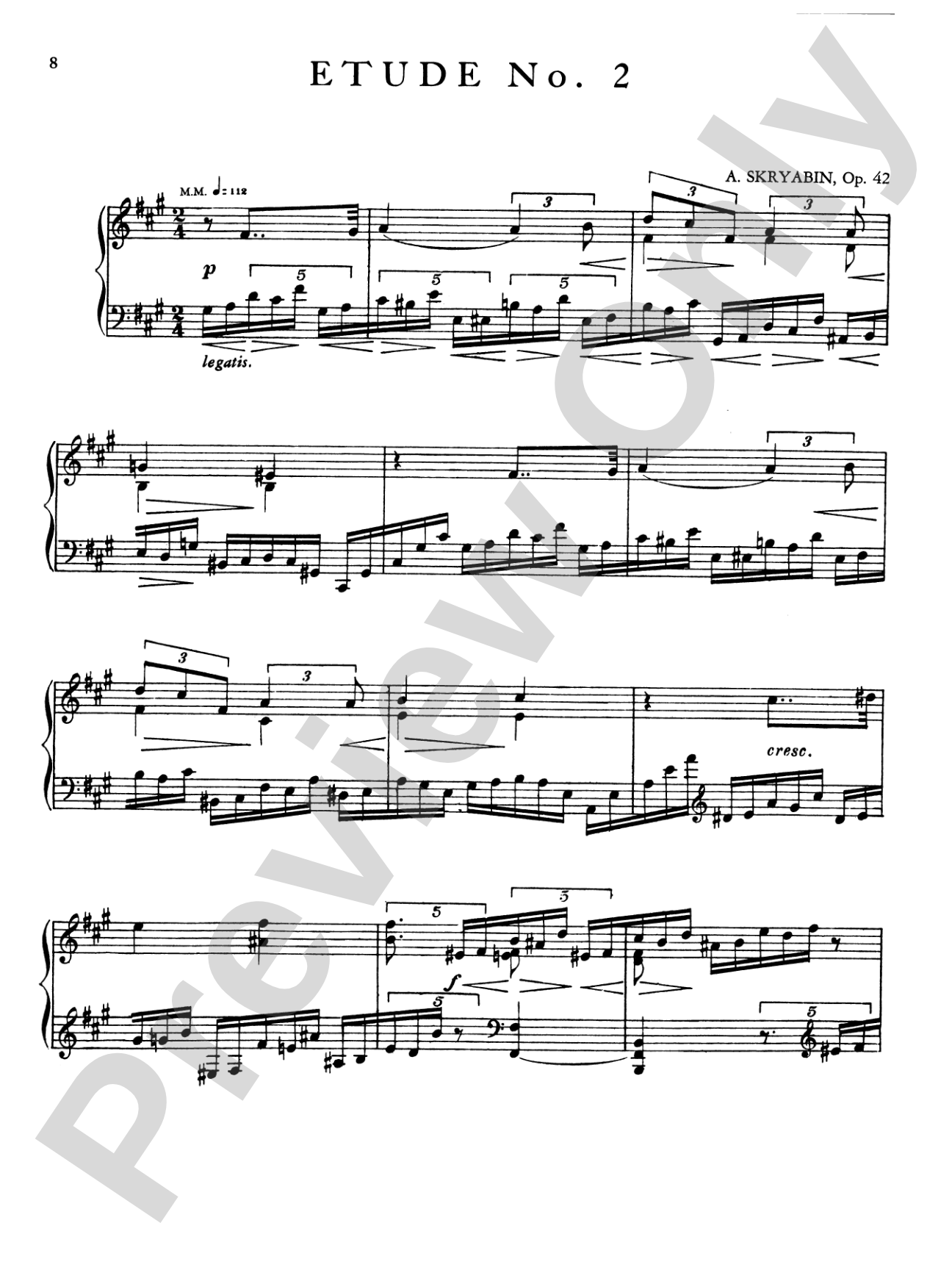
Scriabin: Eight Etudes, Op. 42 Sheet Music Preview

Scriabin: Eight Etudes, Op. 42

By Alexander Scriabin

Item: 00-PC-0009417

Digital Download
$0.99
Description
Expertly arranged piano collection from our Kalmus Edition.

Don't just read it, hear it, play along with it, and watch your students grow with it. In MakeMusic Cloud, Scriabin: Eight Etudes, Op. 42 comes alive with professional accompaniment, adjustable tempo, and built-in practice tools that turn solo practice into real progress.

Sample Audio
No sample audio found.
Sample Video
Additional Details
Series: Kalmus Edition
Publisher: Alfred Music
Page Count: 32
SKU: 00-PC-0009417

More about this title

About the Composer: Alexander Scriabin

Alexander Scriabin (1872-1915) was a Russian pianist and composer who fundamentally expanded the language of harmony in early twentieth-century music. His harmonic innovations, built on overtone relationships and unconventional chord structures, influenced composers far beyond his lifetime. As both performer and creator, Scriabin understood the piano intimately, writing for it with technical brilliance and visionary demands.

Scriabin's mature works blend abstract harmonic exploration with deeply personal spiritual philosophy. His etudes occupy a unique position in the piano canon: they are virtuosic studies that demand technical mastery while delivering profound musical substance. For serious pianists, engaging with Scriabin's etudes means confronting harmony and color as primary compositional elements rather than decorative effects.

Why we love this

These eight etudes sit at the intersection of technical challenge and modernist invention. Scriabin refuses to treat the etude as a mere finger exercise; each one tackles a specific pianistic problem while introducing harmonic language that was genuinely radical for its time. Pianists who master this collection emerge with expanded harmonic hearing and the technical command to navigate twentieth-century repertoire.

What to expect

Scriabin's etudes navigate a sonic world where traditional major and minor harmony dissolves into shimmering, ambiguous color. The writing feels simultaneously intimate and expansive, rooted in Russian musical tradition yet reaching toward abstraction. Playing these pieces demands intense concentration and rewards it with access to a uniquely luminous harmonic universe.

Who it's for

Advanced pianists preparing for university-level study, artists building a contemporary classical recital program, and serious students ready to engage with non-tonal harmonic thinking. These etudes suit pianists who have completed standard Romantic technical studies and seek repertoire that deepens both facility and musical sophistication.

How to get the most out of it

  • Approach the harmonic language as the primary expressive vehicle rather than viewing it as accompaniment to melody. Scriabin's chords contain color; make that color audible through precise pedal work and careful voicing.
  • Practice hands separately longer than you might for Romantic-era etudes. The technical demands are substantial, but the harmonic relationships become clearer when each hand's independent line is secure.
  • Experiment with tempo flexibility within phrases rather than adopting one rigid tempo for each etude. Scriabin's notation often suggests subtle rubato; allow the harmonic weight to shape timing naturally.
  • Listen to multiple recorded interpretations before settling on your own approach. Scriabin's notation leaves interpretive space, and hearing how different pianists voice the chords and balance texture will deepen your own musical choices.

How to use it

These etudes work exceptionally well in recitals pairing early twentieth-century piano works, especially when programmed alongside Debussy or other composers exploring harmonic expansion. A single etude or a small group of them can anchor a contemporary music showcase, or they can serve as the centerpiece of a recital exploring Russian piano composition from the Romantic period into modernism.

Skills your students will build

  • Voicing unconventional chord structures and extended harmonies
  • Pedal technique for color and harmonic blending
  • Navigating non-functional harmony and abstract harmonic progression
  • Technical command of rapid passages, hand crossing, and register shifts
  • Interpretive decision-making in notation with flexible tempo indications
  • Understanding of overtone-based harmony and twentieth-century compositional thinking

You May Also Like