Scottish Folk Song: Viola Sheet Music Preview

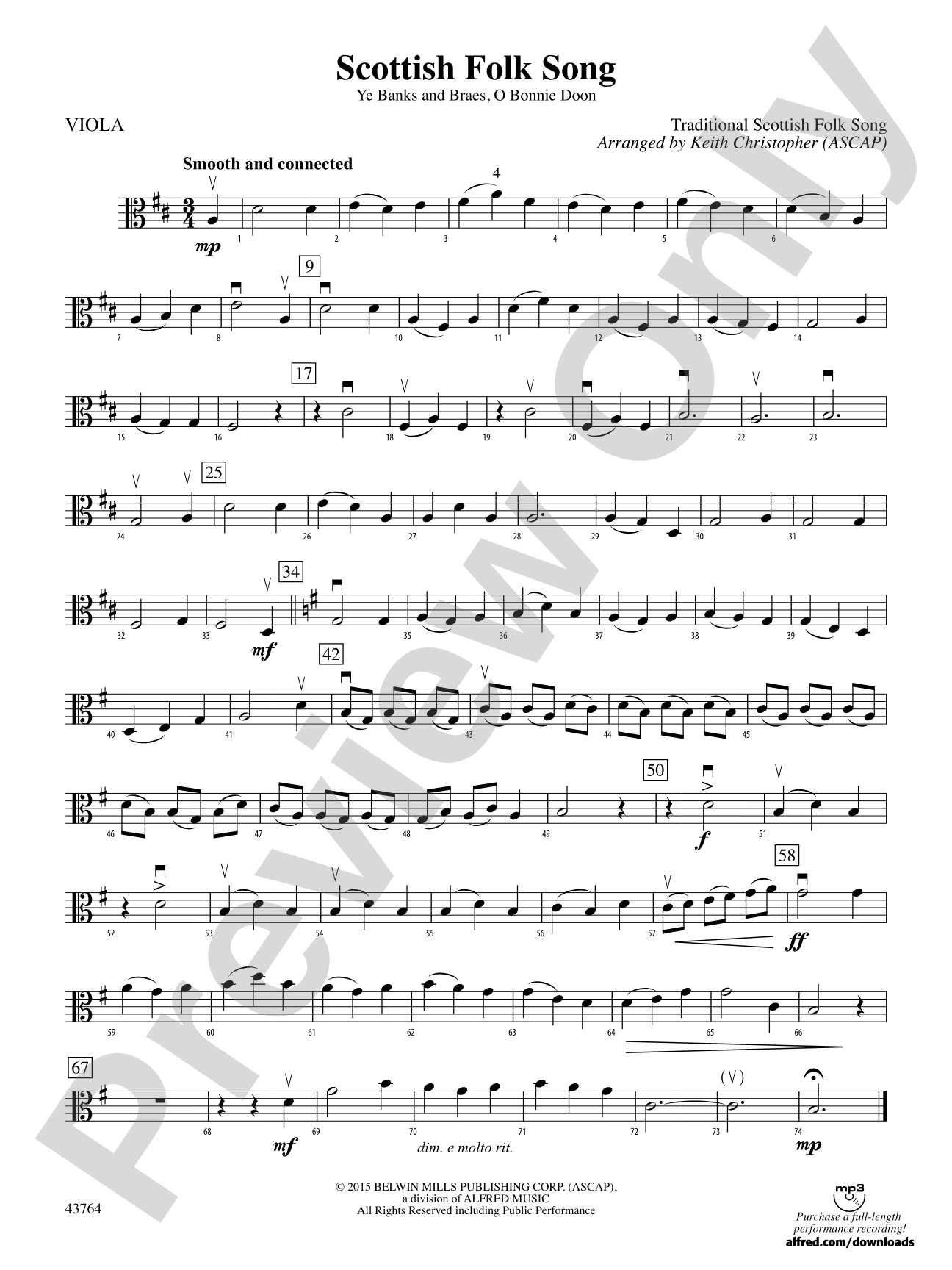
Scottish Folk Song: Viola

Ye Banks and Braes, O Bonnie Doon

Traditional Scottish Folk Song / arr. Keith Christopher

Grade: 2

Item: 00-PC-0016868_VA1

Digital Download
$5.99
Description
This immortal five-note melody is showcased here with warm harmonies in a chorale-like, legato style. Enjoy a taste of Scottish style in this sensitive and engaging setting. Orchestras and audiences will enjoy hearing every section play the timeless melody. (3:05)

Don't just read it, hear it, play along with it, and watch your students grow with it. In MakeMusic Cloud, Scottish Folk Song: Viola comes alive with professional accompaniment, adjustable tempo, and built-in practice tools that turn solo practice into real progress.

Sample Audio
0:00
0:00
Sample Video
Additional Details
Series: Belwin Intermediate String Orchestra
Publisher: Alfred Music
Page Count: 76
SKU: 00-PC-0016868_VA1

More about this title

About the Arranger: Keith Christopher

Keith Christopher

Keith Christopher's catalog spans decades of work across choir, band, and orchestra. Since 1992, he has earned consecutive annual awards from the American Society of Composers, Authors, and Publishers, and his compositions and arrangements have circulated globally through multiple major publishers. His versatility extends beyond instrumental music; he earned a Gold Record for The Dallas Brass's "A Merry Christmas with Brass" and a Dove Award for the choral collection "More Songs for Praise and Worship."

Beyond composing and arranging, Christopher has shaped the music industry through production work, overseeing the creation of over a thousand recordings for music publishers. His contributions to music education and cultural documentation include authoring "The First Christmas Night," a children's book. He and his wife, Tammy, are based in the Nashville, Tennessee area.

Why we love this

Christopher's treatment of this five-note Scottish melody trusts young orchestras to carry a complete musical idea without overshadowing it. The chorale-like writing allows every section to experience playing the principal tune, building ensemble ownership and confidence at a level where that matters most. It's a genuine concert piece, not a learning exercise disguised as music.

What to expect

Warm, unhurried, and quietly dignified. This arrangement honors the simplicity of the original five-note phrase while wrapping it in rich harmonic colors, creating a piece that feels both intimate and substantial. It invites the listener into a moment of reflection rather than spectacle.

Who it's for

Grade 2 orchestras ready to tackle ensemble balance and legato phrasing without the technical demands of fast passagework. Young players benefit from playing a universally recognizable tune and from hearing how orchestral voices interact when all share melodic responsibility.

How to get the most out of it

  • Shape the phrase arcs with subtle dynamic swells rather than abrupt accents; the legato character asks for continuous, singing bow work across all string sections.
  • Balance the violin melody against violas and cellos so the harmonic warmth supports rather than obscures the tune. Use rehearsal time to adjust section volumes until every part feels necessary.
  • Establish a steady, unhurried tempo that lets the melody breathe; rushing this chorale-style setting will flatten its emotional impact.
  • Cue the transitions between sections carefully so the melody passes seamlessly when violas, cellos, or basses take the lead.

How to use it

Program this early in a concert to establish a reflective mood, or pair it with lighter contemporary works to create contrast. The 3:05 duration fits neatly into any concert structure and works especially well when you want the orchestra to demonstrate mature musicianship without strain.

Skills your students will build

  • Sustaining legato phrasing over phrase lengths of 4-8 bars
  • Balancing ensemble sound when multiple sections share the melody
  • Reading and executing dynamic shaping in chorale-style writing
  • Transitioning melodic lead between violin, viola, cello, and bass parts

You May Also Like