
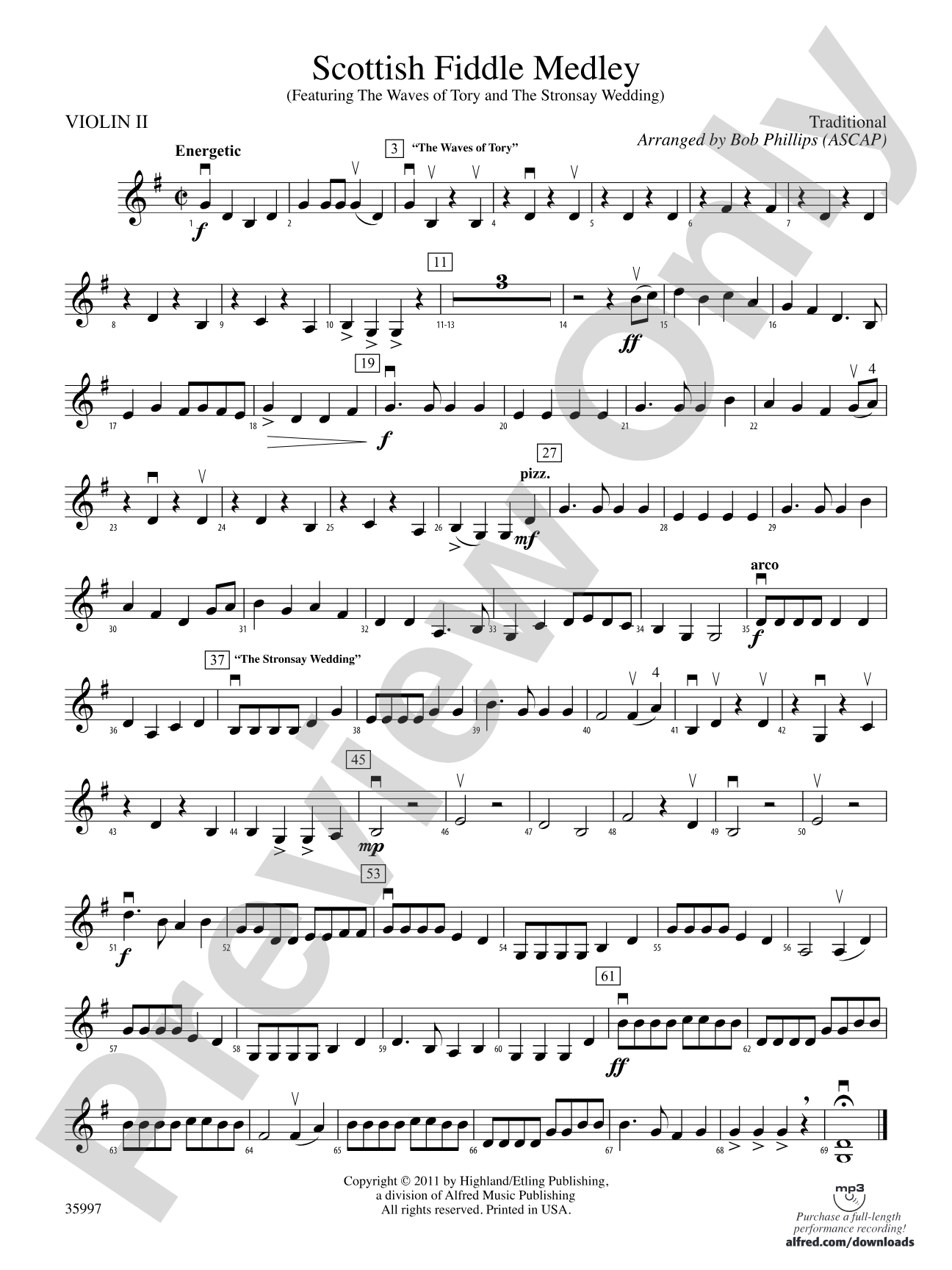

Scottish Fiddle Medley: 2nd Violin
Featuring: The Waves of Tory / The Stronsay Wedding
Traditional / arr. Bob Phillips
Grade: 1.5
Item: 00-PC-0015072_VN2
$5.99
Pickup currently not available
Description
Perfect for young players or as a quick play-down finale for older players, this easy medley will soon become a favorite that you'll hear them playing before class begins. All sections play the melodies of "The Waves of Tory" and "The Stronsay Wedding," providing interest and a chance to work on dynamics. Performance recommendations to help make the tunes sound "fiddley" are provided in the score.


Don't just read it, hear it, play along with it, and watch your students grow with it. In MakeMusic Cloud, Scottish Fiddle Medley: 2nd Violin comes alive with professional accompaniment, adjustable tempo, and built-in practice tools that turn solo practice into real progress.
Open in the Player
Jump straight in and assign it today.
Start Your Free Trial
Open this title and explore the full library in minutes.
Sample Audio
1
Audio File
--:--
0:00
0:00
Sample Video
No sample videos found.
Additional Details
Series:
Highland/Etling String Alternatives
Publisher:
Alfred Music
Page Count:
66
SKU:
00-PC-0015072_VN2
Instrumentation:
string w/ pno acc
More about this title
About the Arranger: Bob Phillips

Bob Phillips (b. 1953) is a composer, arranger, and string pedagogue who has fundamentally shaped how young musicians encounter non-classical styles. Over nearly three decades leading the Saline, Michigan string program, he built an ensemble of over 700 students known nationally for excellence across both traditional and eclectic repertoire. His work extends far beyond the classroom: he founded the Saline Fiddlers Philharmonic, which performed internationally and appeared at the White House; served as resident conductor and arranger for Seattle's Wintergrass Festival for 12 years; and has guest conducted at every major state orchestra and honor ensemble across the country.
Phillips has authored more than 25 textbook series and published over 200 works for orchestras and bands, earning recognition as an ASCAP award-winning composer whose pieces are performed by thousands of string students annually. His innovative approach to large ensemble pedagogy and genre-crossing instruction appears in the widely used Sound Innovations series, the Philharmonic collections (Jazz, Rock, Mariachi, Latin, and Fiddle), and his instructional video series String Clinics to Go, which has reached thousands of educators.
Why we love this
Phillips has crafted this medley with the insight of someone who has spent decades making fiddle music accessible and engaging for young orchestras. The all-sections-play-the-melody approach gives every player a moment in the spotlight while the embedded performance guidance helps students discover what makes traditional Scottish fiddling sound alive. It's the kind of piece that works equally well as an icebreaker at the beginning of rehearsal or as a confident closer at a festival.
What to expect
There's an infectious energy to these two Scottish fiddle tunes; they skip along with the lift and swing of traditional dance music while remaining grounded in the kind of straightforward melodies that stick in your head. When played with attention to the fiddling techniques suggested in the score, the arrangement captures the spirited, communal joy of folk music.
Who it's for
Young string orchestras (Grade 1.5) will find this medley immediately playable and rewarding, while experienced ensembles can use it as a spirited, accessible finale or warmup that showcases how well they understand dance-like phrasing. The all-instruments-featured approach gives every section a clear role and purpose.
How to get the most out of it
- Follow the performance recommendations in the score to shape the ornaments and articulation details that give the melodies their characteristic fiddle character.
- Treat dynamics as a tool for phrasing and storytelling rather than just volume changes; let them reveal the shape of each tune.
- Lock the tempo and articulation between sections so the medley feels like one flowing musical line, even as the focus shifts from violin to viola to cello.
How to use it
This works beautifully as a quick, confident opener that energizes both orchestra and audience, or as a festival finale that leaves listeners smiling and tapping their feet. It also serves well in a pops concert or family concert where you want to show off the personality and musicality of your younger players without overwhelming them technically.
Skills your students will build
- Playing unison and octave doublings with intonation focus across sections
- Shaping dynamic contours to support melodic phrasing in dance forms
- Executing ornaments and articulations that evoke fiddle style (as guided in the score)
- Ensemble balance and rhythmic precision across all four string parts