
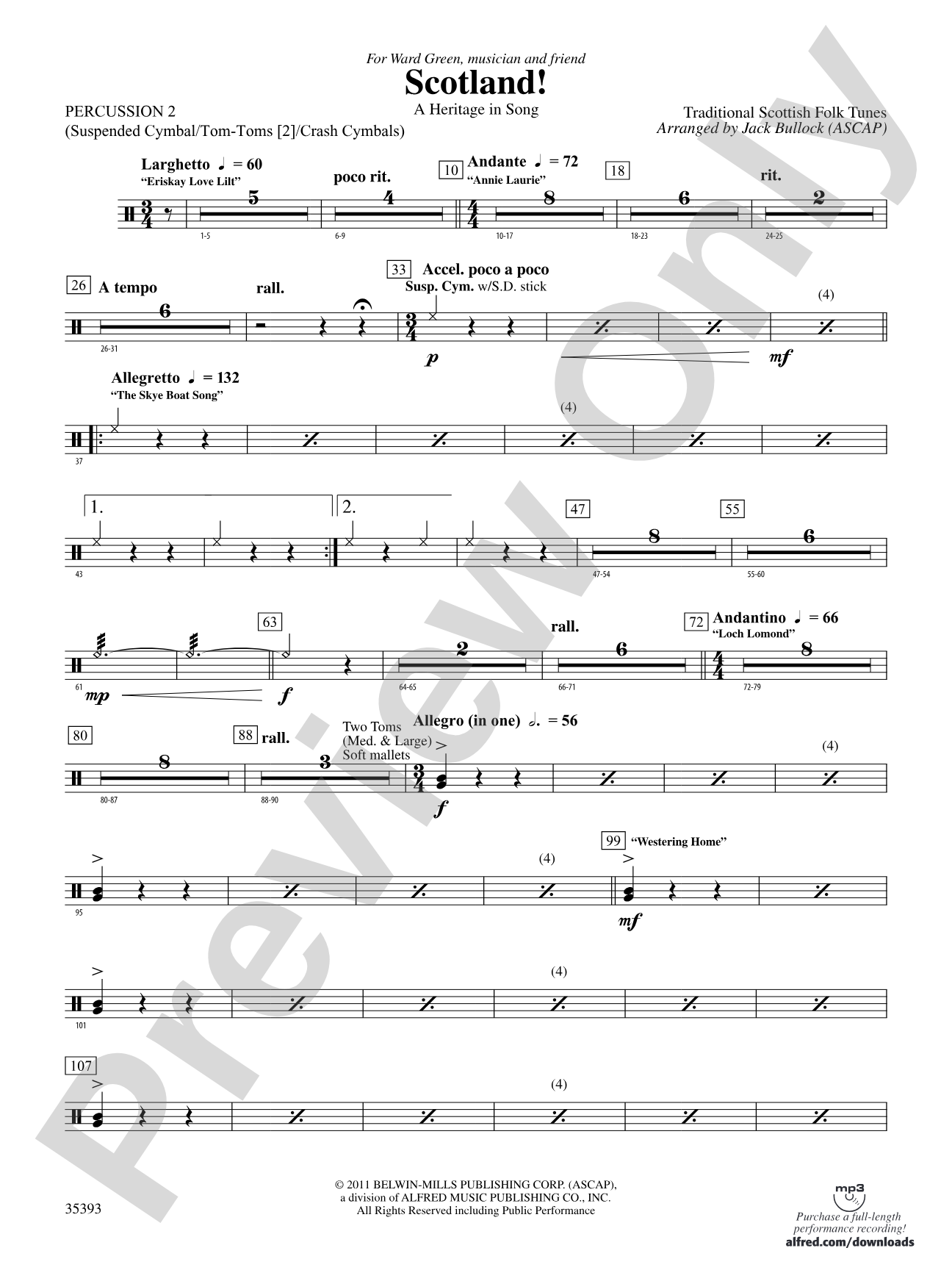

Scotland!: 2nd Percussion
A Heritage in Song
Traditional Scottish Folk Tunes / arr. Jack Bullock
Grade: 3 (Medium Easy)
Item: 00-PC-0014940_PC2
$3.00
Pickup currently not available
Description
When one thinks of music from Scotland, thoughts of bagpipes, highland dancing, Celtic singers, and folk songs come to mind. Music has always been an important part of everyday life in Scotland. This arrangement of Scottish songs for concert band includes many favorites that have become standard fare from the country, including "Annie Laurie," "Loch Lomond," "Scotland the Brave," and others. The Scottish song style is unique, wonderful to experience, and is presented here as a tribute to this beautiful and exciting country. This title is available in MakeMusic Cloud.


Don't just read it, hear it, play along with it, and watch your students grow with it. In MakeMusic Cloud, Scotland!: 2nd Percussion comes alive with professional accompaniment, adjustable tempo, and built-in practice tools that turn solo practice into real progress.
Open in the Player
Jump straight in and assign it today.
Start Your Free Trial
Open this title and explore the full library in minutes.
Sample Audio
1
Audio File
--:--
0:00
0:00
Sample Video
No sample videos found.
Additional Details
Series:
Belwin Concert Band
Publisher:
Alfred Music
Page Count:
236
SKU:
00-PC-0014940_PC2
More about this title
About the Arranger: Jack Bullock

Jack Bullock brings three decades of practical experience to his arranging work, combining performance credentials that span orchestral, operatic, and touring ensembles with deep training in music education. His doctoral study in Music Education grounds his compositions and arrangements in classroom realities; he taught instrumental music full-time for 20 years and served as assistant band director and later department chair at Ithaca College's School of Music.
With over 600 published works across concert band, orchestra, jazz ensemble, and marching band, Bullock has established himself as a trusted voice in ensemble music. His contributions extend beyond his own compositions to collaborative projects like the Belwin 21st Century Band Method and arrangements for the Alfred Music curriculum. His work has taken him across North America and internationally, conducting clinics and workshops while maintaining membership in ASCAP since 1980.
Why we love this
Scottish folk material sits at the intersection of accessibility and cultural richness, and Bullock's arrangement respects both. At Grade 3, the writing voices the melodic character of these familiar songs without oversimplifying them, giving students something genuine to express rather than merely technical exercise to execute. The collection lets a band program authentic repertoire from another tradition in a single cohesive work.
What to expect
These Scottish melodies carry the warmth and dignity of traditional songs passed through generations. The orchestration has both lift and weight, capturing the spirited energy of highland culture alongside moments of lyrical tenderness, creating a program that feels genuinely connected to place and tradition rather than generic folk pastiche.
Who it's for
Concert bands at the Grade 3 level looking to expand their cultural repertoire without overextending technical demands. This arrangement works equally well for concert programs and festival appearances, offering directors a chance to program substantive folk music that resonates with audiences while remaining manageable in the ensemble.
How to get the most out of it
- Establish the rhythmic lilt of Scottish song before rehearsal begins. Play a recording of traditional versions to let students absorb the characteristic phrasing and swing that distinguishes this music from standard march or concert band idioms.
- Balance the melody carrier with its accompaniment carefully in tutti passages. Scottish folk songs thrive on clear, soaring lines supported by warm harmonic color; if the full band plays at uniform volume, the arrangement loses its singing quality.
- Shape phrase endings with slight ritardando rather than hard stops. These songs breathe like vocal music, and respecting that natural phrasing will make the band sound more musicianly and the melodies more memorable.
How to use it
Scotland! works beautifully as a concert centerpiece or opening number, its accessibility and strong melodic material drawing audiences in immediately. Consider pairing it with other folk-based arrangements or cultural traditions to build a themed concert, or use it as a confidence builder early in the season when students benefit from playing music with clear lines and immediate gratification.
Skills your students will build
- Phrasing and expression in melodic lines
- Balance between melody and accompaniment in full ensemble texture
- Cultural listening and folk music style recognition
- Rhythmic precision within Scottish folk song inflection (avoiding mechanical performance)
- Part independence in multi-part harmonic writing