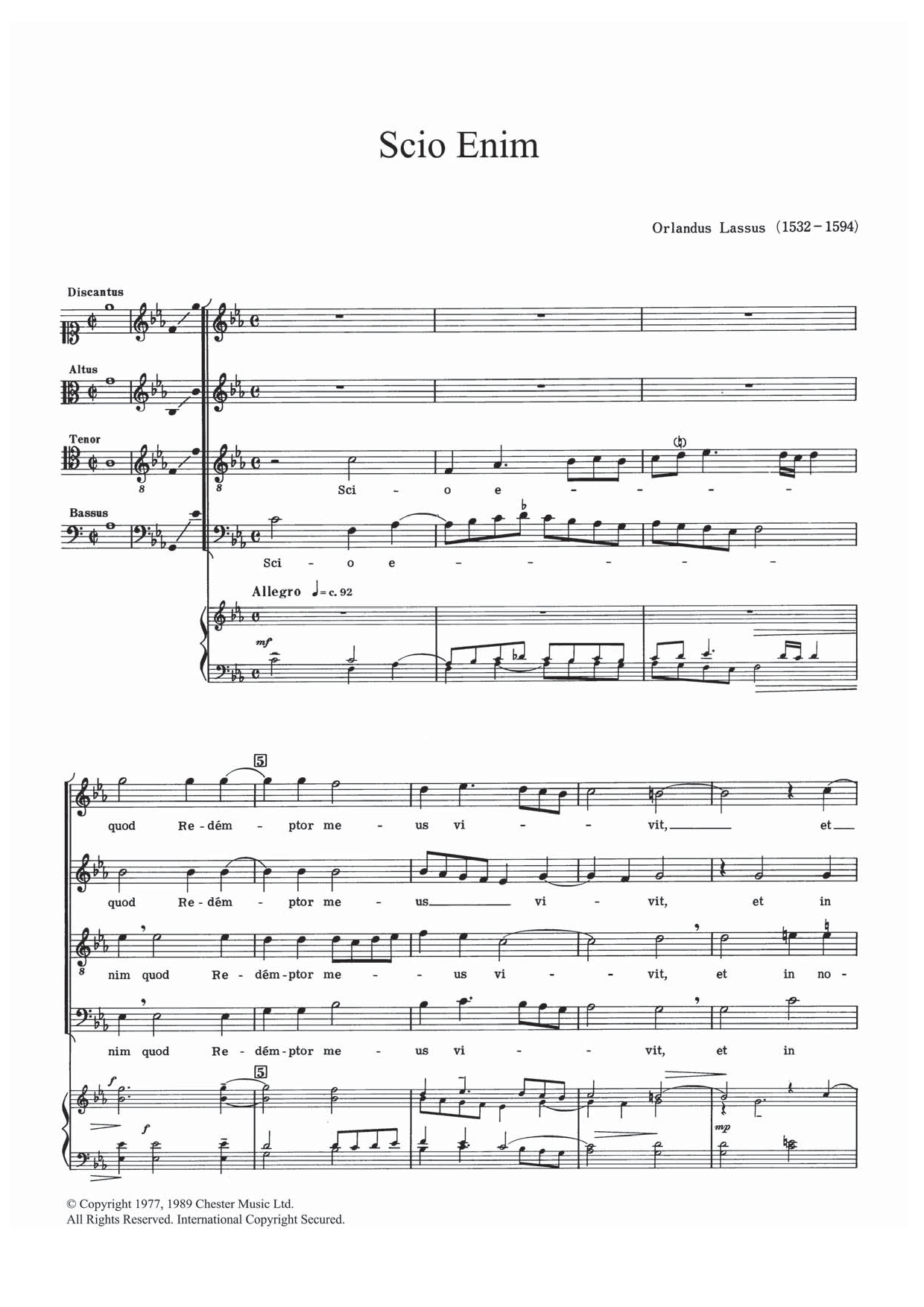
Scio Enim Sheet Music Preview

Scio Enim: SATB Choral Octavo

As performed by Orlandus Lassus

Item: 35-DS00366803

Digital Download
$2.99
Description

Scio Enim: SATB Choral Octavo isn't in MakeMusic Cloud just yet...but it could be. Let us know you'd like to see it, and you'll help shape what comes next. In the meantime, start a free trial and dive into thousands of interactive titles your students can play along with today.

Sample Audio
No sample audio found.
Sample Video
Additional Details
Publisher: Hal Leonard
Page Count: 4
SKU: 35-DS00366803

More about this title

About the Artist: Orlandus Lassus

Orlandus Lassus (c. 1532–1594) stands among the most prolific and versatile composers of the Renaissance. Over his lifetime he produced more than 2,000 works across nearly every genre of vocal and instrumental music, from intimate motets to grand ceremonial compositions. His output shaped the sound of sacred and secular music across Europe, and his mastery of counterpoint set a standard that composers studied for centuries after his death.

For choral directors, Lassus matters because he understood the human voice completely. His writing sits comfortably for singers while demanding real musicianship; his harmonic language is sophisticated but never obscure. Teachers turn to his motets and secular pieces because they work in rehearsal, reward careful preparation, and give singers a direct connection to one of history's most accomplished vocal composers.

Why we love this

Lassus brings architectural strength to this motet without sacrificing the lyrical flow that makes a piece memorable. The four-part writing sits naturally for SATB choirs of modest experience, yet it contains enough harmonic and contrapuntal interest to hold the attention of stronger ensembles. Directors appreciate how efficiently Lassus uses imitation and voice exchange to build momentum while keeping the text clear.

What to expect

Intimate and contemplative, yet architecturally composed. The piece unfolds with the quiet inevitability of a prayer or affirmation, moving through careful harmonic shifts that feel both natural and inevitable. There is no rush here; instead, a steady clarity that comes from voices moving in respectful coordination, each phrase building slightly on what came before.

Who it's for

Intermediate and advanced SATB choirs seeking Renaissance repertoire that balances accessibility with musical substance. This works for choirs with secure music reading and singers who can sustain lines without constantly relying on the piano. It also suits music history classes exploring vocal polyphony across centuries.

How to get the most out of it

  • Balance the text intelligibility across all four parts by resisting the urge to push forte voices forward during imitative passages; let the overall texture carry the line rather than soloistic singing.
  • Attend to the harmonic rhythm in the opening phrase and use it as an anchor for ensemble tuning; Lassus often moves from consonance to consonance with elegant voice leading that reveals itself through careful listening.
  • Shape longer notes as gentle arrivals rather than targets, which prevents the piece from sagging in slower harmonic passages.
  • Consider the piece as a single arc from beginning to end rather than sectional; this prevents interpretive stops that fragment the prayer-like quality Lassus builds into the text setting.

How to use it

Pair this with other Renaissance motets to create a focused concert segment or liturgical service music emphasis. It also serves well as the opening piece on a program that moves across centuries, establishing a foundation in polyphonic thinking before contemporary or Romantic repertoire follows. A capella performance makes this an excellent showcase for tonal blend without accompaniment.

Skills your students will build

  • Renaissance counterpoint and imitative voice leading
  • Singing without vibrato or with minimal vibrato for period-appropriate tone
  • Harmonic analysis and voice leading fundamentals
  • Text expression in Latin within a musical context
  • Ensemble balance within polyphonic texture

You May Also Like