
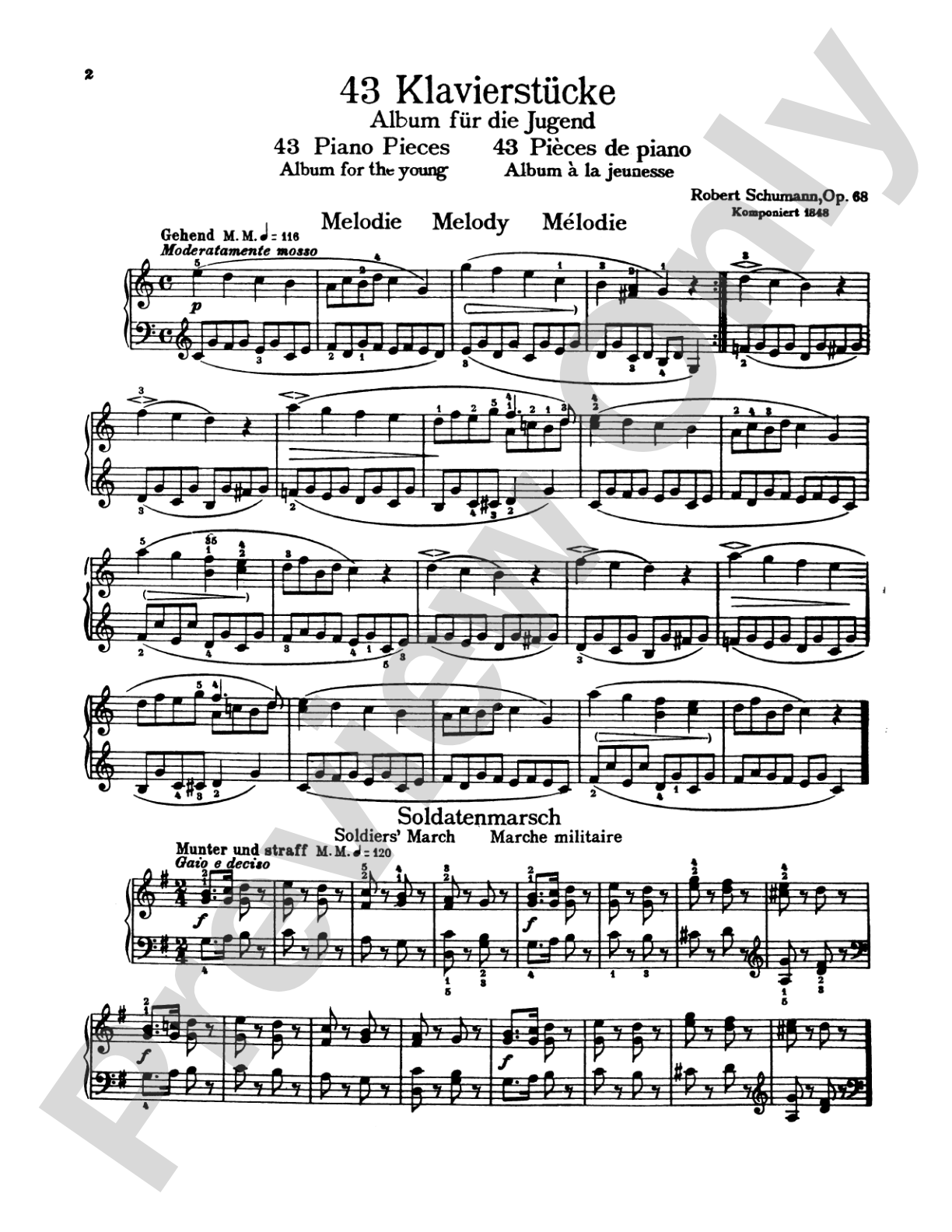

Schumann: Album for the Young, Op. 68: Piano Book
By Robert Schumann
Item: 00-PK-0003319

$13.99
Pickup currently not available
Buy Extra Parts (Digital PDF Download)
Parts Added to Cart!
Related Items
Album for the Young, Opus 68: Piano Book |
$13.95
|
View |
Description
A collection of piano solos composed by Robert Schumann.


Don't just read it, hear it, play along with it, and watch your students grow with it. In MakeMusic Cloud, Schumann: Album for the Young, Op. 68: Piano Book comes alive with professional accompaniment, adjustable tempo, and built-in practice tools that turn solo practice into real progress.
Open in the Player
Jump straight in and assign it today.
Start Your Free Trial
Open this title and explore the full library in minutes.
Sample Audio
No sample audio found.
Sample Video
No sample videos found.
Additional Details
Series:
Kalmus Edition
Publisher:
Alfred Music
Page Count:
52
SKU:
00-PK-0003319
More about this title
About the Composer: Robert Schumann
Robert Schumann (1810, 1856) was a titan of Romantic piano music whose compositions bridged the worlds of virtuosity and intimate lyricism. He shaped the Romantic era not only through his own works but as a critic and advocate for new music; his writings in the Neue Zeitschrift für Musik championed composers like Chopin and Brahms and elevated public discourse about what music could express.
Schumann's approach to composition was inseparable from his literary sensibility. He drew inspiration from poetry, literature, and the inner emotional life in ways that made his music feel conversational and deeply personal. This sensibility reaches its fullest expression in Album for the Young, where he distilled the essence of Romantic piano writing into a collection designed not for concert halls but for the home, for students, and for anyone learning to play.
Why we love this
This collection remains an essential anchor in piano pedagogy because Schumann understood what intermediate students actually need to hear and play. Unlike many teaching collections that feel didactic, these pieces offer genuine musical substance: character, harmonic color, and emotional range that justify repeated study. Programming selections from this book signals to students and audiences alike that classical training and contemporary musical growth belong in the same recital.
What to expect
These pieces capture the intimate world of 19th-century Romanticism. Tender character studies sit alongside miniature dramas; lyrical melodies drift over rippling accompaniments; harmonic surprises arrive with gentle inevitability. The writing feels personal and conversational, inviting the performer into Schumann's own musical thoughts rather than demanding virtuosic display.
Who it's for
Intermediate to early advanced pianists who are ready for pieces with genuine musical narrative and harmonic sophistication. This collection suits students preparing for recitals, exams, or simply deepening their engagement with Romantic repertoire during private study. Teachers seeking repertoire that builds interpretive maturity alongside technical security will find multiple pieces at varying difficulty levels.
How to get the most out of it
- Attend to the poetic titles and character indications Schumann provides. These serve as compositional roadmaps, shaping interpretive choices around rubato, pedaling, and dynamic shape rather than rigid tempo.
- Balance the Romantic sensibility with structural clarity. Schumann's pieces are tightly constructed; clarity of form supports rather than contradicts expressive playing.
- Use the sustain pedal judiciously to blend harmonic colors without muddying texture. The writing often calls for specific coloristic effects that demand precise pedal control.
- Honor the contrapuntal writing in many pieces. Even at modest technical levels, Schumann voices his accompaniments deliberately; hear the independence of lines rather than flattening accompaniments into chordal support.
How to use it
Selections from this collection work beautifully on student recitals mixed with contemporary works or paired with art song texts for interdisciplinary programming. Individual pieces also function as touchstones in the pedagogy of a given year, offering shorter repertoire alongside larger works. Because the set spans accessible to challenging material, you can program strategically from it across multiple students and performance levels.
Skills your students will build
- Pedaling for harmonic color and texture rather than sustain alone
- Shaping melodic phrases within Romantic expression and rubato
- Voicing inner harmonies and accompanying lines with independence
- Interpreting character and mood from titles and compositional detail
- Managing varied tempos and meters across a unified recital program
- Reading Romantic-era notation and performance indications