Schubert: Trio No. 1 in B flat Major Sheet Music Preview

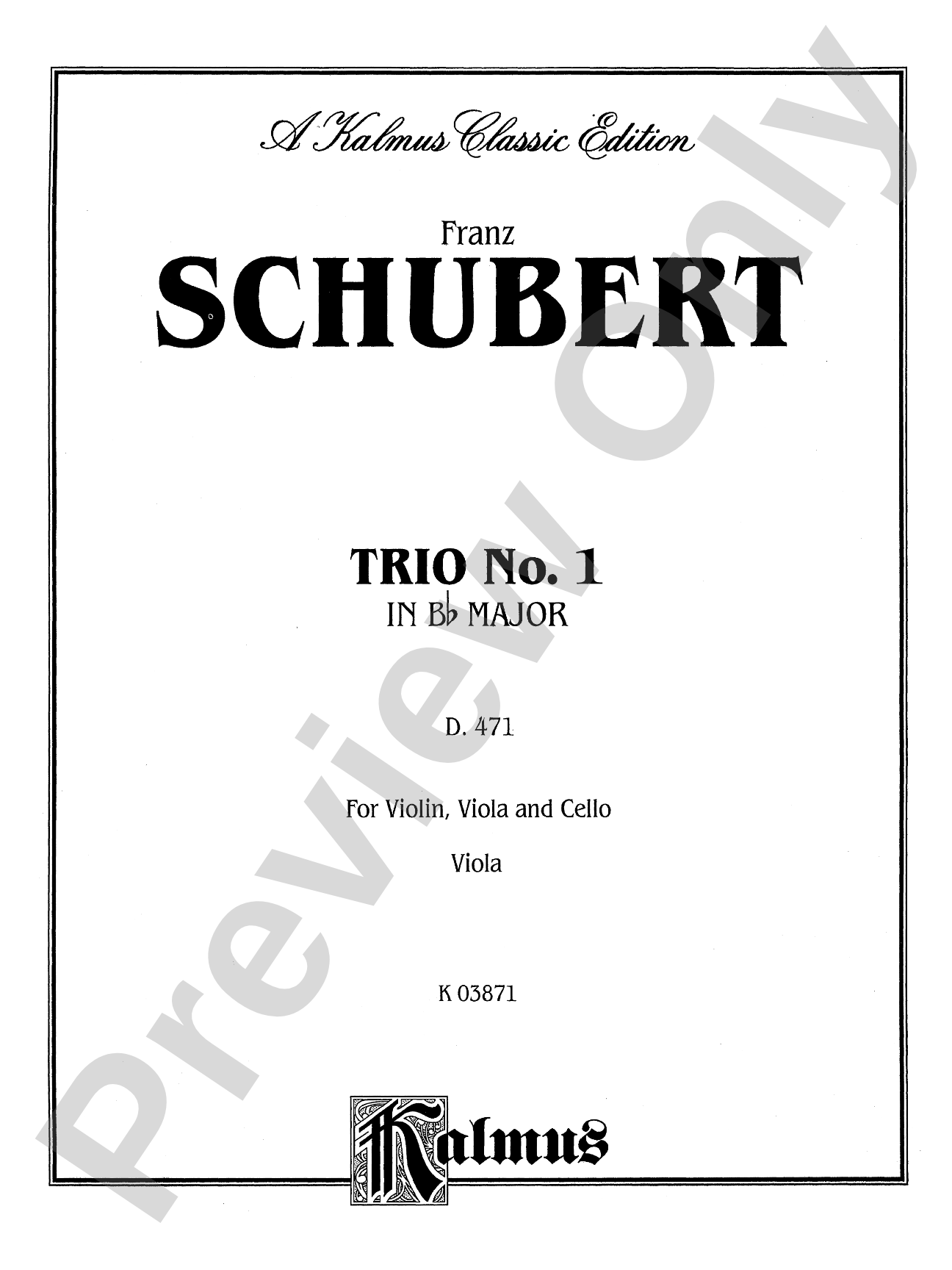
Schubert: Trio No. 1 in B flat Major

By Franz Schubert

Item: 00-PC-0009158

Digital Download
$1.99
Description
A string trios for Violin, Viola, and Cello composed by Franz Schubert.

Don't just read it, hear it, play along with it, and watch your students grow with it. In MakeMusic Cloud, Schubert: Trio No. 1 in B flat Major comes alive with professional accompaniment, adjustable tempo, and built-in practice tools that turn solo practice into real progress.

Sample Audio
No sample audio found.
Sample Video
Additional Details
Series: Kalmus Edition
Publisher: Alfred Music
Page Count: 16
SKU: 00-PC-0009158
Instrumentation: Violin, Viola & Cello

More about this title

About the Composer: Franz Schubert

Franz Schubert (1797-1828) composed over 600 works across every major genre, yet remained largely unknown outside Vienna during his lifetime. His chamber music represents the pinnacle of Classical form extended into Romantic expression, blending structural clarity with harmonic innovation and emotional depth that influenced generations of composers after him.

Schubert's string trios occupy a unique space in his output. Writing for the intimate ensemble of violin, viola, and cello allowed him to explore conversations between instrumental voices with remarkable subtlety, creating works that demand both technical precision and genuine musical empathy from performers.

Why we love this

Schubert's Trio No. 1 in B flat Major sits at the intersection of Classical architecture and Romantic songfulness. The writing showcases genuine interplay among three equal voices rather than treating the trio as a violin vehicle with accompaniment, making it rewarding for chamber musicians at the advanced high school and college levels who are ready to balance ensemble awareness with their own musical line.

What to expect

The opening movement establishes an intimate, conversational tone between the three instruments, with singing phrases that recall Schubert's gift for melody. The work unfolds with the structural confidence of Classical form while allowing moments of harmonic surprise and emotional introspection that feel entirely modern for its era.

Who it's for

Advanced chamber musicians at the high school and undergraduate levels who are comfortable with the harmonic language of the Classical-Romantic transition and ready for the ensemble listening skills that genuine chamber writing demands. String trios preparing for competitions or festivals will find this work a substantial and rewarding challenge.

How to get the most out of it

  • Establish which voice carries the primary melodic material in each section before rehearsal begins; the melody migrates between instruments, and clarity about who is singing prevents muddiness in the ensemble sound.
  • Tune the open strings collectively at the start of every rehearsal and before performance; the interplay of three string voices requires precise intonation to avoid a cloudy blend.
  • Shape the longer phrases as a unit rather than individual instrumental statements; this trio rewards a collaborative approach to phrasing and dynamics across all three parts.
  • Balance the viola part carefully, particularly in passages where it functions as harmonic filler; Schubert wrote idiomatically for the viola, and it must remain audible without overwhelming the violin.

How to use it

Program this as a concert centerpiece for chamber music events or festival performances; it stands confidently alongside Schubert's two other string trios and works well as part of a broader Schubert evening or as a classical-era anchor in a chamber concert mixing eras. The work's modest instrumentation also makes it suitable for intimate venue performances or educational recitals showcasing advanced student ensembles.

Skills your students will build

  • Balancing three equal instrumental voices without hierarchy
  • Reading and performing Romantic-era harmonic language within Classical form
  • Coordinating bowing and phrase shaping across an ensemble
  • Responding to harmonic movement and voice leading rather than relying on a conductor
  • Sustained lyrical playing and legato phrasing across string instruments

You May Also Like