Schubert: Moments Musicaux, Op. 94 Sheet Music Preview

Schubert: Moments Musicaux, Op. 94

By Franz Schubert

Item: 00-PC-0013369

Digital Download
$0.99
Description
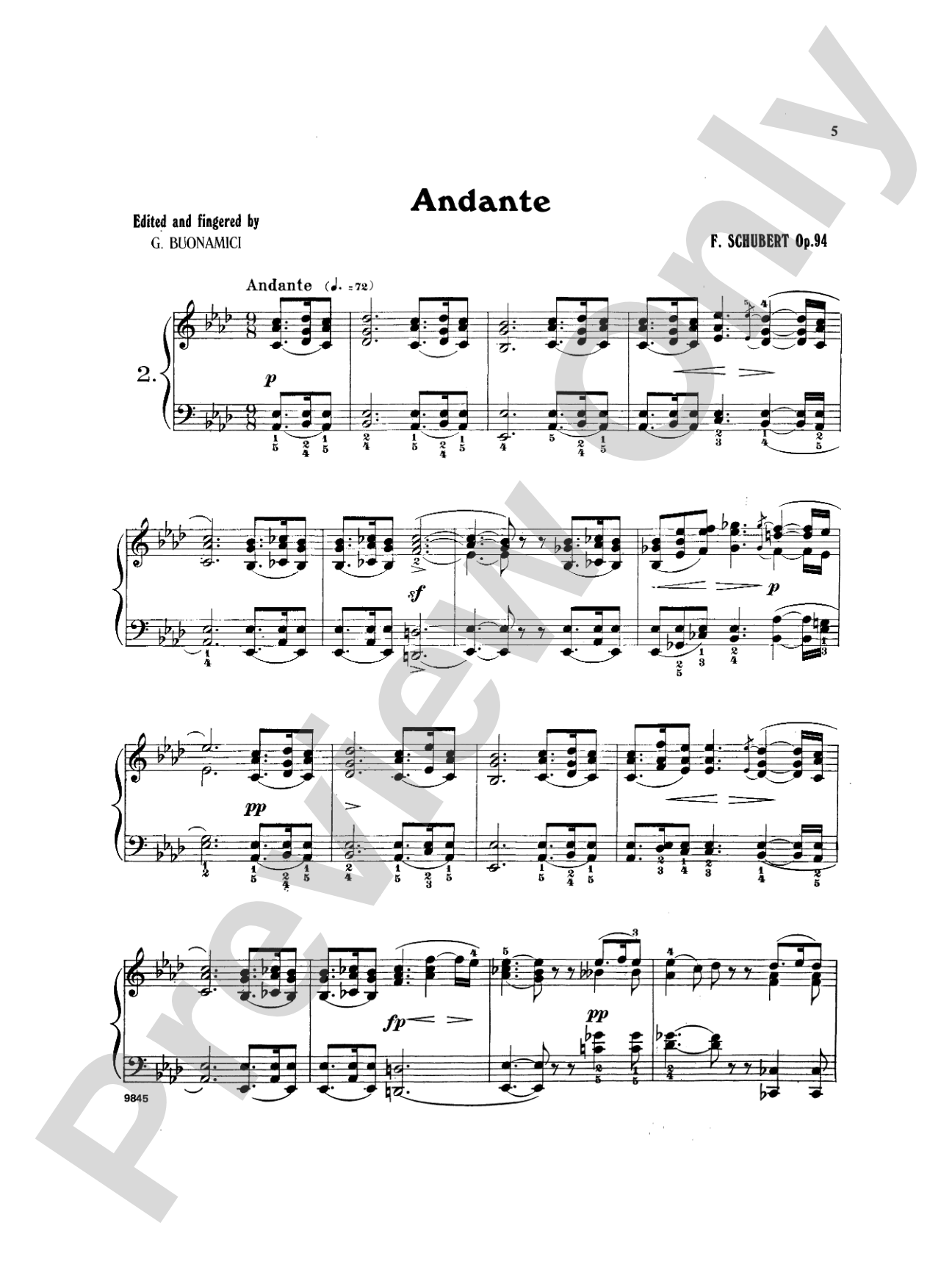
A collection of Piano Solos by Franz Schubert. Songs: Moderato, in C * Andante, in A-flat * Allegro Moderato, in F minor * Moderato, in C minor * Allegro Vivace, in F minor * Allegretto, in A-flat.

Don't just read it, hear it, play along with it, and watch your students grow with it. In MakeMusic Cloud, Schubert: Moments Musicaux, Op. 94 comes alive with professional accompaniment, adjustable tempo, and built-in practice tools that turn solo practice into real progress.

Sample Audio
No sample audio found.
Sample Video
Additional Details
Series: Kalmus Edition
Publisher: Alfred Music
Page Count: 24
SKU: 00-PC-0013369

More about this title

About the Composer: Franz Schubert

Franz Schubert (1797-1828) was an Austrian composer who bridged the Classical and Romantic eras, leaving behind an extraordinary catalog of over 600 works despite his short life. Though he wrote in nearly every genre, his piano music stands as some of the most intimate and emotionally direct in the Classical repertoire, revealing a gift for melody and harmonic innovation that influenced composers for generations.

Schubert's approach to the piano solo was revolutionary for his time. Rather than displaying virtuosity for its own sake, he used the instrument to explore psychological states and emotional subtleties, laying groundwork for the Romantic character piece. His keyboard works remain central to the recital repertoire because they balance technical accessibility with profound musical substance.

Why we love this

This collection captures Schubert at his most lyrical and introspective. Each Moment Musical is a self-contained character study, offering pianists the rare opportunity to perform genuine masterworks that don't require virtuosity to communicate depth. Directors programming student recitals find these pieces invaluable because they teach interpretive subtlety without overwhelming technical demands.

What to expect

These miniatures balance approachability with emotional sophistication. Some movements flow with deceptive simplicity, their beauty emerging through subtle harmonic shifts and delicate textures, while others move with lyrical urgency or nostalgic warmth. Taken as a set, they create a kind of musical diary, documenting intimate emotional moments rather than grand dramatic gestures.

Who it's for

Intermediate to early-advanced pianists who have solid technique and are ready to explore interpretive nuance. These six movements suit students preparing for recitals, competitions, or portfolio performances, as well as adult amateur pianists seeking repertoire with genuine artistic weight.

How to get the most out of it

  • Let the songlike melodic lines breathe naturally; these pieces are built on vocal instincts, so shape phrases as you would sing them rather than driving toward downbeats.
  • Pay close attention to the middle-voice harmonies and accompanimental textures. The richness of these pieces lives as much in what supports the melody as in the melody itself.
  • Respect Schubert's tempo markings as character indications. The difference between Andante and Allegro Moderato isn't just speed; it reflects emotional territory that should be audible to listeners.

How to use it

Program individual movements as standalone recital pieces, or perform two or three together to showcase Schubert's range within a single concert. The A-flat major movements (Andante and Allegretto) pair naturally, as do the two F-minor movements; a director could build an entire recital around exploring a single key through different characters. These also work beautifully in mixed recitals alongside Romantic character pieces or as bridges between larger Classical works.

Skills your students will build

  • Stylistic interpretation of Romantic melody within Classical structure
  • Voice leading and harmonic awareness in accompaniment patterns
  • Pedal control and tonal shaping without excessive ornamentation
  • Phrasing and breathing at the keyboard using vocal models
  • Sight-reading moderate-level Classical and early Romantic notation

You May Also Like