Schmitt: Three Preludes Sheet Music Preview

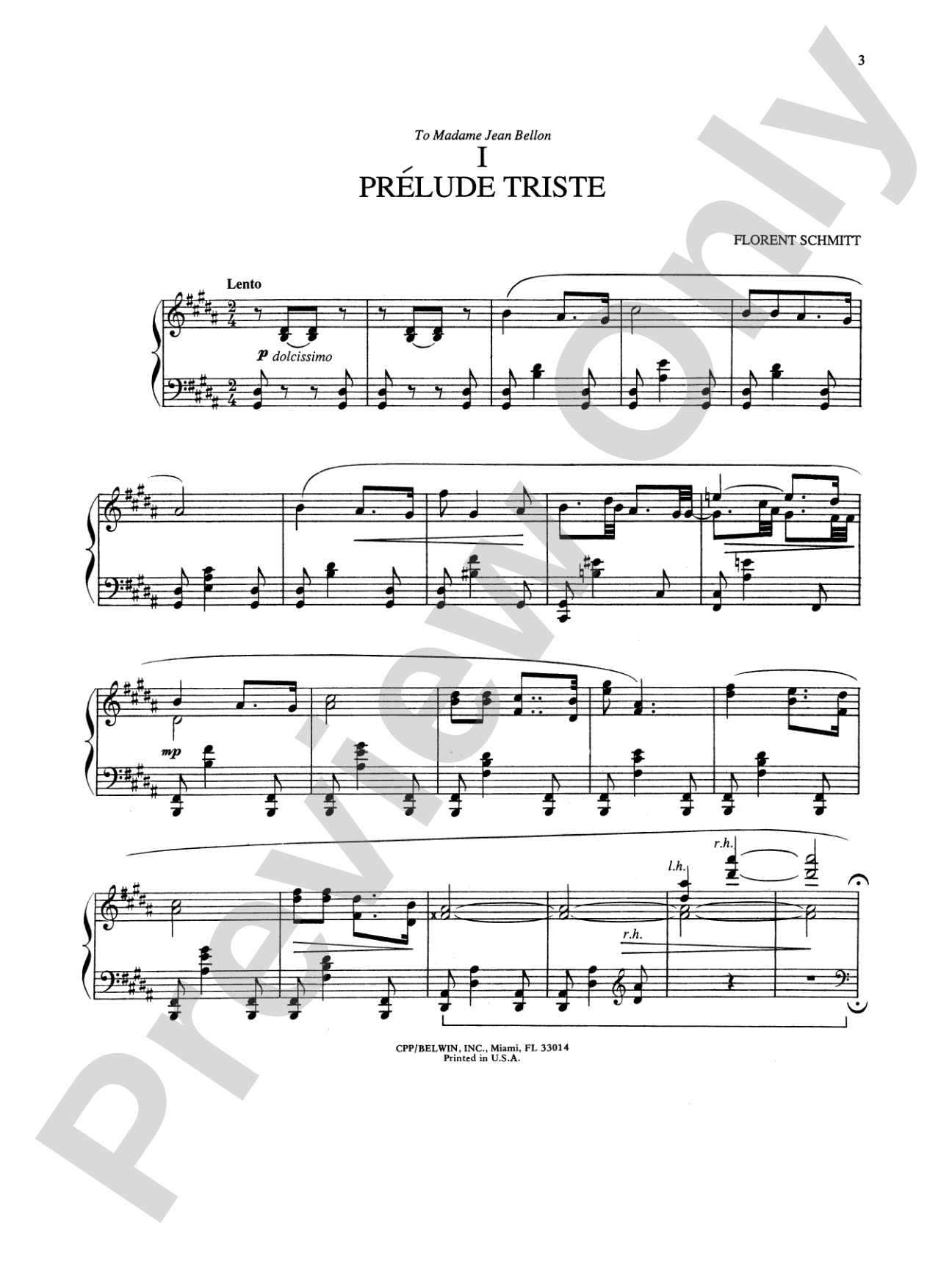
Schmitt: Three Preludes

By Florent Schmitt

Item: 00-PC-0014222

Digital Download
$1.99
Description
Three short preludes for the advancing player from the noted French composer Florent Schmitt. Each can be used separately, or grouped as a suite, and all three offer differing moods and writing styles. A brief biography is also included.

Don't just read it, hear it, play along with it, and watch your students grow with it. In MakeMusic Cloud, Schmitt: Three Preludes comes alive with professional accompaniment, adjustable tempo, and built-in practice tools that turn solo practice into real progress.

Sample Audio
No sample audio found.
Sample Video
Additional Details
Series: Kalmus Edition
Publisher: Alfred Music
Page Count: 12
SKU: 00-PC-0014222

More about this title

About the Composer: Florent Schmitt

Florent Schmitt (1870-1958) was a French composer whose prolific output spanned orchestral, chamber, choral, and keyboard works. A Prix de Rome winner and lifelong innovator, Schmitt bridged late Romanticism and early modernism, crafting music that balances lyrical expression with harmonic sophistication. His piano works reveal a composer deeply conversant with the instrument's expressive range, from delicate impressionistic gestures to robust, architecturally ambitious structures.

Schmitt's catalog includes over 130 compositions, many of which remain underperformed outside France. His music rewards careful study, offering pianists compelling examples of early 20th-century European writing that avoid predictable paths. For music educators, his works provide repertoire that challenges advancing students while remaining grounded in musical substance rather than virtuosic display.

Why we love this

These three preludes pack substantial musical content into a manageable package. Schmitt's structural clarity and harmonic language feel fresh even now, and the fact that each prelude works independently or as a suite gives you real programming flexibility. Students encounter genuine 20th-century compositional thinking without the intimidating technical demands of flashier contemporary work.

What to expect

Schmitt's preludes balance restraint with intensity. The writing is economical but never sparse, with moments of luminous harmonic color alongside passages of almost austere directness. You'll encounter impressionistic touches alongside sturdy architectonic thinking, creating a sonic world that feels distinctly early 20th-century without sacrificing warmth or lyricism.

Who it's for

Pianists at the advancing intermediate to early advanced level who are ready for repertoire beyond the standard Romantic canon. These pieces suit students preparing for recitals, auditions, or simply expanding their sense of what early 20th-century piano music can sound like. Teachers seeking accessible entry points into French modernism will find these preludes both pedagogically sound and musically rewarding.

How to get the most out of it

  • Treat each prelude as its own dramatic arc. Even though they're brief, each has a distinct mood that deserves clear characterization in sound and pacing.
  • Use the score's indications for pedal thoughtfully; Schmitt's harmony often depends on resonance, but clarity matters more than wash. Experiment with half-pedaling to preserve both color and definition.
  • Listen for the voice-leading beneath the surface. Schmitt often disguises melodic lines across registers; tracing these threads shapes phrasing and brings coherence to moments that might otherwise sound fragmented.
  • Allow time to sit with the harmonic language. These preludes reward slow, careful practice that attends to interval relationships and chord color rather than rushing toward notes.

How to use it

These three pieces work beautifully as a complete set in a student or professional recital, offering variety in mood and texture within a concise timeframe. They pair well with other French repertoire from the era, or can anchor a program exploring how different composers approached the prelude genre. Consider programming one or all three alongside Debussy or Ravel to show different approaches to modernist piano writing.

Skills your students will build

  • Voice-leading across broken harmonic textures
  • Pedal control and harmonic resonance in 20th-century harmonic language
  • Phrasing and characterization in non-traditional formal structures
  • Understanding of harmonic color and interval relationships in early modernism
  • Interpretive maturity through engagement with mid-length, character-based works

You May Also Like