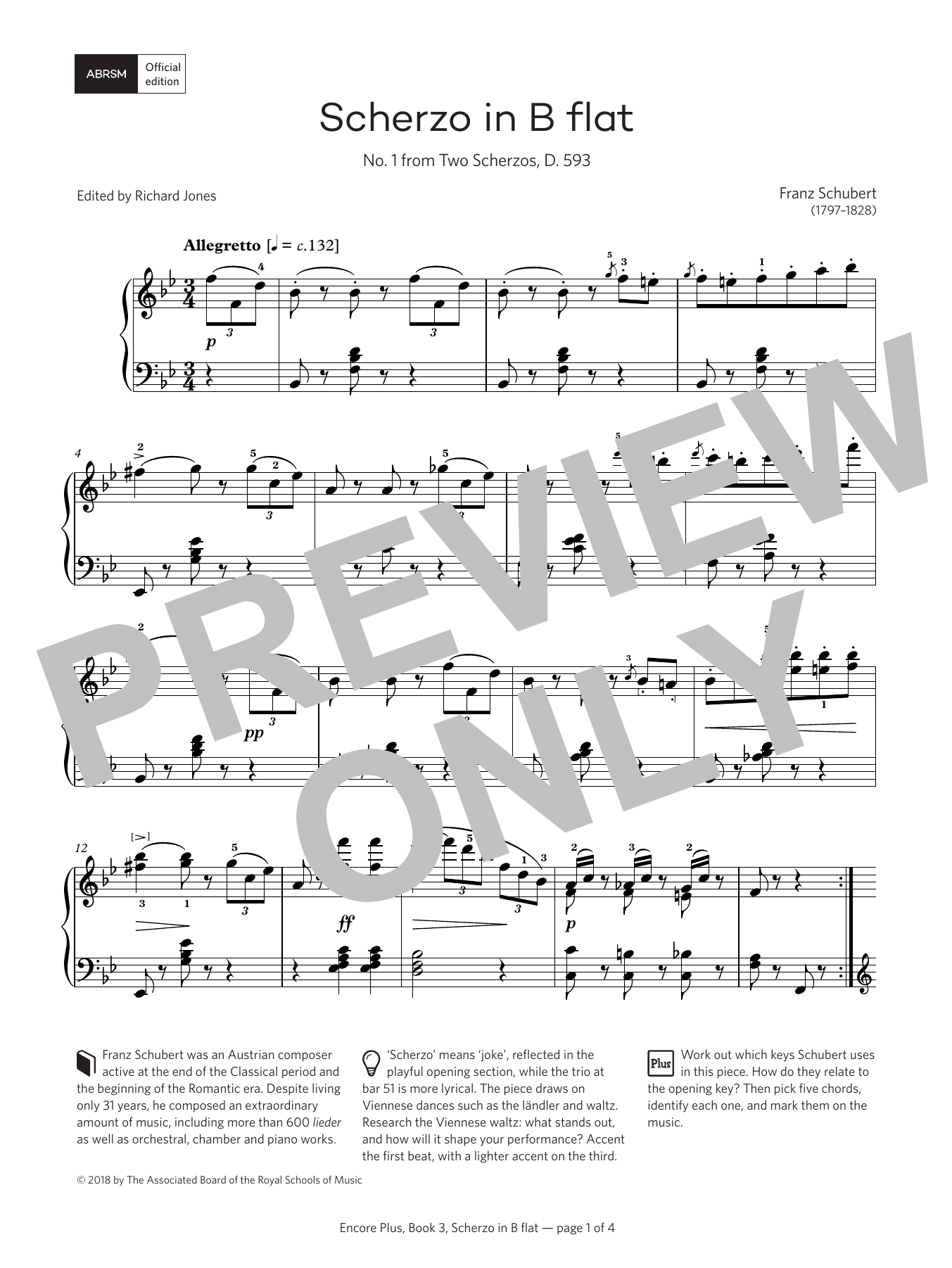
Franz Schubert lived a short life but left an enormous mark on music, composing across every major genre with remarkable fluency. His gift for melody and harmonic innovation shaped the Romantic era, and his piano works remain central to the repertoire for advancing pianists seeking depth beyond technical display.
Why we love this
Schubert's scherzos sit at that sweet spot where students encounter genuine compositional wit and formal sophistication without needing advanced virtuosity. The writing feels conversational and playful; it rewards attention to voice leading and phrasing rather than just speed, making it ideal for pianists ready to think like musicians rather than mechanics.
What to expect
The piece dances with a gentle humor characteristic of Schubert's scherzos. It moves between playful, almost impish themes and quieter, more introspective moments, unfolding with the conversational ease of a composer thinking through musical ideas in real time.
Who it's for
Grade 6 pianists working toward upper intermediate fluency who are ready to engage with Romantic period writing. This piece suits students who have solid technical foundation and want to explore lyrical expression and formal structure in classical repertoire.
How to get the most out of it
Clarify the rhythmic swing in the scherzo sections. Schubert often writes with a lilting quality that lives between strict time and rubato; let the natural accentuation of the melody guide your tempo.
Shape phrases by listening to the bass line as carefully as the melody. This piece thrives when both hands are equally engaged in storytelling.
Resist the urge to rush transitions between sections. The contrast between thematic material is most effective when each idea has space to register.
How to use it
Feature this in a classical showcase or salon recital where it can anchor a short Schubert set or sit comfortably alongside other Grade 6 repertoire. It also works well as a teaching concert piece that demonstrates stylistic understanding to an audience without demanding the stamina of longer sonata forms.
Skills your students will build
Scherzo form and character (typical structures and harmonic expectations)
Romantic period expression within Classical formal frameworks
Voice independence between melody and accompaniment
Phrasing and shape in lyrical passages
Tempo flexibility and rhythmic character within steady pulse
You May Also Like
Scan to Complete Your Purchase
Use your phone's camera to scan the code below
You'll log in on your phone and the order will be added to your account