
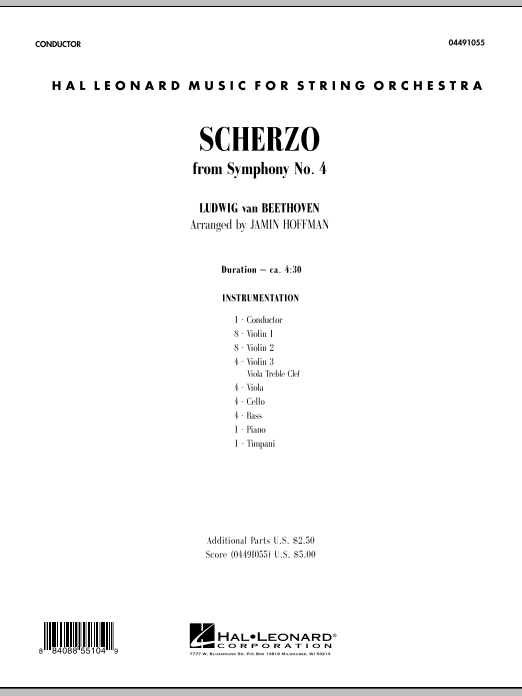

Scherzo from Symphony No. 4: String Orchestra Conductor Score & Parts
By Ludwig Van Beethoven / Arranged by Jamin Hoffman
Grade: 3-4
Item: 35-PK00175823
$45.00
Pickup currently not available
Buy Extra Parts (Digital PDF Download)
Parts Added to Cart!
Description
This lively movement is a masterpiece of hemiola, providing an opportunity for students to hone their counting skills. With strong, memorable themes featuring all sections of the orchestra and a beautiful middle section, this scherzo in minuet-trio form will have audiences whistling the melodies all the way home! Dur: 4:30


Scherzo from Symphony No. 4: String Orchestra Conductor Score & Parts isn't in MakeMusic Cloud just yet...but it could be. Let us know you'd like to see it, and you'll help shape what comes next. In the meantime, start a free trial and dive into thousands of interactive titles your students can play along with today.
Request This Title
Tell us you want it.
Start Your Free Trial
Explore everything that's ready to play right now.
Sample Audio
No sample audio found.
Sample Video
No sample videos found.
Additional Details
Publisher:
Hal Leonard
SKU:
35-PK00175823
More about this title
About the Composer: Ludwig Van Beethoven
Beethoven spent his career expanding the boundaries of symphonic form, and his Fourth Symphony stands as proof of his gift for combining structural innovation with infectious melodic writing. Composed during a period of relative personal stability, this work brims with wit and energy, making it a cornerstone of the classical orchestra repertoire and an invaluable teaching score.
Why we love this
The hemiola writing here demands genuine rhythmic clarity from your section leaders, yet the payoff is immediate. Audiences recognize these melodies instantly, and your students leave rehearsal humming Beethoven rather than groaning about counting exercises.
What to expect
Propulsive and playful, with a rhythmic cleverness that makes listeners sit up and pay attention. The middle section offers genuine lyrical warmth before the familiar themes charge back in with unstoppable momentum.
Who it's for
String orchestras working at the intermediate level who are ready to tackle rhythmic complexity without drowning in note-reading difficulty. This arrangement lets students engage directly with Beethoven's orchestration while building the counting stamina they need for later symphonic work.
How to get the most out of it
- Isolate the hemiola passages in sectional rehearsals by having one section tap the underlying pulse while another plays the superimposed rhythmic figure; this builds independence without requiring separate practice parts.
- Let the strong thematic material in the first section breathe; resist the urge to drive the tempo, as the scherzo character lives in the rhythmic snap, not the speed.
- Balance the lovely trio section by asking viola and cello to shape their lines with genuine singing tone; this contrast makes the return to the scherzo hit harder.
How to use it
Pair this with lighter overture fare for a concert celebrating the classical period, or program it mid-set when you need to recapture audience energy after a slower work. At under five minutes, it's the perfect closer for a chamber concert or the bridge piece in a longer symphonic program.
Skills your students will build
- Reading and performing hemiola rhythms across multiple measure groupings
- Maintaining subdivision through metric modulation
- Shaping contrasting themes with appropriate character and intensity
- Balancing melodic lines across string sections in minuet-trio form
- Listening for cueing points in a fast-moving orchestral score