
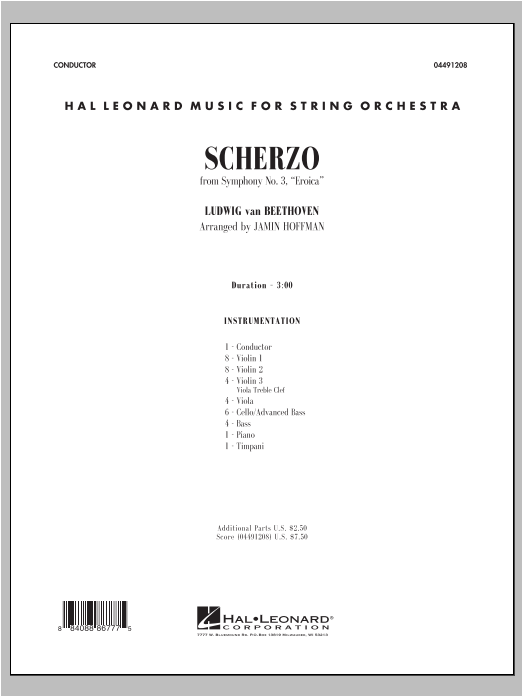

Scherzo from Symphony No. 3 (Eroica): String Orchestra Conductor Score & Parts
As performed by Ludwig Van Beethoven / Arranged by Jamin Hoffman
Grade: 3-4
Item: 35-PK00252316
$55.00
Pickup currently not available
Buy Extra Parts (Digital PDF Download)
Parts Added to Cart!
Description
Once again, Jamin Hoffman brings us a skilled adaption of a Beethoven symphony scherzo, this time from the beloved Eroica Symphony. The string writing is ideal for student orchestras and gives an opportunity to perform one of the great treasures of the classical symphonic repertoire, and a work that helped define elements of the coming Romantic period. Dur: 3:00


Scherzo from Symphony No. 3 (Eroica): String Orchestra Conductor Score & Parts isn't in MakeMusic Cloud just yet...but it could be. Let us know you'd like to see it, and you'll help shape what comes next. In the meantime, start a free trial and dive into thousands of interactive titles your students can play along with today.
Request This Title
Tell us you want it.
Start Your Free Trial
Explore everything that's ready to play right now.
Sample Audio
No sample audio found.
Sample Video
No sample videos found.
Additional Details
Publisher:
Hal Leonard
SKU:
35-PK00252316
More about this title
About the Artist: Ludwig Van Beethoven
Ludwig van Beethoven (1770-1827) fundamentally transformed the symphony from a light, entertaining form into a vehicle for profound artistic expression. His nine symphonies span nearly four decades and chart the evolution of Western music itself, expanding orchestral forces, deepening harmonic language, and broadening the emotional and structural possibilities of the genre. As a deaf composer in his final years, Beethoven proved that inner vision transcends physical limitation, leaving an indelible mark on every composer who followed.
For music educators, Beethoven's symphonies represent an essential pedagogical anchor. They teach students what symphonic thinking sounds like: how themes develop, how orchestration serves drama, and how a composer sustains coherence across large-scale works. The Eroica Symphony in particular marks a turning point, introducing the expanded orchestra and structural ambition that would define the Romantic era.
Why we love this
Jamin Hoffman's arrangement respects the structural brilliance and rhythmic drive of Beethoven's original while keeping the string writing within reach for developing ensembles. The scherzo's explosive energy and playful character make it an engaging performance experience; students encounter authentic classical symphonic language without the orchestration complexity that would require a full orchestra.
What to expect
Restless and witty, with sudden outbursts of energy that catch the ear. The scherzo bounces forward on nimble string figures and creates moments of surprising tenderness in the trio before the returning theme reasserts its playful character with renewed vigor.
Who it's for
String orchestra directors working with intermediate ensembles who want to program substantial classical repertoire without requiring a full orchestra. Students benefit from engaging with one of history's most important symphonies in a scaled arrangement that preserves the composer's essential ideas.
How to get the most out of it
- Shape the opening staccato figures with clarity and precision; they establish the scherzo's character immediately and benefit from crisp articulation across the section.
- Emphasize the dynamic contrasts. Beethoven marks sudden shifts between forte and piano, and honoring these changes creates the wit and surprise that define the movement.
- Balance the inner voices carefully during the contrapuntal passages. Violas and second violins often carry important harmonic or melodic material that colors the overall sound.
- Maintain rhythmic independence in the trio section; the shift in character needs clear differentiation in both tempo stability and articulation from your strings.
How to use it
Place this work on a classical concert to anchor student understanding of symphonic architecture, or pair it with a chamber work and a contemporary piece to frame how orchestral writing evolved from the early 19th century forward. It also serves well as a season opener, offering enough technical and musical substance to set an ambitious tone while remaining accessible enough to build ensemble confidence early in rehearsals.
Skills your students will build
- Classical articulation and phrasing conventions
- Dynamic shaping and sudden contrasts
- Part independence in contrapuntal writing
- Reading and executing rhythmic figures in staccato and legato
- Balancing inner voices while maintaining forward momentum
- Responding to subtle character changes between main theme and trio