
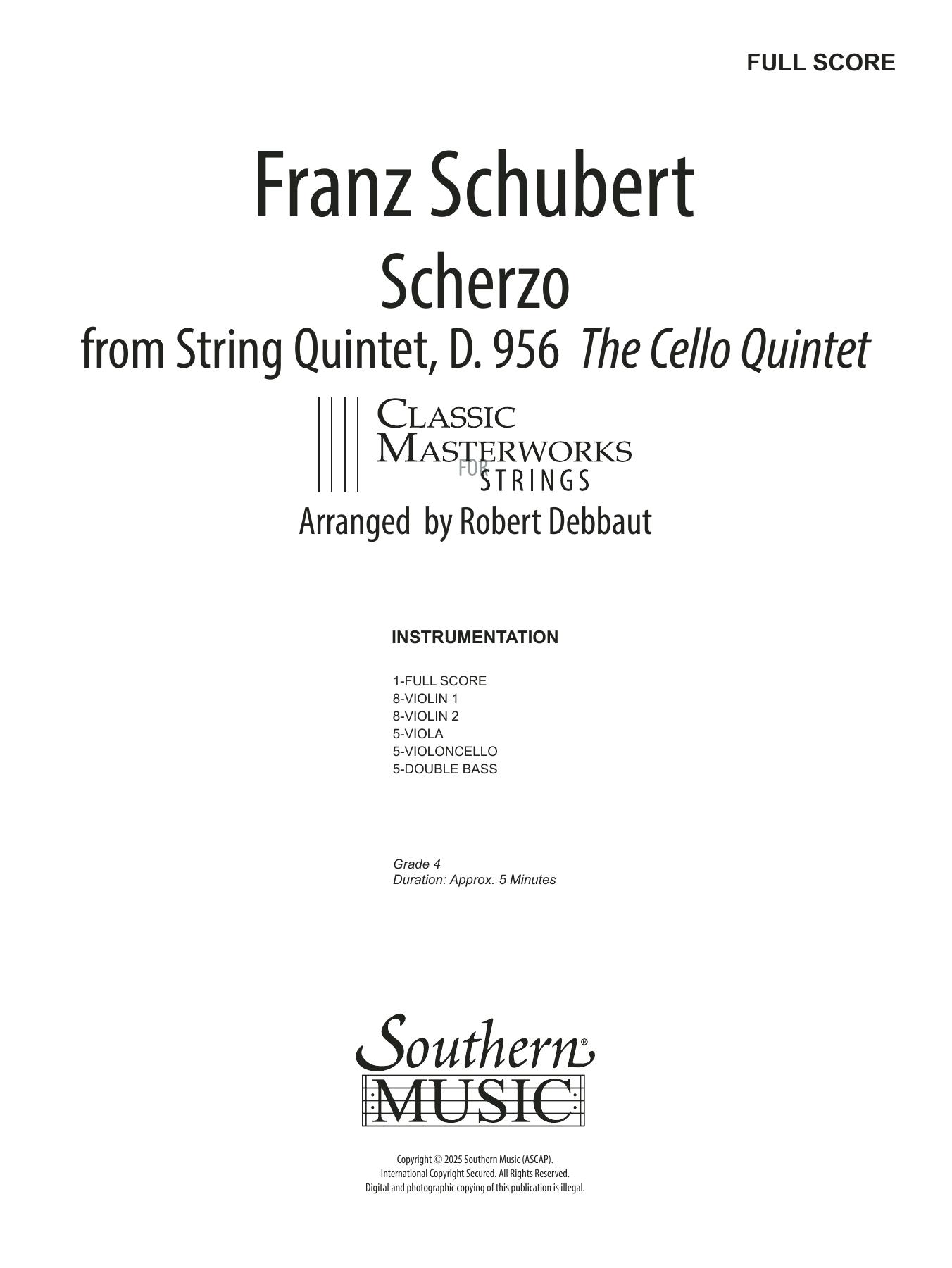

Scherzo from String Quintet, D. 956 (arr. Robert Debbaut): String Orchestra Conductor Score & Parts
By Franz Schubert / Arranged by Robert Debbaut
Grade: 4
Item: 35-PK01725440
$65.00
Pickup currently not available
Buy Extra Parts (Digital PDF Download)
Parts Added to Cart!
Description
The String Quintet in C major (D.956, Op. Posth. 163) is Schuberts final chamber work. It is sometimes called the Cello Quintet because unlike the standard string quintet, which includes an extra viola, this work adds an extra cello. Completed just two months prior to the composers death, it did not receive its first performance until 1850. The third movement Scherzo itself close to eleven minutes in length comprises two large sections, with a repeat of the first section to create a fast-slow-fast format. This version for advanced string orchestra condenses the performance time to about five minutes while retaining all the essential melodic mastery of Schubert.


Scherzo from String Quintet, D. 956 (arr. Robert Debbaut): String Orchestra Conductor Score & Parts isn't in MakeMusic Cloud just yet...but it could be. Let us know you'd like to see it, and you'll help shape what comes next. In the meantime, start a free trial and dive into thousands of interactive titles your students can play along with today.
Request This Title
Tell us you want it.
Start Your Free Trial
Explore everything that's ready to play right now.
Sample Audio
No sample audio found.
Sample Video
No sample videos found.
Additional Details
Publisher:
Hal Leonard
SKU:
35-PK01725440
More about this title
About the Composer: Franz Schubert
Schubert spent his short life in Vienna composing across every major genre, yet he remains best known for his lieder and chamber works. His gift for melody was almost inexhaustible; even in his most structurally ambitious pieces, themes emerge with the inevitability of folk song.
The String Quintet in C major arrived near the end of his life, when his harmonic language had grown richer and more exploratory. Unlike his earlier chamber works, this quintet trades the traditional second viola for a second cello, a choice that darkens the sonority and allows for greater textural depth. It stands as one of his final testaments to the power of pure instrumental lyricism.
Why we love this
Advanced student orchestras rarely encounter Schubert at this level, and this arrangement opens a door to one of music's most elegant three-movement structures. The Scherzo especially rewards careful listening; its rhythmic playfulness and sudden harmonic shifts keep players engaged without demanding virtuosic display. Robert Debbaut's condensation respects the original's architecture while making it accessible to ensembles that might not tackle the full quintet.
What to expect
A conversation between energetic humor and introspection. The opening scherzo dances with a light touch, then yields to a slower middle section that reveals unexpected emotional depth before the first theme returns. Throughout, the writing sings in that distinctly Schubertian way where melody feels inevitable yet surprising.
Who it's for
Advanced high school and college string orchestras looking to expand beyond standard Grade 4 repertoire into chamber music idioms. Directors seeking to introduce students to Schubert's late style without the rehearsal demands of his full chamber works.
How to get the most out of it
- Shape the opening theme with warmth rather than brassiness; Schubert's writing assumes the rounded sound of a chamber group, not a full orchestra.
- Pay attention to the harmonic surprises in the middle section. They deserve a slight tenuto and a conscious shift in color to register for listeners.
- Balance the cello voices carefully. With two cello parts in the original concept, the lowest voice can muddy if the first cellos overshadow the seconds.
- Resist the urge to rush the Minore section. Schubert builds depth through stillness, and restraint in tempo pays off when the scherzo returns.
How to use it
Pair this with larger Romantic works to show Schubert's chamber sensibility at concert length. It also serves as an excellent gateway to the complete quintet; students who master this version have internalized the harmonic language and will grasp the original more quickly.
Skills your students will build
- Balancing multiple melodic lines within a single section
- Maintaining rhythmic precision in syncopated figures
- Navigating sudden key shifts and harmonic modulation
- Sustaining warm tone across extended phrases
- Responding to conductor cues in contrasting sections