
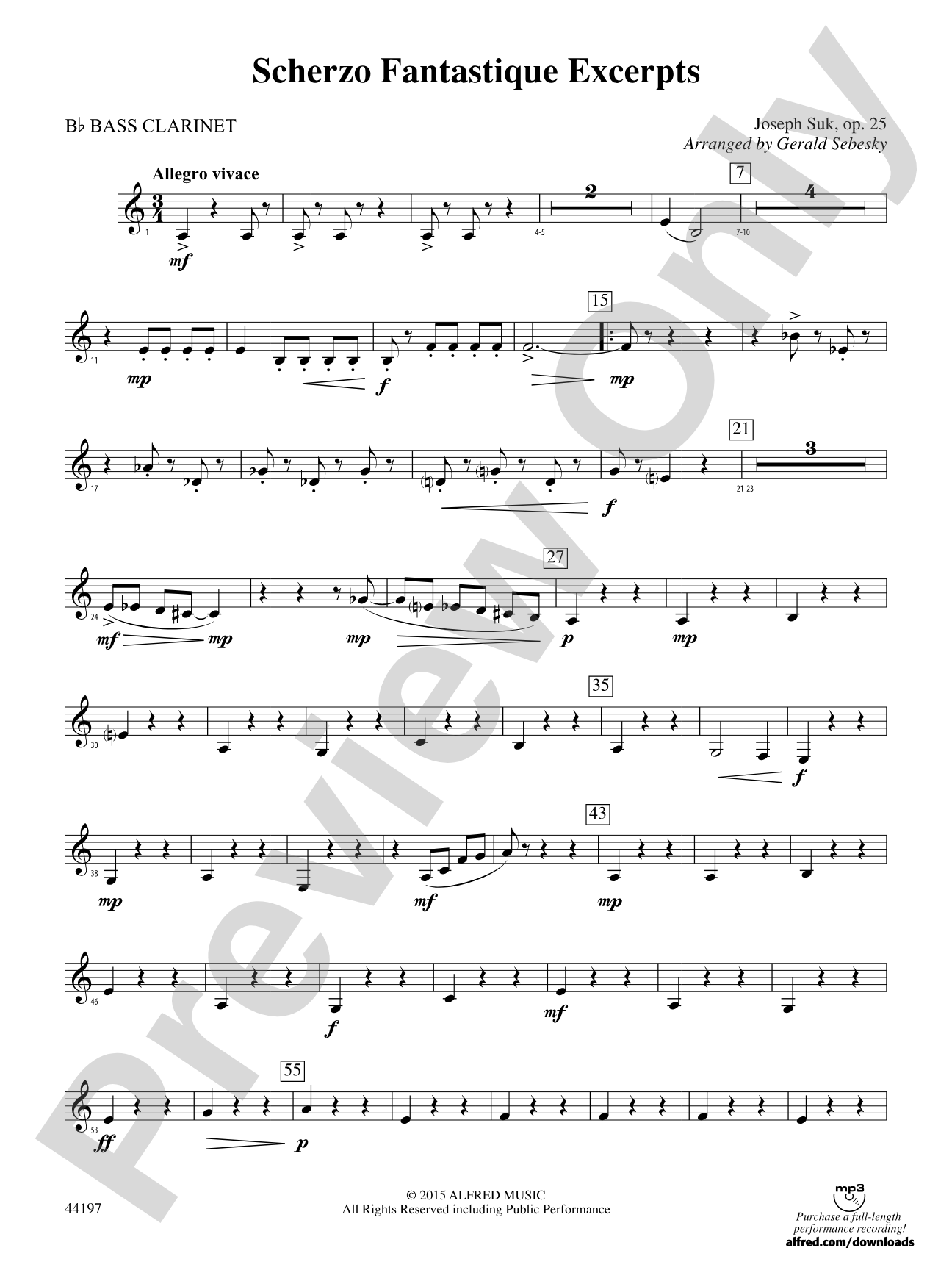

Scherzo Fantastique Excerpts: B-flat Bass Clarinet
Op. 25
By Joseph Suk / arr. Gerald Sebesky
Grade: 3.5 (Medium)
Item: 00-PC-0017047_BC
$5.99
Pickup currently not available
Description
Joseph Suk, considered to be one of the leading composers in Czech Modernism, began composing at the age of 17 and was greatly inspired by his teacher Antonin Dvorák. His original "Scherzo Fantastique" is a 15-minute work, scored for full Romantic orchestra. This charming arrangement highlights the main thematic material in a condensed, yet authentic presentation for concert band. (3:45)


Don't just read it, hear it, play along with it, and watch your students grow with it. In MakeMusic Cloud, Scherzo Fantastique Excerpts: B-flat Bass Clarinet comes alive with professional accompaniment, adjustable tempo, and built-in practice tools that turn solo practice into real progress.
Open in the Player
Jump straight in and assign it today.
Start Your Free Trial
Open this title and explore the full library in minutes.
Sample Audio
1
Audio File
--:--
0:00
0:00
Sample Video
No sample videos found.
Additional Details
Series:
Alfred Concert Band
Publisher:
Alfred Music
Page Count:
262
SKU:
00-PC-0017047_BC
More about this title
About the Composer: Joseph Suk
Joseph Suk (1874-1935) stands as one of the defining voices of Czech Modernism, a composer who bridged Romantic lyricism with early twentieth-century harmonic innovation. A composition student of Antonín Dvořák, Suk absorbed his teacher's gift for memorable melody and rich orchestration while developing a more introspective, emotionally complex musical language. He spent most of his life in Prague, where he was active as a composer, violinist, and educator, leaving behind a substantial catalog that includes symphonies, chamber works, and orchestral tone poems that remain central to Czech musical identity.
Suk's orchestral writing is characterized by sophisticated textures, bold harmonic shifts, and a keen sense of thematic development. His works often explore psychological and philosophical themes with remarkable depth, moving beyond the nationalistic program music of his contemporaries. Though less frequently performed internationally than his mentor Dvořák, Suk's music has earned increasing recognition among conductors and audiences who appreciate its emotional substance and compositional craft.
Why we love this
This arrangement distills fifteen minutes of orchestral invention into a tight, four-minute concert work without sacrificing Suk's harmonic sophistication or melodic appeal. Gerald Sebesky's orchestration for concert band honors the original's textural clarity while making the piece entirely idiomatic for wind instruments, giving students access to genuine twentieth-century Czech modernism at a Grade 3.5 level. The condensed form and high-quality arrangement make this an excellent choice for directors seeking substantial musical content that doesn't require rehearsal time proportional to a full-length work.
What to expect
A scherzo with restless energy and psychological undercurrent, this music darts and turns with wit and sophistication. Suk's chromaticism and harmonic ambiguity give familiar Romantic gestures an unsettling, almost sardonic edge; the piece entertains while it intrigues, never settling into comfortable predictability.
Who it's for
This score and parts set serves concert band directors at the intermediate to early advanced level who want to program music of genuine artistic substance without committing to an extended rehearsal timeline. Students encounter authentic early twentieth-century compositional voice and Czech musical idiom while building facility with the harmonic language of modernism.
How to get the most out of it
- Balance the primary melody against Suk's habit of layering independent lines in the harmony; resist the urge to let sustained chords overwhelm the thematic material.
- Attend carefully to harmonic color and voice leading in the transition passages, where Suk shifts tonal centers. These moments require clean articulation and steady pulse to prevent muddiness.
- Shape phrases according to Suk's chromatic voice movement rather than phrase lengths that feel obvious; this music rewards subtle, informed conducting that allows harmonies to speak.
- Bring the woodwind and brass sections into balance during tutti sections so that Suk's orchestration strategy remains audible; the original orchestral version depends on clarity of instrumental families.
How to use it
Program this as a concert opener or as a clever interlude between heavier works; its condensed length and moderately advanced difficulty make it ideal for a spring concert where you want to showcase student musicianship without overextending rehearsal capacity. It also pairs well with other early twentieth-century European works or with standard Romantic repertoire, offering students a window into how composers were reimagining the concert band sound in that era.
Skills your students will build
- Navigating chromatic harmony and tonal ambiguity in early twentieth-century modernist writing
- Balancing independent melodic lines and complex voiced harmonies
- Shaping longer phrases that follow harmonic rather than metric architecture
- Reading and performing sophisticated orchestral textures adapted idiomatically for wind band