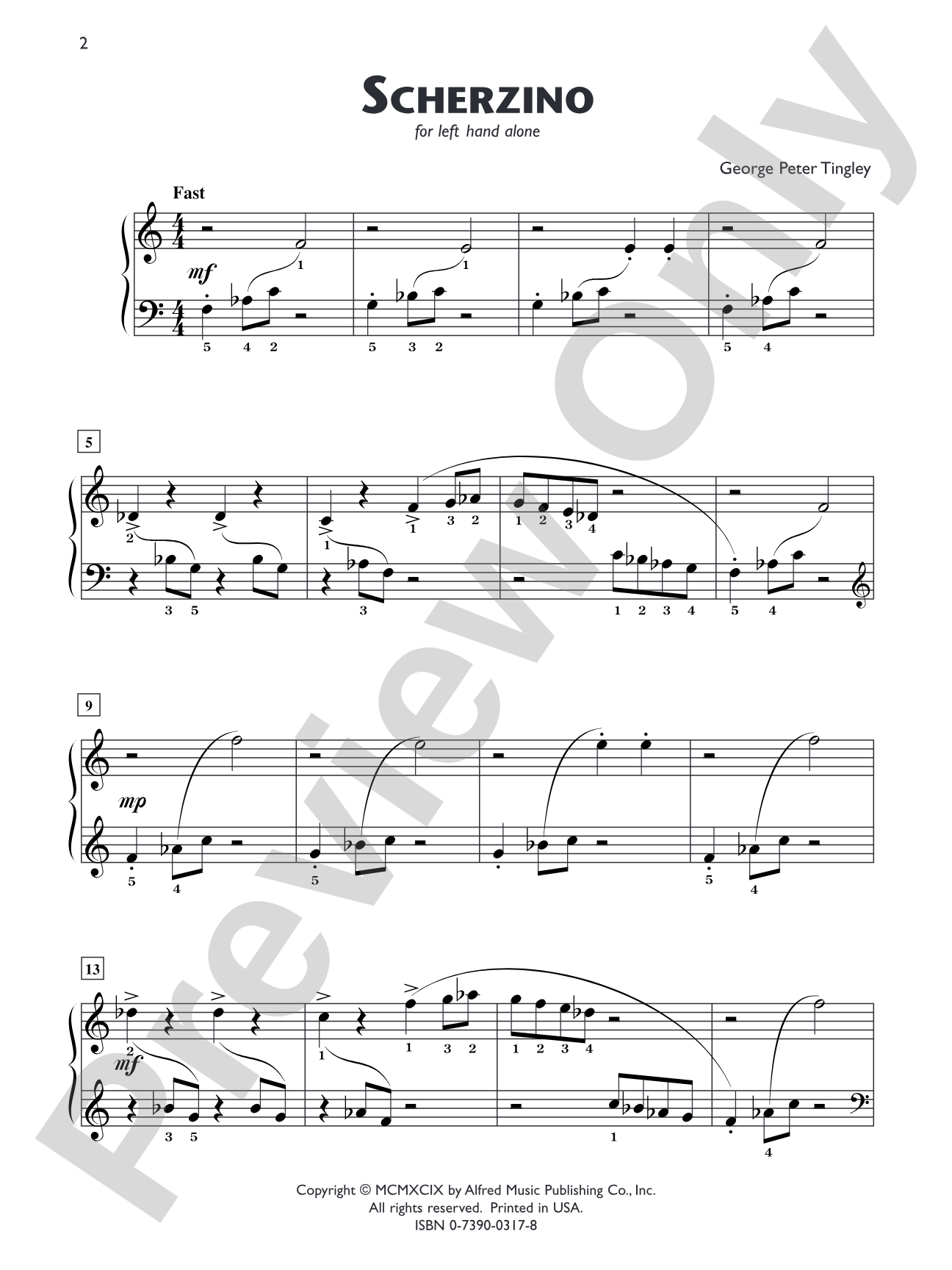
Scherzino (for left hand alone) - Piano Solo Sheet Music Preview

Scherzino (for left hand alone) - Piano Solo: Piano

By George Peter Tingley

Level: Early Intermediate

Item: 00-PB-0000752

Digital Download
$3.50
Description
This little scherzo for the left hand alone is a two-page piece suitable for early intermediate students. In the key of F minor, it moves at a fast, accented pace with some leaps of an octave or more. Contrasting dynamics are also featured. A Federation Festivals 2016-2020 selection. A Federation Festivals 2020-2024 selection.

Scherzino (for left hand alone) - Piano Solo: Piano isn't in MakeMusic Cloud just yet...but it could be. Let us know you'd like to see it, and you'll help shape what comes next. In the meantime, start a free trial and dive into thousands of interactive titles your students can play along with today.

Sample Audio
No sample audio found.
Sample Video
Additional Details
Publisher: Alfred Music
Page Count: 4
SKU: 00-PB-0000752

More about this title

About the Composer: George Peter Tingley

George Peter Tingley

George Peter Tingley grew up in the Oakland area and began violin at age four before discovering piano at ten. He quickly gravitated toward composition and improvisation, crediting his teenage years spent playing along with Beatles records as formative musical training. He earned degrees in Piano Performance from California State University, Hayward, and in Music Theory from USC, where he also studied composition privately with Nadia Boulanger during the 1970s in Paris.

After returning to California, Tingley built a career as a private teacher and educational composer, publishing over 75 piano pieces since 1989. His work has reached competitive festivals nationwide; his duet collection "Fiddle and the Tuba" is listed by the National Federation of Music Clubs, and his composition "Kristi's Theme" was commissioned for Olympic figure skater Kristi Yamaguchi and orchestrated for full symphony. He continues to live and work in Point Richmond, California.

Why we love this

This piece tackles a genuine pedagogical challenge: giving early intermediate students a technically rewarding solo that doesn't require two hands. The left hand carries all the musical weight here, building independence and control while the student navigates F minor, rhythmic accents, and dynamic contrast. It's genuine composition, not a technical exercise, and its inclusion in two consecutive Federation Festivals cycles proves its value to adjudicators and students alike.

What to expect

Bright and restless, like a musical idea that won't sit still. The F minor key and rapid accents give it a playful, almost mischievous quality, while the dynamic shifts and octave jumps keep both performer and listener engaged across its two pages.

Who it's for

Early intermediate pianists ready to explore left-hand independence and rhythmic precision. This is ideal for students working toward festival competitions or looking for a confident solo that demands musicality without requiring advanced double-note technique.

How to get the most out of it

  • Prepare the octave leaps separately at a steady, comfortable tempo before bringing them up to the piece's intended fast pace; this builds security and prevents tension in the forearm.
  • Map the dynamic changes on a first reading and give them as much attention as you would in a two-handed piece; the contrast shapes the form and keeps the scherzo character lively.
  • Anchor the accented rhythms with a confident, clear touch rather than forcing volume; precision of articulation matters more than loudness when one hand carries the entire texture.

How to use it

Strong choice for a student recital where you want to feature a capable early intermediate pianist in a solo that sounds ambitious without overwhelming them. It also works well as a Festival Festivals selection or as an interlude between larger ensemble pieces on a studio recital, where its compact length and distinctive character provide welcome contrast.

Skills your students will build

  • Left-hand independence and control across a wide range of the keyboard
  • Executing octave leaps cleanly and confidently
  • Shaping dynamic contrasts within a fast, accented rhythmic framework
  • Reading and interpreting accented articulation marks
  • Navigating F minor tonality

You May Also Like