Scenes from the Louvre (arr. Robert Longfield) Sheet Music Preview

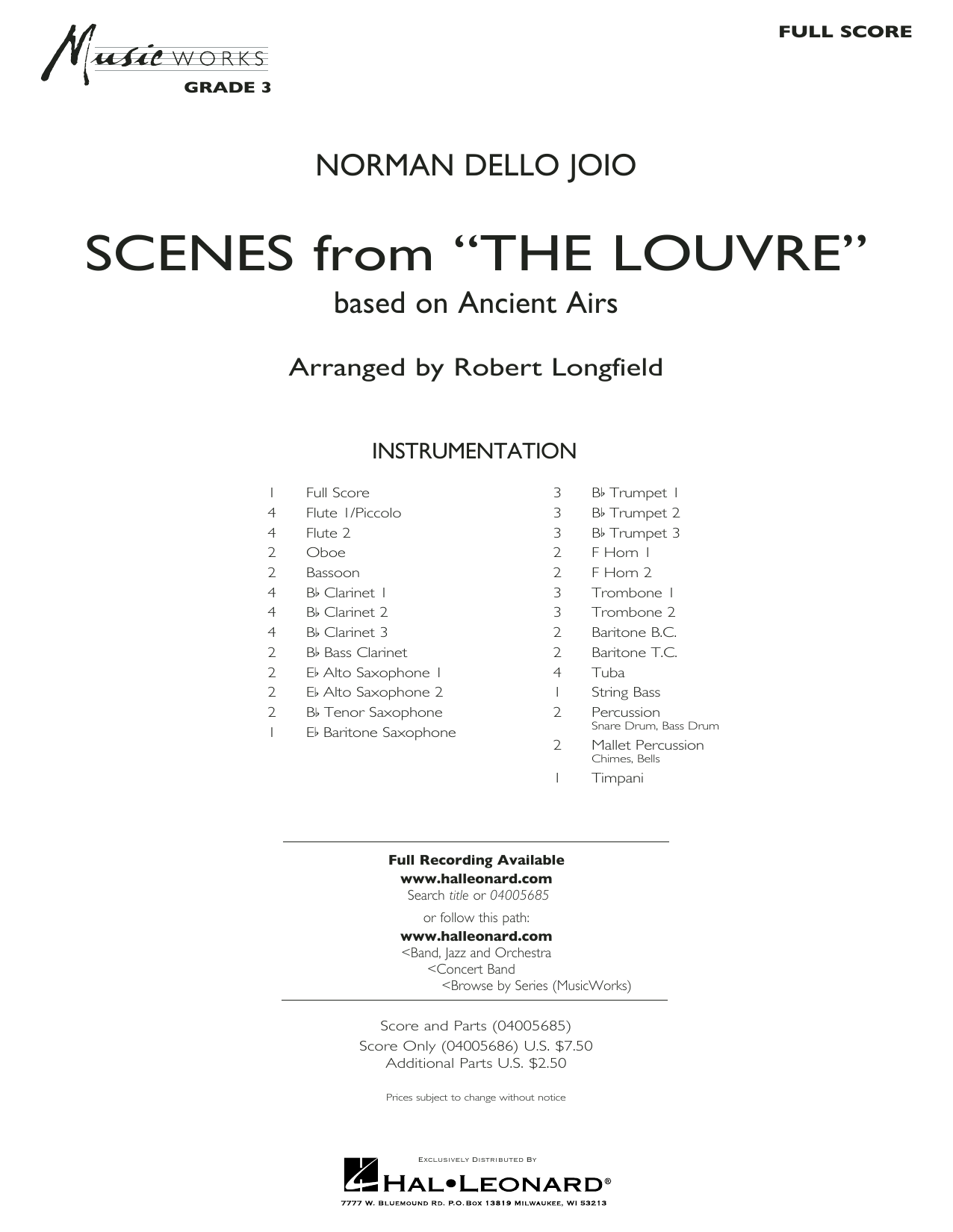
Scenes from the Louvre (arr. Robert Longfield): Concert Band Conductor Score & Parts

By Norman Dello Joio / Arranged by Robert Longfield

Grade: 3

Item: 35-PK00435132

Digital Download
$75.00

One moment…

Description
Composer Norman Dello Joio (1913-2008) received an Emmy award for his 1965 score for the television program "The Louvre". His concert band adaptation resulted in a five movement suite combining original material with themes by Renaissance composers such as Susato, Lully, and Cesti. In this arrangement for younger players, Robert Longfield skillfully truncates each movement and lessens the technical demands while carefully maintaining the essence of this masterful wind band repertoire classic. Dur: ca. 6:00

Scenes from the Louvre (arr. Robert Longfield): Concert Band Conductor Score & Parts isn't in MakeMusic Cloud just yet...but it could be. Let us know you'd like to see it, and you'll help shape what comes next. In the meantime, start a free trial and dive into thousands of interactive titles your students can play along with today.

Sample Audio
No sample audio found.
Sample Video
Additional Details
Publisher: Hal Leonard
SKU: 35-PK00435132

More about this title

About the Composer: Norman Dello Joio

Norman Dello Joio (1913-2008) built a career bridging classical composition with popular media. His 1965 television score for "The Louvre" earned him an Emmy and demonstrated his gift for writing accessible, engaging music that reaches beyond concert hall audiences. His orchestral and band works balance modernist sensibilities with lyrical melodic writing, making his music particularly valuable for educators seeking substantial repertoire that doesn't alienate younger ensembles.

Dello Joio's approach to arranging existing material, evident in this suite of Renaissance themes, reveals a composer who understood how to honor historical sources while creating something fresh. His concert band works remain standards in the educational repertoire because he never talked down to student musicians; instead, he wrote with clarity and respect for what developing players could accomplish.

Why we love this

Longfield's adaptation preserves the five-movement architecture and sophisticated harmonic language of Dello Joio's original while respecting what Grade 3 bands can realistically execute. This lets your students experience genuine concert music rather than a simplified knockoff; they're performing real material, just scaled appropriately. The Renaissance source material gives the suite historical depth, making it rich teaching repertoire that extends beyond pure technique.

What to expect

Stepping through a museum where Renaissance paintings are suddenly animated by a modern sensibility. Themes that feel historically grounded meet Dello Joio's lush harmonic language and orchestration, creating something that honors the past while sounding distinctly mid-century. The suite alternates between energetic dances and reflective, lyrical passages that give performers genuine emotional material to shape.

Who it's for

Grade 3 bands with solid fundamentals and players ready to handle straightforward sixteenth-note figures and moderate range demands across all sections. Directors seeking substantial concert repertoire that fills a full program slot (six minutes) without requiring multiple years of sectional mastery work.

How to get the most out of it

  • Balance the texture between melody and supporting voices across movements. The Renaissance themes deserve clear statement, but Dello Joio's orchestration creates interdependent lines that will disappear if any section dominates.
  • Let the pacing breathe between movements rather than pushing tempo throughout. Each section has distinct character; rushing them together flattens what makes the suite memorable.
  • Listen closely to how woodwind doublings shift from movement to movement. These subtle instrumental choices drive much of the piece's variety, so intentional voice leading matters more than volume here.

How to use it

Position this as your anchor piece in a concert built around historical themes or musical travel, pairing it with other works that explore different periods or traditions. At six minutes, it sits perfectly as a centerpiece without overshadowing lighter openers or giving way to a single heavy closer. The cultural and artistic dimension makes it particularly effective in concerts that include educational program notes or presentations on Renaissance music.

Skills your students will build

  • Interpreting harmonic color and balance in Renaissance-derived melodic material
  • Sustaining attention across sectional transitions while maintaining ensemble coherence
  • Executing articulation and phrasing that honors both dance rhythms and lyrical passages
  • Reading simple polyphonic textures where multiple independent lines create the overall fabric
  • Responding to subtle dynamic and tempo shifts that shape character between movements

You May Also Like