
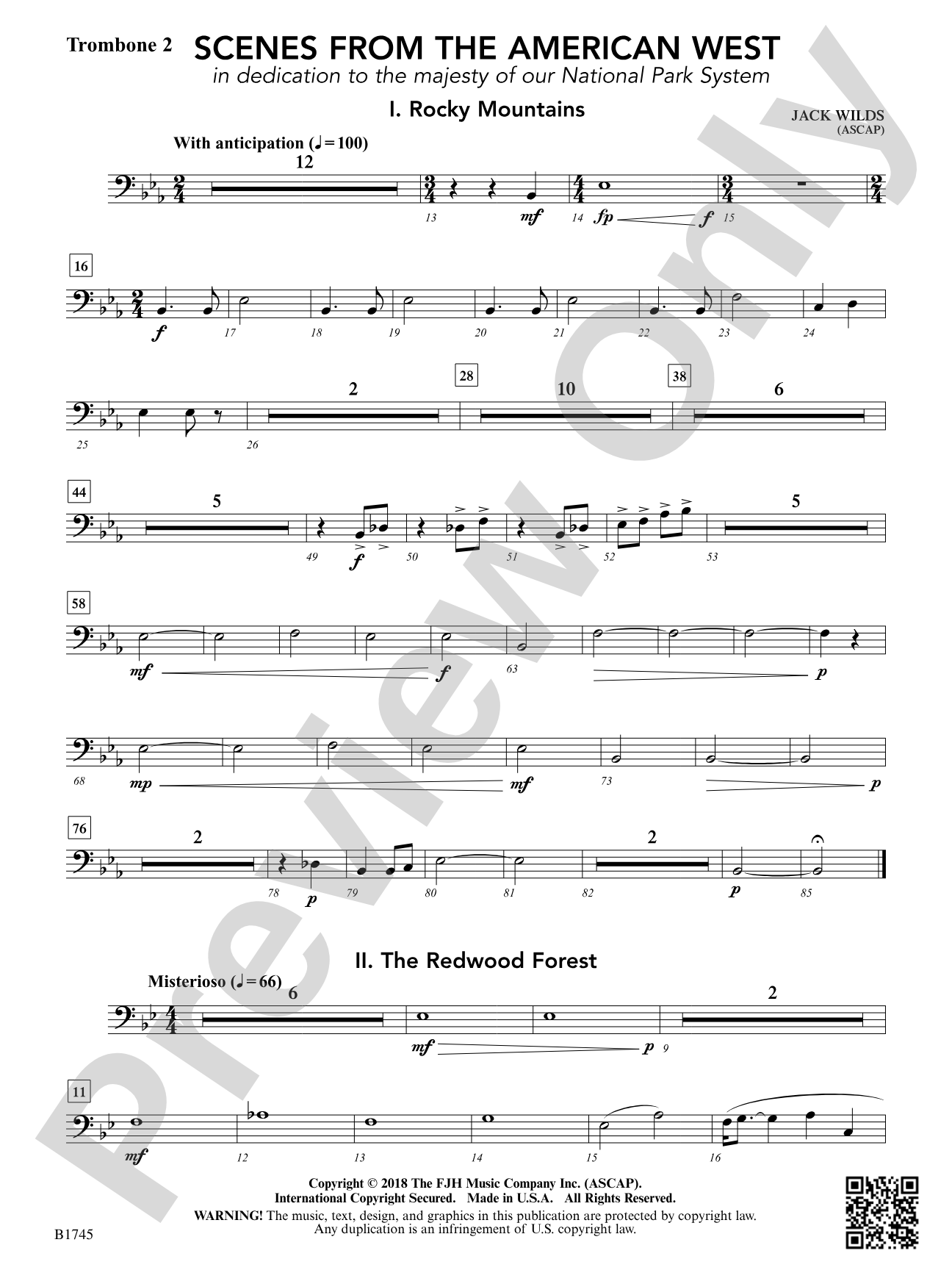

Scenes from the American West: Trombone 2
By Jack Wilds
Grade: 2.5
Item: 98-PC-DB1745_TN2
$7.00
Pickup currently not available
Description
Commissioned to commemorate the 100th anniversary of America’s National Park Service, this suite is a musical portrait of three cherished natural areas. The first movement is a short fantasia based on the folk song Rocky Mountain. The second movement portrays wonder at the sheer size and scope of the Redwood forest. The last movement is a fast, energetic portrayal of ancient pictographs found at Big Bend National Park.


Scenes from the American West: Trombone 2 isn't in MakeMusic Cloud just yet...but it could be. Let us know you'd like to see it, and you'll help shape what comes next. In the meantime, start a free trial and dive into thousands of interactive titles your students can play along with today.
Request This Title
Tell us you want it.
Start Your Free Trial
Explore everything that's ready to play right now.
Sample Audio
1
Audio File
--:--
0:00
0:00
Sample Video
Additional Details
Series:
FJH Young Band
Publisher:
The FJH Music Company, Inc.
SKU:
98-PC-DB1745_TN2
More about this title
About the Composer: Jack Wilds

Jack Wilds composes across ensemble types and age groups, from children's choirs through professional orchestras. His work draws inspiration from visual art, literature, philosophy, and music itself, resulting in pieces that challenge developing musicians while remaining accessible to them. His chamber works have been performed by the Attacca Quartet, members of the New York Philharmonic and Atlanta Symphony, and at international festivals including the International Trombone Festival and Wyoming Festival.
A former public school band director, Wilds has published over 40 works for wind ensemble and choir at developing levels. His wind band compositions appear on festival required repertoire lists across multiple continents and have been performed at the Midwest Clinic and educator conferences nationwide. He teaches composition, music theory, ear training, and music technology at Texas State University and serves as Co-Director of Music at First Presbyterian Church in San Marcos, a position he has held for 13 years.
Why we love this
Wilds captures the grandeur of America's natural wonders without asking your band to exceed its technical grasp. The three contrasting movements give you a complete concert arc that feels substantial, while the Grade 2.5 writing keeps rehearsal time focused on musicality rather than mechanics. This is the kind of patriotic work that actually sounds like it belongs in a concert, not a checklist.
What to expect
Three distinct musical landscapes unfold within manageable technical bounds. The opening evokes the rugged dignity of mountain terrain through folk melody, the middle section builds contemplative wonder at immense natural scale, and the final movement erupts with primitive energy and visual storytelling.
Who it's for
Directors programming grade 2 to 3 bands who want substantial, meaningful literature that connects to American history. The suite works equally well for concert bands approaching contest/festival repertoire requirements or those building programs around thematic programming.
How to get the most out of it
- Find the character within each movement's tempo; the opening fantasia needs breath and space, not just note accuracy. Shape the phrasing as if telling the story of the mountains themselves.
- Balance the second movement's textural layers carefully. The Redwood forest movement builds wonder through layering, so transparency in the middle voices will let the full architecture emerge.
- The final movement's energy comes from rhythmic precision and articulation clarity rather than speed. Lock the section's rhythmic pulse early in rehearsal so the pictograph imagery can drive the musical narrative.
How to use it
This suite functions beautifully as a complete concert program segment, allowing you to program a full narrative arc in one work. Its patriotic and educational roots make it ideal for concerts celebrating American heritage, national parks, or environmental themes. The contest/festival designation also makes it a strong choice for spring competition calendars where judges expect substantive Grade 2-3 repertoire.
Skills your students will build
- Ensemble blend and balance across varied textures and instrumental combinations
- Phrasing and musical storytelling through extended melodic lines
- Rhythmic precision in folk-based material and energetic final section
- Dynamic control and sustain across three distinct musical moods
- Reading and executing programmatic cues that connect music to visual imagery