
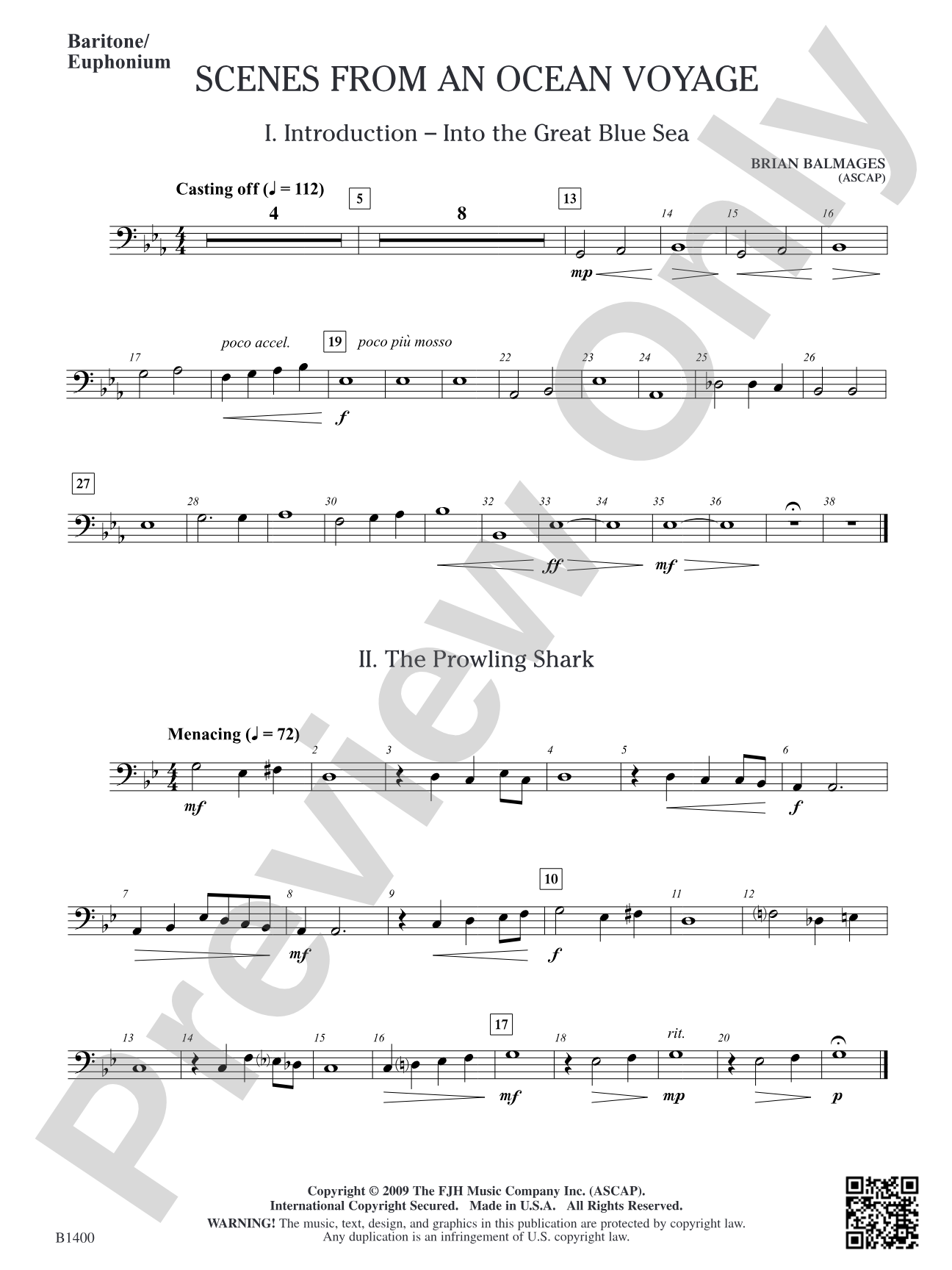

Scenes from an Ocean Voyage: Baritone/Euphonium
By Brian Balmages
Grade: 1.5;2
Item: 98-PC-DB1400_BBC1
$7.00
Pickup currently not available
Description
This spectacular four-movement work paints extraordinary pictures of sea life. Movements include Introduction - Into the Great Blue Sea, The Prowling Shark, Dolphins at Play, and Whale Sighting. Wonderfully programmatic with a wide array of effects and imagery, this work is orchestrated to sound much more difficult than its grade level indicates. Perform the entire work or just a few movements - they all stand on their own. Extremely engaging!


Don't just read it, hear it, play along with it, and watch your students grow with it. In MakeMusic Cloud, Scenes from an Ocean Voyage: Baritone/Euphonium comes alive with professional accompaniment, adjustable tempo, and built-in practice tools that turn solo practice into real progress.
Open in the Player
Jump straight in and assign it today.
Start Your Free Trial
Open this title and explore the full library in minutes.
Sample Audio
1
Audio File
--:--
0:00
0:00
Sample Video
No sample videos found.
Additional Details
Series:
FJH Developing Band
Publisher:
The FJH Music Company, Inc.
SKU:
98-PC-DB1400_BBC1
More about this title
About the Composer: Brian Balmages

Brian Balmages moves fluidly across orchestral, band, and chamber music spheres, earning recognition from major institutions and venues worldwide. His compositions have been heard at Carnegie Hall, the Kennedy Center, the Sydney Opera House, and the Toronto Centre for the Arts, performed by ensembles ranging from professional orchestras to elementary school groups. He received the A. Austin Harding Award from the American School Band Directors Association, won the 2020 NBA William D. Revelli Composition Contest for Love and Light, and was elected to the American Bandmasters Association.
As both composer and conductor, Balmages maintains an active guest conducting schedule with all-state ensembles, university groups, and professional orchestras across the globe. He has conducted at the Midwest Clinic, Western International Band Clinic, and numerous international conferences. His music was performed during the 2013 Presidential Inaugural Prayer Service, and he has received commissions from major universities including Miami, where he composed for the presidential inauguration. Balmages currently serves as Director of MakeMusic Publications and Digital Education for Alfred and MakeMusic.
Why we love this
Balmages crafts vivid scenes that pull young players into the story with orchestration that feels far more sophisticated than the actual technical demands. Each movement captures distinct character and texture without requiring advanced ranges or rhythmic complexity, making this ideal for building musical maturity in developing bands. The optional structure lets you perform standalone movements for shorter concerts or program the full cycle for larger events.
What to expect
A journey across open water. The opening invites you into endless blue expanses; the shark section crackles with tension and danger; the dolphins bounce and weave with joy; the whale reveals itself as a majestic, moving presence. The work breathes and shifts like an actual voyage, never settling into routine.
Who it's for
Developing concert bands and intermediate ensembles looking for repertoire with genuine artistic substance at grade 1.5, 2. Directors seeking contest or festival material that engages students through narrative programming while remaining technically accessible.
How to get the most out of it
- Shape the introduction with dynamic gradations rather than sudden shifts; let the band discover the ocean's vastness through color changes in the woodwind and brass layers.
- Anchor the shark movement with a steady, predatory pulse from the low reeds and brass; clarity in the rhythmic foundation allows the upper voices to create effective surface imagery.
- Balance the dolphin section so that playful countermelodies emerge without overpowering the primary line; younger musicians often enjoy the dialogue between sections once they hear the conversation.
- Reserve your fullest sonority and longest crescendo for the whale sighting finale; the emotional payoff depends on restraint in earlier moments.
How to use it
Open a concert with the full work to establish an immersive, adventurous tone for your audience, or select individual movements to anchor different sections of a program. The shark movement works particularly well as a festival showcase piece, while the opening and whale sighting create bookend moments for larger thematic concerts.
Skills your students will build
- Reading and executing programmatic cues through articulation and dynamics
- Balancing texture across multiple instrumental color changes
- Sustaining musical phrasing across movement-long melodic arcs
- Responding to sectional independence and interdependence in counterpoint
- Controlling dynamic range from delicate to full ensemble sonority