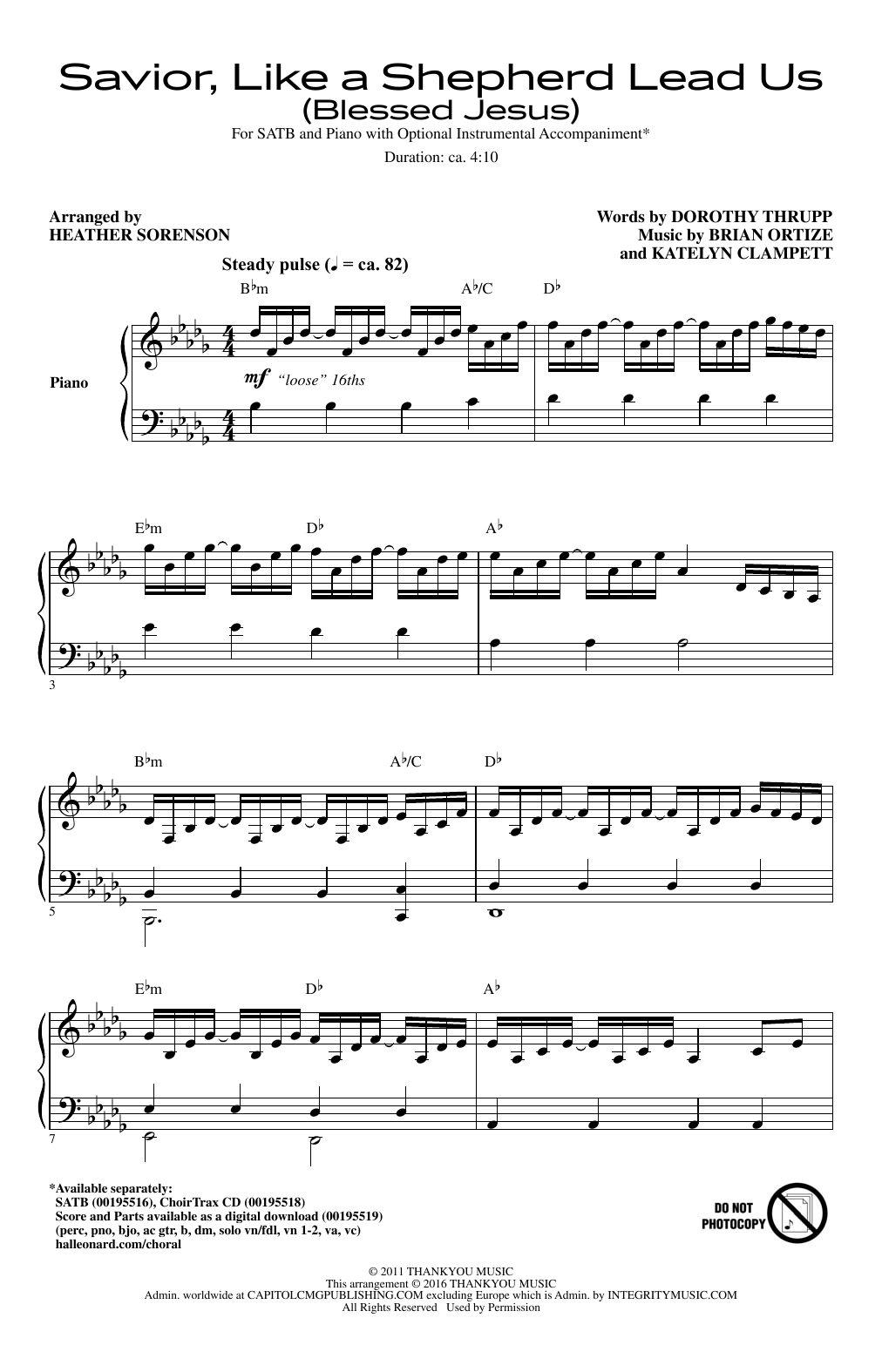
Savior, Like A Shepherd Lead Us Blessed Jesus Sheet Music Preview

Savior, Like A Shepherd Lead Us Blessed Jesus: SATB Choral Octavo

Arranged by Heather Sorenson

Item: 35-DS00359875

Digital Download
$2.99
Description

Savior, Like A Shepherd Lead Us Blessed Jesus: SATB Choral Octavo isn't in MakeMusic Cloud just yet...but it could be. Let us know you'd like to see it, and you'll help shape what comes next. In the meantime, start a free trial and dive into thousands of interactive titles your students can play along with today.

Sample Audio
No sample audio found.
Sample Video
Additional Details
Publisher: Hal Leonard
Page Count: 11
SKU: 35-DS00359875

More about this title

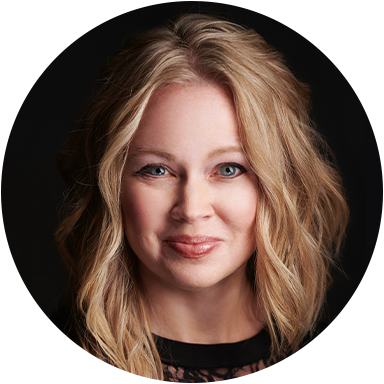
About the Arranger: Heather Sorenson

Heather Sorenson

Heather Sorenson brings a rare fluency across both traditional and contemporary Christian music idioms, a versatility that has made her arrangements and compositions sought after in churches, universities, and concert halls worldwide. Based in Dallas, TX, she built her reputation first as a pianist before establishing herself as a composer and orchestrator whose work spans choral, piano, and orchestral genres. Her commissions have included projects for Texas A&M University, the John F. Kennedy Memorial Foundation, and Carnegie Hall's premiere of the oratorio EXODUS.

Beyond her creative output, Sorenson has shaped music education through teaching elementary music at Grace Academy of Dallas and serving as an adjunct professor at Baylor University. She remains deeply invested in the field as a frequent guest conductor and speaker at churches across the country and regularly leads workshops at worship conferences and universities. When not composing or traveling to conduct, she dedicates time to benefit concerts supporting nonprofit organizations.

Why we love this

Sorenson's treatment preserves the hymn's familiar melodic line while enriching it with subtle harmonic sophistication and tasteful voice leading that engages singers without overwhelming them. This arrangement sits comfortably in the repertory of choirs at any level of development, offering room for musical growth through thoughtful part writing that rewards careful attention to blend and balance.

What to expect

The piece carries the earnest reverence of a well-loved hymn while Sorenson's arrangement adds warmth and gentle depth through her voice leading. You'll find moments of meditative stillness alongside passages that build toward affirmation, creating a trajectory that feels both traditional and alive.

Who it's for

This octavo works for sacred choirs seeking repertory with substance and spiritual resonance. The SATB voicing accommodates both mixed adult choirs and advanced high school ensembles with mature singers capable of handling four-part writing.

How to get the most out of it

  • Balance the soprano melody against supportive harmonies by encouraging lower voices to sing with confidence rather than receding completely. This builds the hymn's noble character without sacrificing clarity.
  • Attend to the text underlay with particular care since hymn arrangements depend on singers understanding the lyrical content. Rehearse phrase endings where words align with harmonic motion.
  • Explore dynamic contrast across the arrangement rather than singing at a single volume level throughout. Subtle crescendos and decrescendos on successive phrases create shape and prevent monotony.
  • Consider the organ or piano accompaniment as an equal voice rather than mere background. Rehearse with your accompanist early so the ensemble hears how their voices integrate with harmonic support.

How to use it

Include this in worship services or sacred concerts as a centerpiece rather than filler. The familiar tune draws congregations and listeners in, making it an excellent bridge between opening or closing pieces in a concert program.

Skills your students will build

  • sustaining phrase lines over harmonic changes
  • balancing four-part SATB texture with clear soprano melody
  • responding to text accents and phrasing in hymn settings
  • blending vowels across chord changes
  • sight-reading traditional hymn notation and accompaniment

You May Also Like