
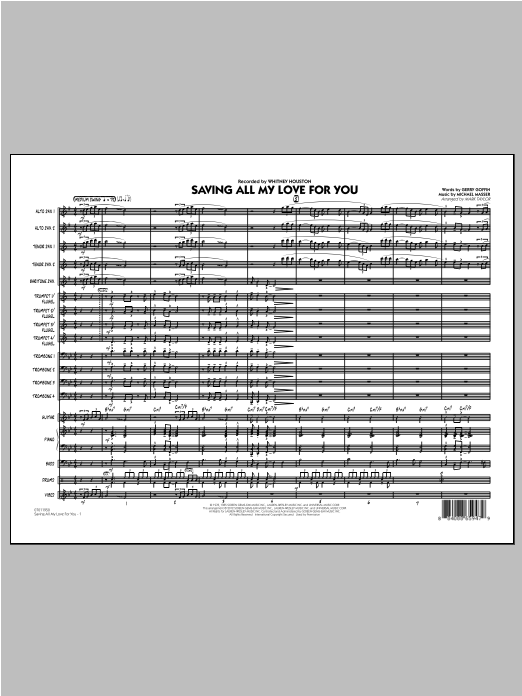

Saving All My Love for You: Jazz Ensemble Conductor Score & Parts
By Gerry Goffin / By Michael Masser / As performed by Whitney Houston / Arranged by Mark Taylor
Grade: 4
Item: 35-PK00246668
$50.00
Pickup currently not available
Buy Extra Parts (Digital PDF Download)
Parts Added to Cart!
Description
Here is a beautifully scored version of Whitney Houston's popular ballad from 1985, her first recording to reach #1 on the pop charts. Mark passes the melody around to different sections, but the style is always smooth and silky! Includes solo for tenor sax.


Saving All My Love for You: Jazz Ensemble Conductor Score & Parts isn't in MakeMusic Cloud just yet...but it could be. Let us know you'd like to see it, and you'll help shape what comes next. In the meantime, start a free trial and dive into thousands of interactive titles your students can play along with today.
Request This Title
Tell us you want it.
Start Your Free Trial
Explore everything that's ready to play right now.
Sample Audio
No sample audio found.
Sample Video
No sample videos found.
Additional Details
Publisher:
Hal Leonard
SKU:
35-PK00246668
More about this title
About the Composer: Gerry Goffin
Gerry Goffin shaped the landscape of popular music as one of the most prolific songwriters of the 1960s and 1970s. Partnering with composer Carole King, he crafted countless hits that defined an era, from "(You Make Me Feel Like) A Natural Woman" to "Will You Love Me Tomorrow." His gift for crafting emotionally direct lyrics paired with memorable melodies made him a cornerstone of the Brill Building songwriting tradition.
Goffin's work demonstrates how strong melodic writing and lyrical clarity can transcend genre and generation. For music educators, his catalog offers accessible entry points into understanding what makes a song endure: clarity of emotion, singable lines, and harmony that serves the story rather than obscuring it.
Why we love this
Mark Taylor has arranged this ballad with genuine sophistication. Rather than featuring one soloist throughout, he distributes the melody strategically across the ensemble, creating a sense of collective ownership while showcasing different timbral combinations. The resulting texture stays warm and burnished from beginning to end, never veering into oversaturation.
What to expect
A smooth, unhurried meditation on devotion. The arrangement wraps the melody in silky voicings and warm harmonies, creating an intimate atmosphere even in a full ensemble setting. There's an elegance here, a restraint that lets the emotional core of the song breathe.
Who it's for
Jazz ensembles at the intermediate level looking for accessible, engaging repertoire that challenges musicianship without requiring virtuosity. This works equally well for groups building their ballad repertoire or for directors seeking pieces that appeal to diverse audiences without compromising musical substance.
How to get the most out of it
- Balance the melody line carefully when passing between sections. The beauty of this arrangement lies in seamless handoffs, so establish clear section leads before each entrance and check that players understand the phrasing intent from their predecessors.
- Shape the tenor sax solo with generous space around it. Encourage the soloist to sing through the changes rather than race through the harmonic progression; the accompaniment can breathe and support with restraint.
- Pay close attention to dynamic control in the backgrounds. Sustained harmonies can easily overshadow the foreground, especially in the lower registers. Rehearse sections independently first, then layer them in to find the right weight.
- Treat this as a vocal piece translated to instruments. Every phrase should have a natural peak and release, mimicking how a singer would phrase "Saving All My Love." Avoid machine-like consistency in articulation.
How to use it
Program this as a contrast piece in a jazz concert, particularly if surrounding it with more uptempo or rhythmically complex arrangements. It also serves as an effective closer for a concert focused on popular music or as a showcase for section blend and expressive playing. Consider pairing it with other ballads to underscore the ensemble's ability to handle lyrical, song-based material with sensitivity.
Skills your students will build
- Phrasing and shaping melodic lines across sectional passes
- Balancing solo and ensemble voices in a harmonic context
- Sustaining tone quality and intonation in slow tempo settings
- Reading and interpreting jazz chord changes
- Ensemble texture control and dynamic restraint