
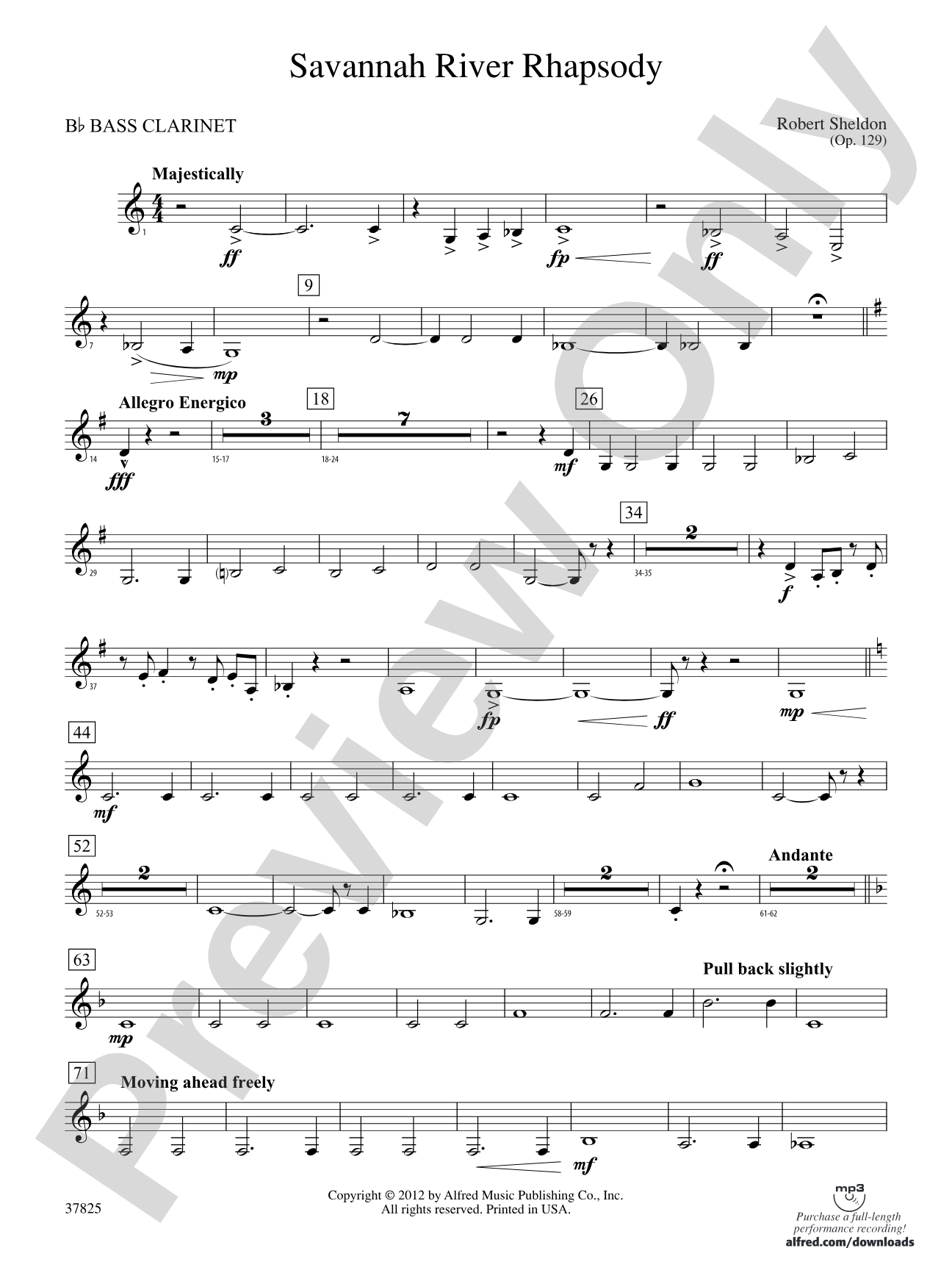

Savannah River Rhapsody: B-flat Bass Clarinet
By Robert Sheldon
Grade: 3.5 (Medium)
Item: 00-PC-0015355_BC
$3.00
Pickup currently not available
Description
Commissioned by and written for the Georgia Music Educators District Ten Band Directors Association, "Savannah River Rhapsody" was premiered by the District's outstanding high school honor band in Augusta, Georgia, conducted by the composer. The Savannah River plays an enormous part in the lives, history, and commercial vitality of the region. The piece begins at the source of the river, in the southern Appalachians, with an introduction representing the grandeur of this ancient mountain range. As the music continues, it follows the river downstream, changing tonality and style with every river bend. (5:15) This title is available in MakeMusic Cloud.


Don't just read it, hear it, play along with it, and watch your students grow with it. In MakeMusic Cloud, Savannah River Rhapsody: B-flat Bass Clarinet comes alive with professional accompaniment, adjustable tempo, and built-in practice tools that turn solo practice into real progress.
Open in the Player
Jump straight in and assign it today.
Start Your Free Trial
Open this title and explore the full library in minutes.
Sample Audio
1
Audio File
--:--
0:00
0:00
Sample Video
No sample videos found.
Additional Details
Series:
Alfred Concert Band
Publisher:
Alfred Music
Page Count:
280
SKU:
00-PC-0015355_BC
More about this title
About the Composer: Robert Sheldon

Robert Sheldon stands among today's most prolific and widely performed composers for wind band. His works appear on honor band and contest programs across the globe, and his music has been heard in some of the world's most prestigious concert halls, from Carnegie Hall to the Kennedy Center. He holds a doctorate from VanderCook College of Music and has been recognized with awards from the American School Band Directors Association, Phi Beta Mu, and ASCAP.
Beyond composing, Sheldon has shaped wind band pedagogy as lead author of Sound Innovations for Concert Band. He conducts regularly with All-State and Regional Honor Bands and serves as a clinician and guest conductor internationally, having worked with ensembles throughout North America, Europe, Asia, and Australia. His commissions and new publications reflect an ongoing commitment to creating music that speaks to both performers and audiences.
Why we love this
Sheldon's gift for storytelling through instrumental music shines here. A piece commissioned by directors for directors, it captures regional pride and natural beauty while remaining technically accessible for a solid Grade 3.5 ensemble. The journey downstream works brilliantly as a concert centerpiece—it's engaging enough to hold an audience and rewarding enough to keep your band invested across five minutes of continuous narrative.
What to expect
A guided tour through landscape and history. The opening evokes mountain grandeur and ancient stone; as the river moves downstream, the harmonic palette shifts and the musical character transforms, mirroring bends and channels. It's lyrical and reflective in places, energetic in others, with an arc that feels inevitable rather than forced.
Who it's for
High school concert bands with solid musicianship and section maturity. This piece works well for honors bands, district festivals, and concert programs where audiences appreciate program music with genuine regional connection. Directors seeking contest and festival repertoire at Grade 3.5 will find a thoughtful, well-crafted option that doesn't rely on gimmickry.
How to get the most out of it
- Shape the opening mountain introduction with dynamics and careful balance so the grandeur registers without overshadowing the ensemble's ability to blend. The expressive quality here sets the journey's tone.
- Mark the tonal and stylistic shifts as the river bends. Each section transition should feel like a distinct destination, not an abrupt gear change. Work transitions in sectional rehearsals so the entire ensemble understands the geography.
- Pay attention to the 5:15 runtime and maintain steady pacing. Resist the urge to slow too much in lyrical passages; the river keeps moving. Consistent pulse through tempo changes helps the narrative arc land cleanly.
How to use it
Program this as a concert centerpiece or opening number when you want to set a narrative tone for the evening. It pairs well with patriotic or regional programming, or alongside other Americana-inspired works. The 5:15 length and Grade 3.5 accessibility make it suitable for fall or spring concert programs where you want to showcase your band's musicality without extreme technical demands.
Skills your students will build
- Sustained dynamic control and balance across changing harmonic textures
- Tonal flexibility and intonation adjustment as the piece shifts tonality
- Phrase shape and breath management in longer lyrical passages
- Sectional ensemble coordination during key and style transitions
- Listening for narrative arc and musical storytelling in concert music