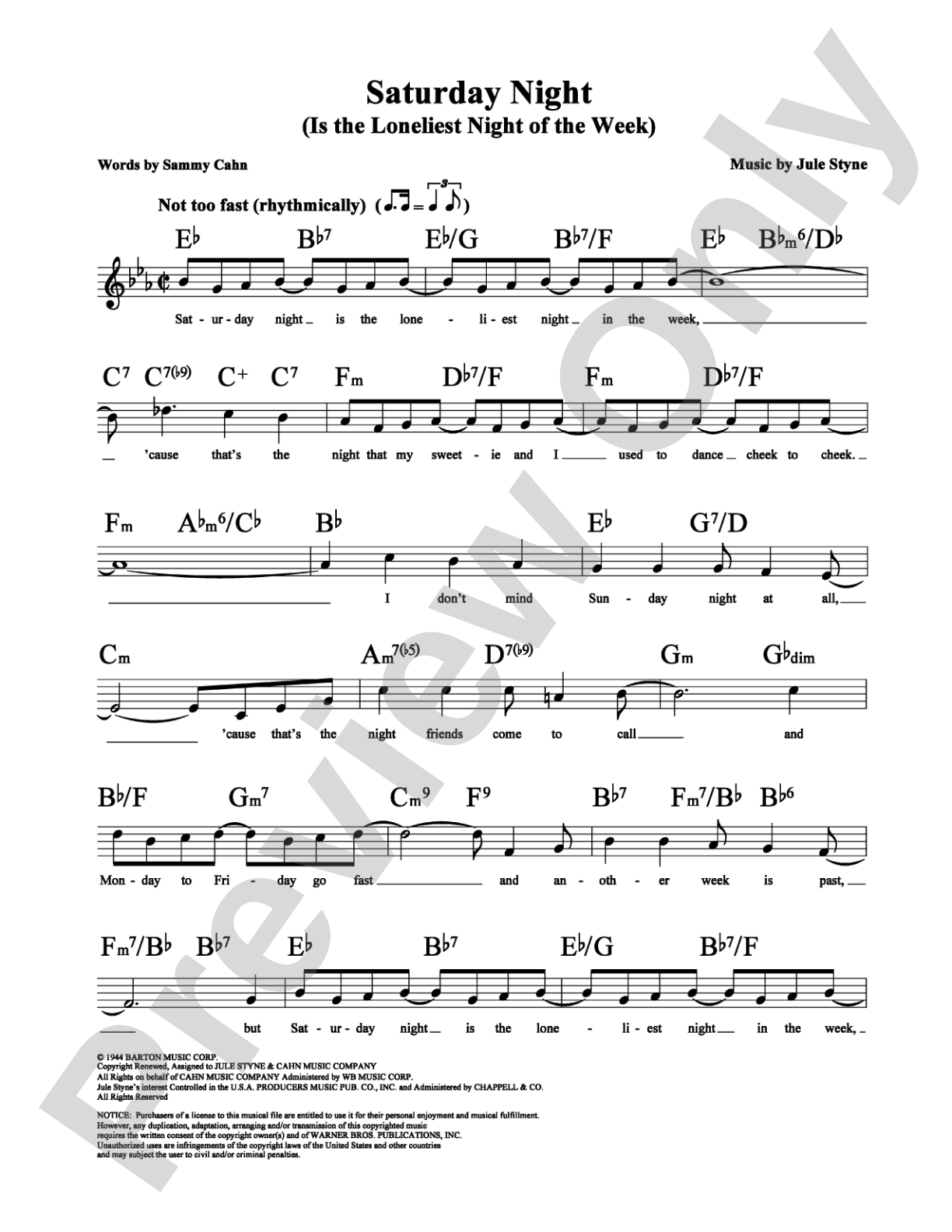
Saturday Night (Is the Loneliest Night of the Week): Lead Sheet Digital Sheet Music

Saturday Night (Is the Loneliest Night of the Week): Lead Sheet Digital Sheet Music

Jule Styne, Frank Sinatra

Item: 00-PS-0002583

Digital Download
$1.99
Description

Saturday Night (Is the Loneliest Night of the Week): Lead Sheet Digital Sheet Music isn't in MakeMusic Cloud just yet...but it could be. Let us know you'd like to see it, and you'll help shape what comes next. In the meantime, start a free trial and dive into thousands of interactive titles your students can play along with today.

Sample Audio
No sample audio found.
Sample Video
Additional Details
SKU: 00-PS-0002583

More about this title

About the Artist: Frank Sinatra

Frank Sinatra (1915-1998) shaped popular song interpretation for generations. His phrasing, breath control, and emotional nuance set the standard for jazz vocals and remain essential study for anyone serious about American songbook performance.

Why we love this

This lead sheet captures one of the great torch songs, and Sinatra's definitive recording gives you the phrasing blueprint. It's an ideal model for teaching jazz interpretation, rubato, and how to make a melody tell a story without oversinging.

What to expect

Saturday Night in F major (or your transposed key) is a minor-key meditation disguised in a major key signature. The melody sits in the middle voice, intimate and conversational, with changes that move through several harmonic territories. It has the reflective quality of late-night jazz, when the club is emptying and the longing becomes tangible.

Who it's for

This lead sheet works for jazz musicians building their repertoire, vocalist coaches teaching interpretation of classic standards, and ensembles exploring the American Songbook. It's also valuable for pianists and guitarists who want to understand how a standard is constructed and voiced.

How to get the most out of it

  • Study Sinatra's original recording for his treatment of space and silence; the rests matter as much as the notes.
  • Lean into the harmonic richness with your chord comping. These changes reward thoughtful reharmonization and voice leading.
  • Shape the melody with restraint. The lyrical content is melancholic, so resist the urge to oversell the emotion.
  • Pay attention to the lyric phrasing even if you're playing an instrumental version; let the words guide your pacing and breath points.

How to use it

Program this in a jazz ensemble concert, a standards-focused recital, or a vocal master class exploring the Sinatra songbook. It pairs naturally with other torch songs from the same era and gives students a chance to study how professionals shape a simple but emotionally complex melody.

Skills your students will build

  • Reading and interpreting lead sheet notation
  • Understanding jazz harmony and chord extensions
  • Phrasing and rubato in the American Songbook tradition
  • Vocal or instrumental interpretation of lyric-driven melody
  • Working with harmonic movement across multiple keys

You May Also Like