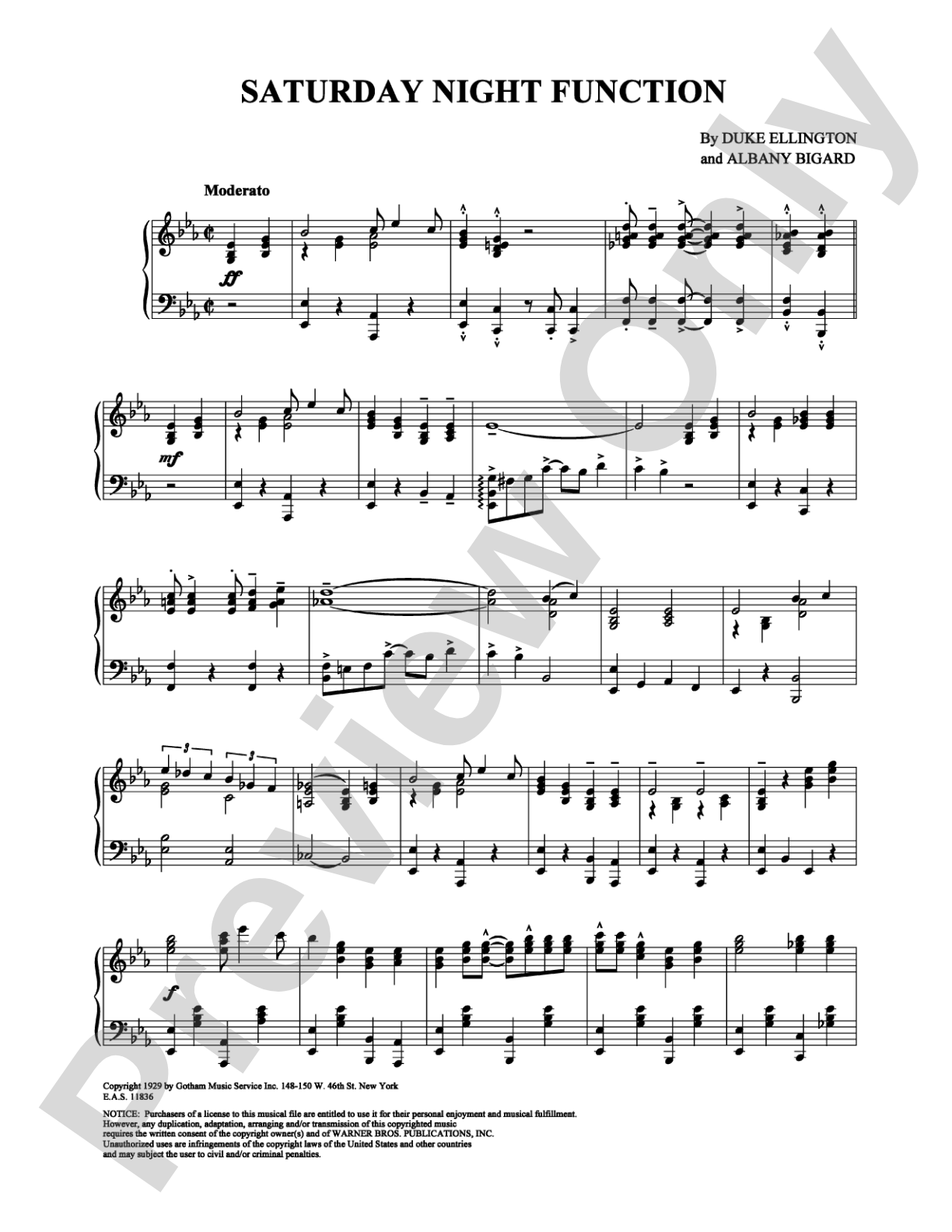
Saturday Night Function: Piano Digital Sheet Music

Saturday Night Function: Piano Digital Sheet Music

Duke Ellington, Albany Bigard

Item: 00-PS-0008202

Digital Download
$3.99
Description

Saturday Night Function: Piano Digital Sheet Music isn't in MakeMusic Cloud just yet...but it could be. Let us know you'd like to see it, and you'll help shape what comes next. In the meantime, start a free trial and dive into thousands of interactive titles your students can play along with today.

Sample Audio
No sample audio found.
Sample Video
Additional Details
SKU: 00-PS-0008202

More about this title

About the Artist: Duke Ellington

Duke Ellington (1899-1974) stands as one of the most consequential composers in American music history. His output spans nearly five decades of original compositions, orchestrations, and arrangements that fundamentally shaped jazz, popular song, and American concert music. Ellington's approach to harmony, orchestration, and formal structure elevated jazz composition to an art form that commands serious study alongside classical tradition.

For music educators, Ellington's catalog offers direct access to sophisticated harmonic thinking, rhythmic innovation, and melodic craftsmanship. His piano writing is particularly instructive, balancing accessibility with genuine compositional depth. Teachers and students engage with his work not as historical artifact but as living repertoire that demands interpretive maturity and understanding of jazz vocabulary.

Why we love this

Saturday Night Function captures Ellington's gift for writing jazz standards with genuine melodic substance and harmonic interest. The piece rewards pianists who understand swing style and voicing language without requiring virtuosic technical display. Programming this alongside classical repertoire or other jazz standards signals to your students that jazz composition deserves the same serious attention as any other tradition.

What to expect

Saturday Night Function has the rhythmic buoyancy and social warmth of its title. The piece swings with genuine ease, balancing an approachable melody against sophisticated harmonies that ask for refined voicing. Playing it summons the elegant, unhurried confidence of a seasoned jazz pianist in their element.

Who it's for

Jazz pianists at the intermediate level and above who are building a standards repertoire and developing fluency with Ellington's compositional voice. Students studying American popular song or jazz history will find concrete musical examples of how Ellington merged classical craft with jazz idiom.

How to get the most out of it

  • Understand the harmonic progression deeply before worrying about tempo. Ellington's chords often move by chromatic voice leading rather than functional harmony, so your sense of the underlying structure will guide your voicing choices.
  • Approach the rhythm with relaxed confidence rather than metronomic precision. Jazz swing relies on slight pushes and delays that come from hearing the band groove, not from playing mechanically.
  • Listen to the recorded standard to absorb the idiomatic phrasing and articulation. Notice where notes breathe, where the accompaniment lays back, and how the melody sits against the harmonic foundation.

How to use it

This works beautifully in a recital that mixes jazz and classical styles, or as part of a concert exploring American songwriting. Pair it with other standards or jazz compositions to create a coherent set, or use it as a bridge piece that acknowledges jazz alongside concert repertoire.

Skills your students will build

  • jazz swing articulation and rhythmic phrasing
  • reading and voicing jazz harmony
  • improvisation over a standard form (if students are developing solos)
  • stylistically aware accompaniment and comping techniques

You May Also Like