Sarabande & Gavotte (from the Holberg Suite, Op. 40): Bassoon Sheet Music Preview

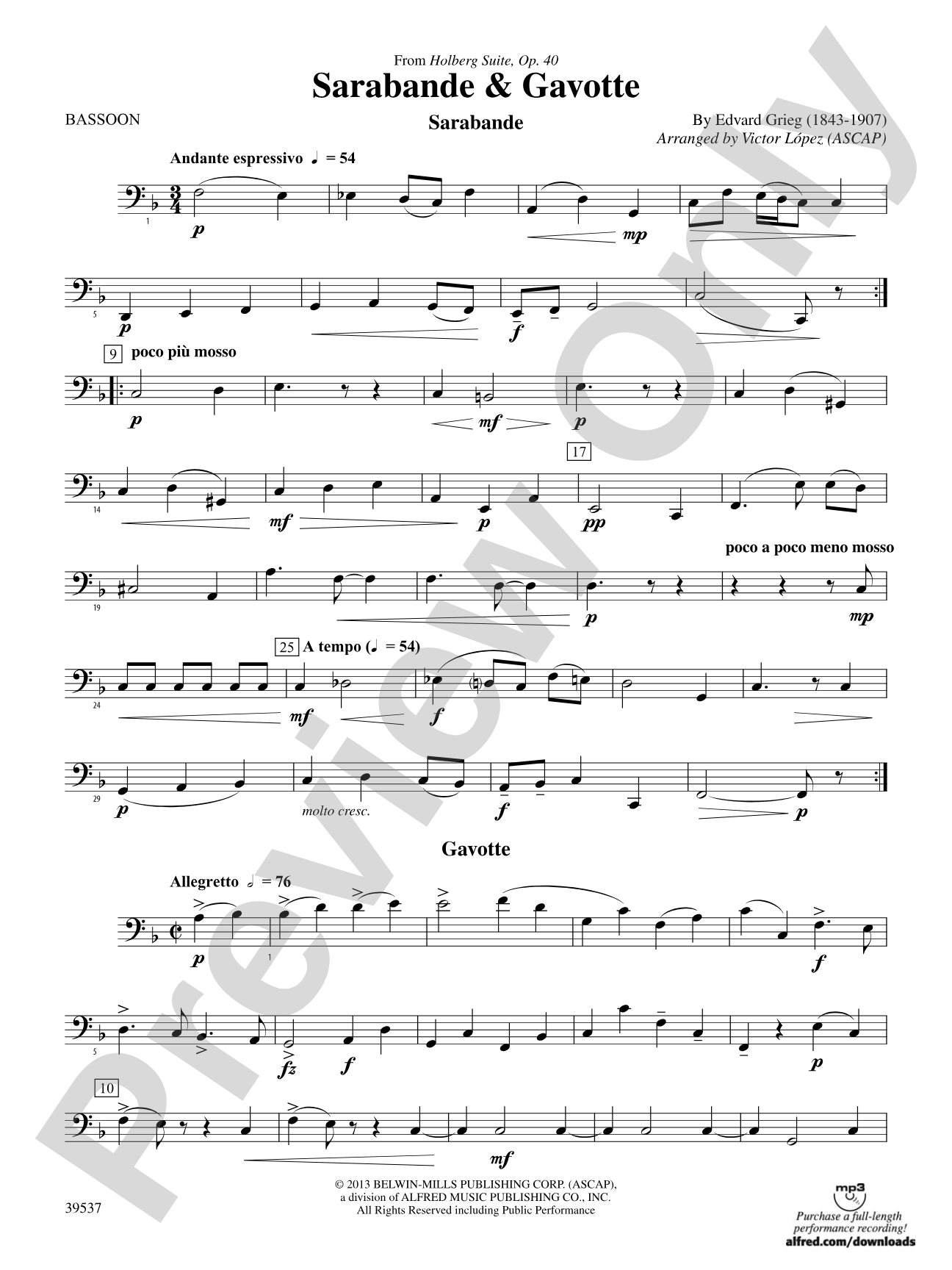
Sarabande & Gavotte (from the Holberg Suite, Op. 40): Bassoon

By Edvard Grieg / arr. Victor López

Grade: 3 (Medium Easy)

Item: 00-PC-0015851_B1

Digital Download
$3.00
Description
"Sarabande" and "Gavotte" are the second and third movements of the Holberg Suite, Op. 40, a standard movement of the Baroque suite. Both movements may be performed as part of the entire suite or as a stand-alone selection. This arrangement is true to the original work---as feasible and offers the sonorities of the concert band ensemble in a very playable version. The first movement, "Praeludium," (00-38363) released last season, has recently been selected as Reviewer's Choice in the October 2012 issue of The Instrumentalist magazine. (7:00) This title is available in MakeMusic Cloud.

Don't just read it, hear it, play along with it, and watch your students grow with it. In MakeMusic Cloud, Sarabande & Gavotte (from the Holberg Suite, Op. 40): Bassoon comes alive with professional accompaniment, adjustable tempo, and built-in practice tools that turn solo practice into real progress.

Sample Audio
0:00
0:00
Sample Video
Additional Details
Series: Belwin Concert Band
Publisher: Alfred Music
Page Count: 232
SKU: 00-PC-0015851_B1

More about this title

About the Composer: Edvard Grieg

Edvard Grieg (1843-1907) stands as Norway's greatest composer and a defining voice of Romantic nationalism. His gift for melody and harmonic color transformed Norwegian folk traditions into concert works of international stature, influencing generations of composers who followed. In the classroom and rehearsal hall, Grieg's music remains essential repertoire because it combines accessibility with genuine artistic substance.

Why we love this

Victor López's arrangement captures the Baroque elegance of Grieg's original suite while giving your band genuine concert-hall sonorities at a workable technical level. The Grade 3 scoring lets students grapple with real musical architecture—phrasing, balance, and character—rather than just managing mechanics. Programming these two movements gives you flexibility: perform them as contrasting studies in Baroque style, or add them to a broader concert that includes the Praeludium.

What to expect

The Sarabande unfolds with courtly restraint and gentle melancholy, its long-lined melody evoking the poise of a formal Baroque dance. The Gavotte shifts the mood with brighter energy and rhythmic buoyancy, maintaining the same harmonic sophistication but in a lighter, more spirited frame.

Who it's for

Bands at the Grade 3 level who are ready to explore standard concert repertoire beyond popular transcriptions. Directors seeking authentic Baroque/Romantic material that doesn't require advanced technical facility but rewards careful musical attention.

How to get the most out of it

  • Shape the Sarabande's long lines with subtle dynamic contour rather than pushing individual phrases; the stately Baroque character depends on restraint and elegance in the upper voices.
  • Balance the melodic material carefully between sections—clarinet and saxophone lines need support without drowning in accompaniment figures that can easily overshadow the texture.
  • Articulate the Gavotte's rhythmic profile cleanly; sprightly character emerges from precision in tonguing and rhythmic alignment, especially in the faster sections.
  • Use the conductor score to identify key harmonic shifts and guide your ensemble through Grieg's gentle chromatic voice leading, which can blur if intonation slips.

How to use it

These movements work well on a concert pairing classical and Romantic era music, offering a bridge between those aesthetics through Grieg's historical lens. Consider programming them back-to-back with contrasting modern works, or add the Praeludium (available separately) to present the entire suite as a multi-movement feature.

Skills your students will build

  • Baroque phrasing and articulation
  • Balance and blend in homophonic textures
  • Reading and executing longer melodic lines with subtle dynamic shaping
  • Understanding harmonic movement and voice leading through Romantic-era scoring
  • Ensemble precision in rhythmic figures and ornamental passages

You May Also Like