
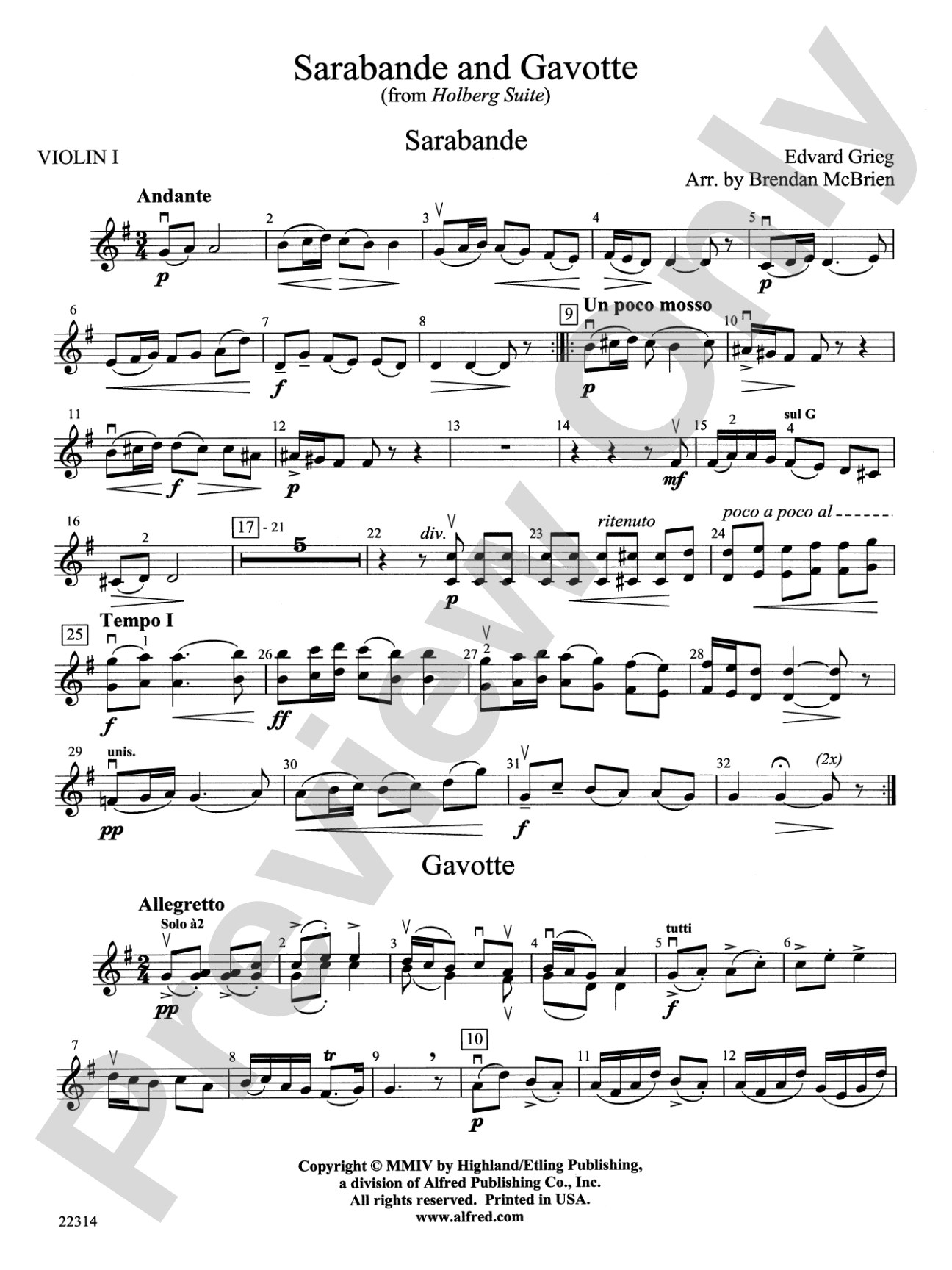

Sarabande and Gavotte: 1st Violin
(from Holberg Suite)
By Edvard Grieg / arr. Brendan McBrien
Grade: 3.5
Item: 00-PC-0000563_VN1
$5.99
Pickup currently not available
Description
Holberg Suite was composed in the Baroque dance-suite style, and consists of five movements, with the Sarabande and Gavotte as the second and third of these. In this arrangement, careful attention has been paid to the original intentions in Grieg's masterpiece. All dynamics, accents and stylistic markings should be observed in preparing this work-as it will bring out the wonderful subtleties in Grieg's writing. This title is available in MakeMusic Cloud.


Don't just read it, hear it, play along with it, and watch your students grow with it. In MakeMusic Cloud, Sarabande and Gavotte: 1st Violin comes alive with professional accompaniment, adjustable tempo, and built-in practice tools that turn solo practice into real progress.
Open in the Player
Jump straight in and assign it today.
Start Your Free Trial
Open this title and explore the full library in minutes.
Sample Audio
1
Audio File
--:--
0:00
0:00
Sample Video
No sample videos found.
Additional Details
Series:
Highland/Etling String Orchestra
Publisher:
Alfred Music
Page Count:
124
SKU:
00-PC-0000563_VN1
More about this title
About the Composer: Edvard Grieg
Edvard Grieg (1843-1907) stands as Norway's most celebrated composer, bringing the musical language of Romantic Europe into dialogue with Scandinavian folk traditions. His gift for melody and harmonic color transformed nationalist composition into something universal, influencing generations of musicians across Europe and beyond.
Grieg's pedagogical legacy runs as deep as his concert works. He understood how to write music that challenges developing musicians without overwhelming them, and his attention to orchestral detail makes every arrangement of his work a lesson in composition itself. The Holberg Suite, written to commemorate the bicentenary of playwright Ludwig Holberg, demonstrates this perfectly: it captures Baroque dance forms through a distinctly Romantic sensibility.
Why we love this
McBrien's arrangement preserves the sophistication of Grieg's orchestration while remaining genuinely playable for high school orchestras. The Sarabande and Gavotte pair beautifully in a concert program, offering contrasting character and tempo without demanding virtuosic passage work. These movements give developing string musicians the chance to inhabit a real masterwork, not a simplified imitation of one.
What to expect
The Sarabande walks with the stately dignity of a Baroque court dance, its slow harmonic movement allowing each chord change to resonate with warmth and elegance. The Gavotte that follows dances in crisp 4/4 time, witty and bright, with the rhythmic clarity of a French court piece filtered through Grieg's lush Romantic sensibility.
Who it's for
String orchestras at the Grade 3.5 level who are ready for genuine Romantic-era masterworks with complexity beyond basic technique books. These movements suit ensembles with solid intonation, some experience with stylistic awareness, and directors seeking festival-ready repertoire with real musical substance.
How to get the most out of it
- Honor the stylistic markings with the same care you'd give a Bach suite. Baroque phrasing lives in the articulation and dynamic shaping, not in tempo flexibility.
- Balance the inner voices in the Sarabande, particularly the violas and second violins. Grieg's voice-leading deserves clarity even in a full string sound.
- Let the Gavotte breathe with rhythmic precision rather than rushing. A steady, dance-like pulse at the marked tempo will reveal the elegant counterpoint.
- Shape the longer lines dynamically across measures rather than within them. This prevents the music from feeling choppy and allows the Romantic harmony to unfold naturally.
How to use it
These two movements make a natural pairing for a concert featuring classical and Romantic repertoire. The Sarabande works well as a bridge between Baroque and later works, while the Gavotte offers buoyancy that can lift energy in the second half of a program. Together they demonstrate how a great composer honors historical forms without abandoning his own voice.
Skills your students will build
- Baroque dance interpretation within a Romantic harmonic framework
- Dynamic shaping and stylistic marking execution
- Voice-leading clarity and inner-part independence
- Sustained phrasing across slow harmonic movement
- Rhythmic precision in sectional coordination