
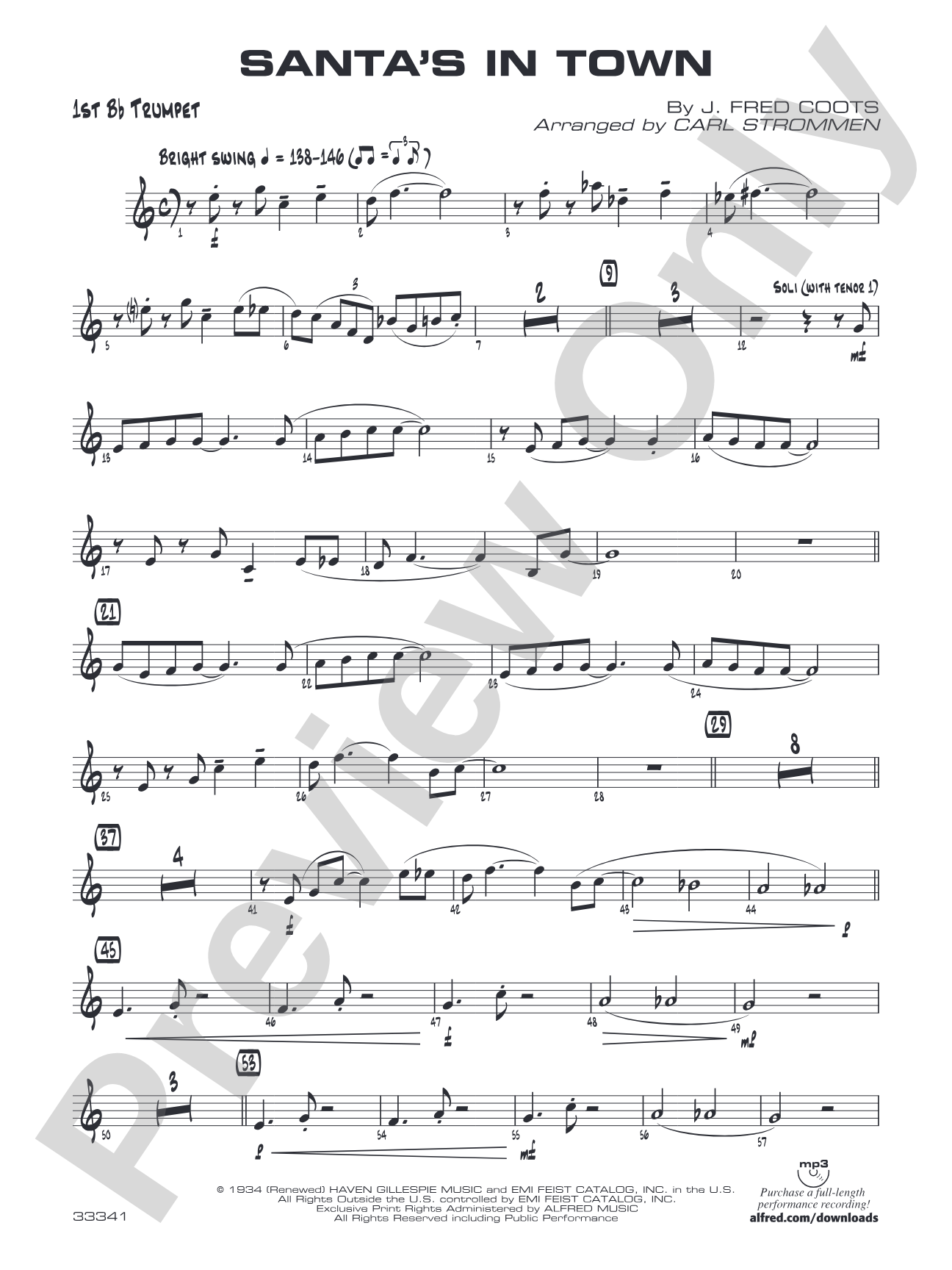

Santa's in Town: 1st B-flat Trumpet
Music by J. Fred Coots / arr. Carl Strommen
Grade: 2 (Medium Easy)
Item: 00-PC-0016202_T1
$5.99
Pickup currently not available
Description
You better watch out---this fine swing chart on the classic holiday favorite is easy to put together, swings, has a written trumpet solo, a sax soli, a nice shout chorus, and a modulation. Lead trumpet range is to written G on top of the staff. This chart will be effective with minimal prep time! (3:40)


Don't just read it, hear it, play along with it, and watch your students grow with it. In MakeMusic Cloud, Santa's in Town: 1st B-flat Trumpet comes alive with professional accompaniment, adjustable tempo, and built-in practice tools that turn solo practice into real progress.
Open in the Player
Jump straight in and assign it today.
Start Your Free Trial
Open this title and explore the full library in minutes.
Sample Audio
1
Audio File
--:--
0:00
0:00
Sample Video
No sample videos found.
Additional Details
Series:
Young Jazz Ensemble
Publisher:
Alfred Music
Page Count:
90
SKU:
00-PC-0016202_T1
More about this title
About the Composer: J. Fred Coots
J. Fred Coots (1897-1964) composed some of the most enduring American popular songs of the early 20th century. His melodies had a gift for simplicity and immediate memorability, qualities that made them perfect vehicles for both radio and film. "Santa's in Town" exemplifies his ability to write a hook that sticks with listeners long after they hear it.
Coots worked during the golden age of Tin Pan Alley and beyond, crafting songs that defined the sound of mid-century American entertainment. His compositions have been recorded countless times across multiple genres, a testament to their fundamental strength as melodies. For jazz educators, his work offers straightforward, singable themes that students can grasp quickly and then transform through improvisation and arrangement.
Why we love this
Carl Strommen's arrangement cuts right to the heart of what makes a holiday jazz chart work: it swings hard, features transparent voicings that don't require perfect section balance to sound good, and includes clear solo and soli moments that give students real responsibility. The written trumpet solo and shout chorus create natural performance highlights without demanding extensive rehearsal time, which means you can add this to your winter concert with confidence even in a crowded rehearsal schedule.
What to expect
Bright and propulsive, with the kind of optimistic swing that defines mid-century holiday charm. The shout chorus lands with enough punch to wake up an audience, while the written solo moments give individual voices room to shine without demanding technical fireworks. It sounds bigger and more polished than the rehearsal time required would suggest.
Who it's for
Jazz ensembles at the intermediate level who need a crowd-pleasing holiday number that doesn't demand weeks of preparation. Grade 2 instrumentation and straightforward changes make it accessible to high school and advanced middle school groups with mixed experience levels. Directors looking to program something seasonal that also develops core ensemble skills will find this chart earns its place in a winter concert.
How to get the most out of it
- Lock the rhythm section into a consistent swing feel from the opening; the chart's accessibility depends on a steady, relaxed pocket rather than precision rushing.
- Give the trumpet soloist time with the solo section in sectionals; a confident solo delivery lifts the entire chart and makes the audience lean in.
- Balance the sax soli by having saxes play it with unified articulation and phrase shape, treating it as a mini section feature rather than background texture.
- Use the modulation as a dynamic reset point; bring the energy up slightly as the key change arrives to signal the chart's final push to the audience.
How to use it
Slot this into a winter concert as a second-half opener to shift the energy after a handful of ballads or concert pieces. The 3:40 runtime fits neatly between longer works, and the holiday theme makes it a natural fit for December programming without feeling forced into January or February sets. Pair it with other seasonal jazz standards or mix it into a varied-repertoire concert where it stands out as the infectious, swinging moment that catches listeners' attention.
Skills your students will build
- Swing articulation and phrasing across all sections
- Reading and executing written solos with idiomatic jazz phrasing
- Section soli balance and unified ensemble playing
- Responding to key modulations and dynamic shape changes
- Maintaining groove while accommodating written material and improvisation