
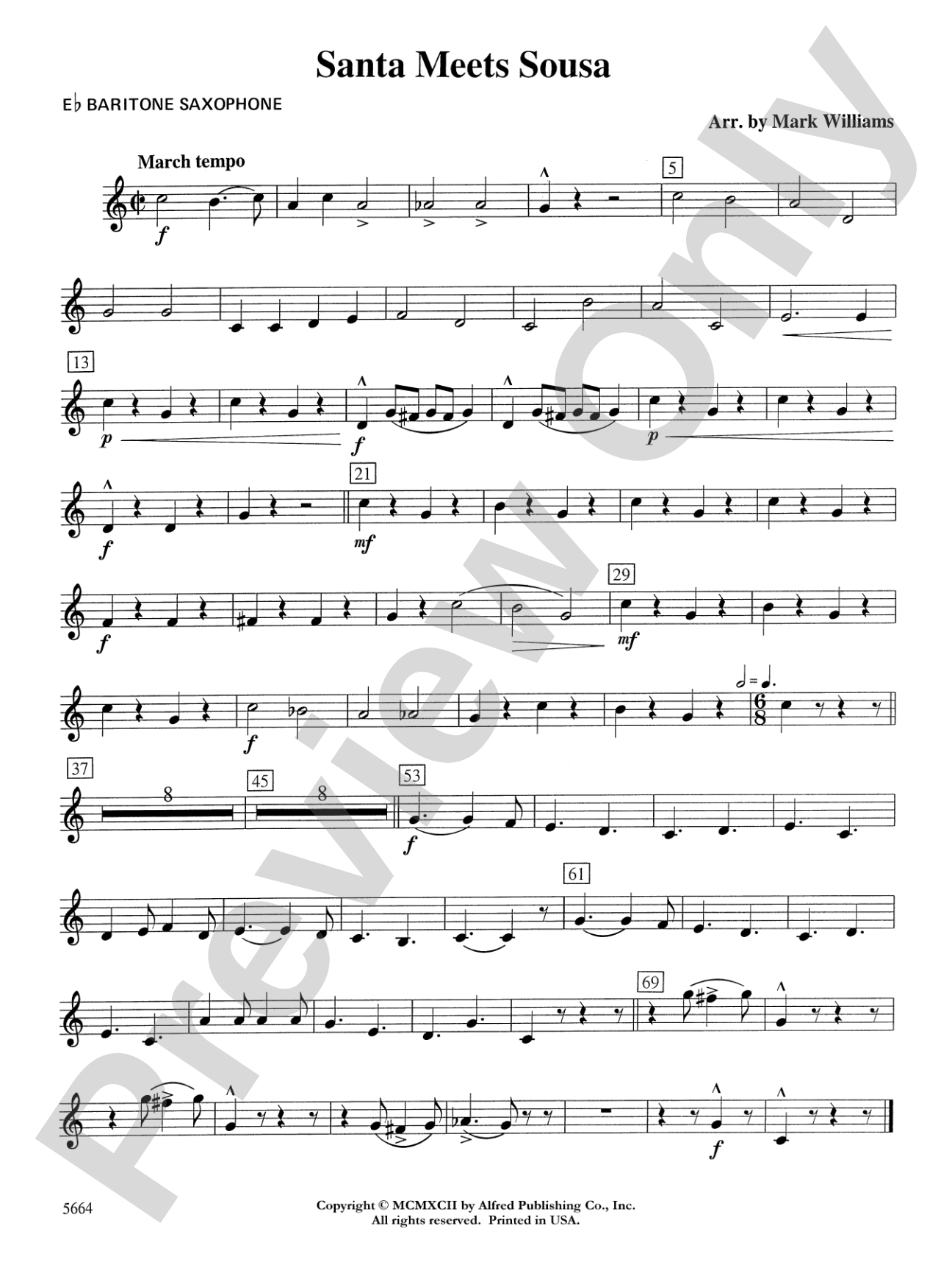

Santa Meets Sousa: E-flat Baritone Saxophone
Arr. Mark Williams
Grade: 2 (Medium Easy)
Item: 00-PC-0001905_BTX
$3.00
Pickup currently not available
Description
Your audience will leave your Christmas concert in a festive, upbeat mood when you close your program with this tongue-in-cheek Christmas medley. Three famous Sousa marches, Stars and Stripes Forever, Sempre Fidelis and the Washington Post, are skillfully interwoven with an assortment of familiar Christmas carols including 'Jingle Bells,' 'Up on the Housetop,' 'Deck the Halls' and 'O Little Town.' (Grade 2---Easy Medium)


Don't just read it, hear it, play along with it, and watch your students grow with it. In MakeMusic Cloud, Santa Meets Sousa: E-flat Baritone Saxophone comes alive with professional accompaniment, adjustable tempo, and built-in practice tools that turn solo practice into real progress.
Open in the Player
Jump straight in and assign it today.
Start Your Free Trial
Open this title and explore the full library in minutes.
Sample Audio
1
Audio File
--:--
0:00
0:00
Sample Video
Additional Details
Series:
Young Symphonic
Publisher:
Alfred Music
Page Count:
128
SKU:
00-PC-0001905_BTX
More about this title
About the Arranger: Mark Williams

Mark Williams built a career writing and arranging music specifically for student ensembles. His catalog exceeds 200 published works for band, orchestra, and choir, and he co-authored the Accent on Achievement Band Method, a foundational resource in instrumental music education. Born in Chicago and raised in Spokane, Washington, Williams taught elementary band in Washington schools for many years and held degrees in music education from Eastern Washington University.
As a clinician and guest conductor, Williams traveled extensively across the United States, Canada, and Australia, bringing his pedagogical approach directly to music programs. He served as woodwind performer and arranger for the 560th Air Force Band and conducted the Spokane British Brass Band as its Artistic Director. His contributions to school music earned recognition including the Gralia Competition at the Western International Band Clinic and multiple ASCAP Special Awards.
Why we love this
Williams captures the spirit of a holiday finale without sacrificing musicality. The seamless weaving of Sousa's march idioms with recognizable Christmas carols creates an arrangement that feels both sophisticated and instantly appealing to audiences of all ages. At Grade 2, it's accessible enough for developing ensembles yet entertaining enough to earn genuine applause as a closing selection.
What to expect
This arrangement sparkles with wit. Listeners immediately recognize the Sousa marches as energetic American classics, then delight when beloved Christmas carols suddenly pop through the texture. The overall effect is upbeat, clever, and unapologetically festive, landing somewhere between genuinely musical and playfully tongue-in-cheek.
Who it's for
Directors programming winter concerts for Grade 2 concert bands who want a closing number that entertains and amuses without asking the ensemble to oversimplify. It works equally well for musicians gaining confidence with moderate technical demands and for audiences who appreciate clever musical humor.
How to get the most out of it
- Keep the march character sharp and crisp throughout. Sousa's style demands clarity of articulation and precise rhythmic control, which sharpens the contrast when familiar carol melodies emerge.
- Balance the melody with the harmonic and rhythmic layers beneath it. When carols enter against march accompaniments, resist the urge to let either dominate; the interplay is the point.
- Use dynamic variety to highlight the transitions between source materials. A slight lift or drop in volume signals listeners that something new is arriving and keeps their attention engaged.
How to use it
Program this as your concert closer to send the audience home in good spirits. Its lighthearted character creates a natural endpoint for a mixed winter concert that includes more serious seasonal literature earlier in the program. The arrangement also serves well for holiday assemblies, community events, or any performance where you want to balance musicianship with audience enjoyment.
Skills your students will build
- Maintaining rhythmic precision in compound march textures
- Identifying and executing melody-accompaniment relationships
- Balancing articulation across contrasting musical styles
- Reading through key and time signature changes
- Sustaining ensemble cohesion during thematic transitions