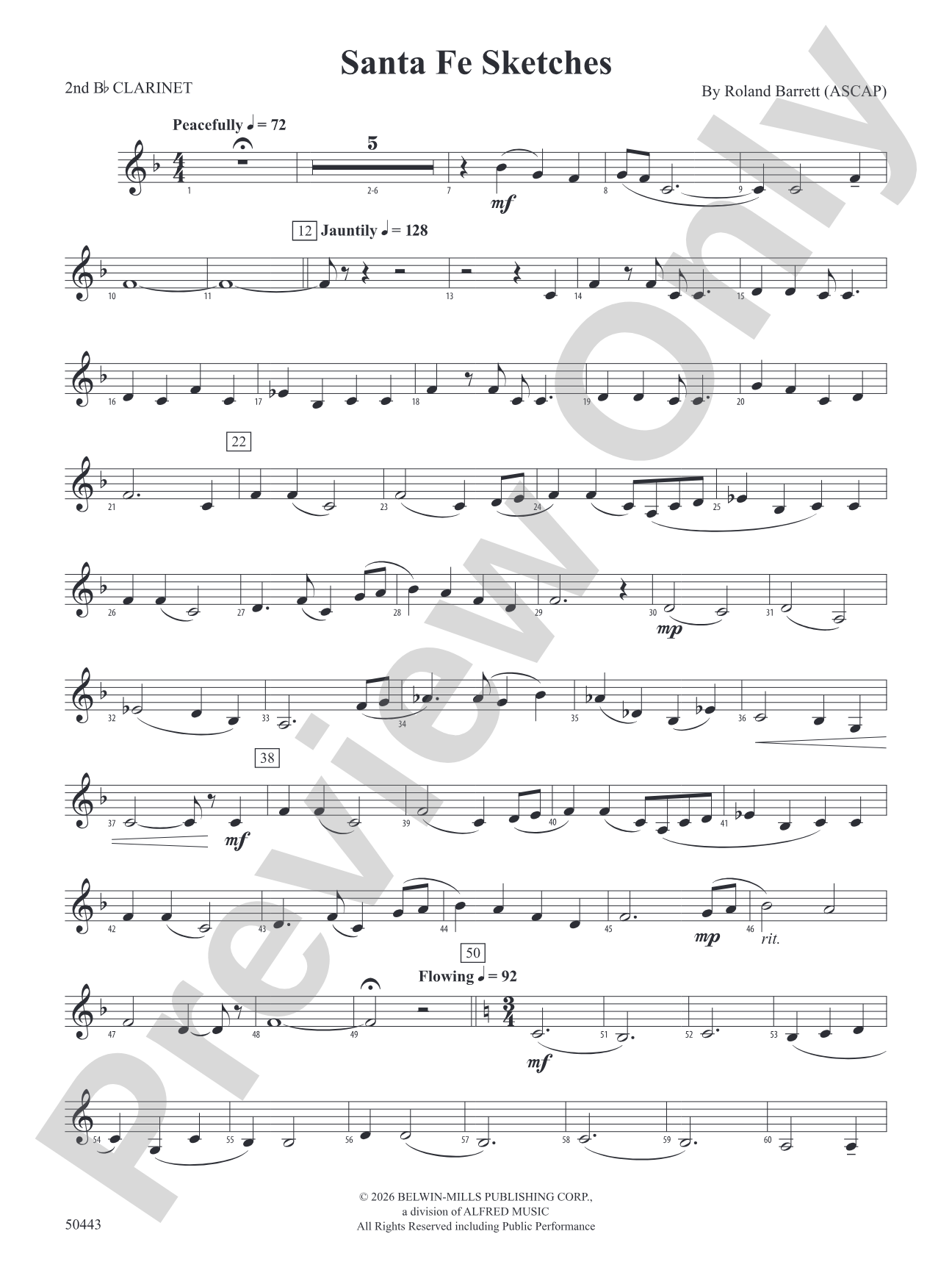
Santa Fe Sketches: 2nd B-flat Clarinet Sheet Music Preview

Santa Fe Sketches: 2nd B-flat Clarinet

By Roland Barrett

Grade: 2.5

Item: 00-PC-0019782_C2

Digital Download
$3.00
Description
Celebrating the epic grandeur of the American West, Santa Fe Sketches, by Roland Barrett, features multiple contrasting sections meant to depict a journey through the vast sweeping expanses of the lands west of the Mississippi River. Opening with a tranquil passage representing sunrise on the open prairie, the action includes a jaunty stagecoach ride, a quiet sunset in the western sky, a surprise early-morning thunderstorm, and the joyous arrival as the travelers reach their final destination.

Santa Fe Sketches: 2nd B-flat Clarinet isn't in MakeMusic Cloud just yet...but it could be. Let us know you'd like to see it, and you'll help shape what comes next. In the meantime, start a free trial and dive into thousands of interactive titles your students can play along with today.

Sample Audio
0:00
0:00
Sample Video
Additional Details
Series: Belwin Young Band
Publisher: Alfred Music
SKU: 00-PC-0019782_C2

More about this title

About the Composer: Roland Barrett

Roland Barrett

Roland Barrett holds the position of music theory and composition faculty member at the University of Oklahoma, where he has taught since 2001. His scholarly focus centers on twentieth century music, with teaching responsibilities spanning undergraduate and graduate theory and composition courses. Beyond the classroom, Barrett serves as musical arranger for the Pride of Oklahoma marching band.

As a composer and arranger, Barrett has established himself nationally with over two hundred published works for symphonic band, chamber ensembles, and marching band. His compositions have been performed by the Dallas Wind Symphony and countless All-State and All-Region Honor Bands, with performances featured on National Public Radio, USA Network, and at major conventions including the Midwest Band & Orchestra Convention and the International Trumpet Guild. He is a multiple recipient of the ASCAPlus award.

Why we love this

Santa Fe Sketches succeeds because it tells a complete narrative arc in accessible language. Each section has distinct musical character and instrumentation that allows younger ensembles to experience contrast and storytelling without overwhelming technical demands, making it ideal for building musicianship alongside contest preparation.

What to expect

Santa Fe Sketches captures the cinematic sweep of Western landscape: the hushed anticipation of dawn, the rollicking energy of travel, the contemplative beauty of dusk, the primal drama of a sudden storm, and the triumphant relief of arrival. The music moves through these moments with clear imagery and genuine emotional journey.

Who it's for

This piece serves Grade 2.5 concert bands seeking accessible repertoire with programmatic substance. It works equally well for contest/festival preparation and concert performances where you want to showcase your ensemble's range without demanding virtuosic technical facility.

How to get the most out of it

  • Shape the opening sunrise passage with sensitive dynamic control in the woodwind choir; the tranquility depends on restraint rather than volume.
  • Mark the stagecoach section's rhythmic momentum clearly in rehearsal so the band feels the forward motion without rushing the articulation.
  • Balance the low brass during the sunset to ensure the underlying harmonic foundation supports rather than obscures the melody.
  • Prepare the thunderstorm section with clear sectional independence; the storm's power comes from each section executing its rhythmic pattern precisely.

How to use it

Program this alongside other American-themed works to build a concert narrative, or feature it as a contest entry that demonstrates your band's musicality and storytelling ability. Its episodic structure also makes it an excellent teaching piece for introducing younger players to programmatic band music and sectional balance.

Skills your students will build

  • Shaping phrases with dynamic contrast in sustained passages
  • Maintaining rhythmic precision in syncopated and driving sections
  • Coordinating independent rhythmic figures across sections
  • Responding to programmatic content through interpretive musical choices

You May Also Like